
Public PoC Released for Critical Rails Active Storage RCE Vulnerability
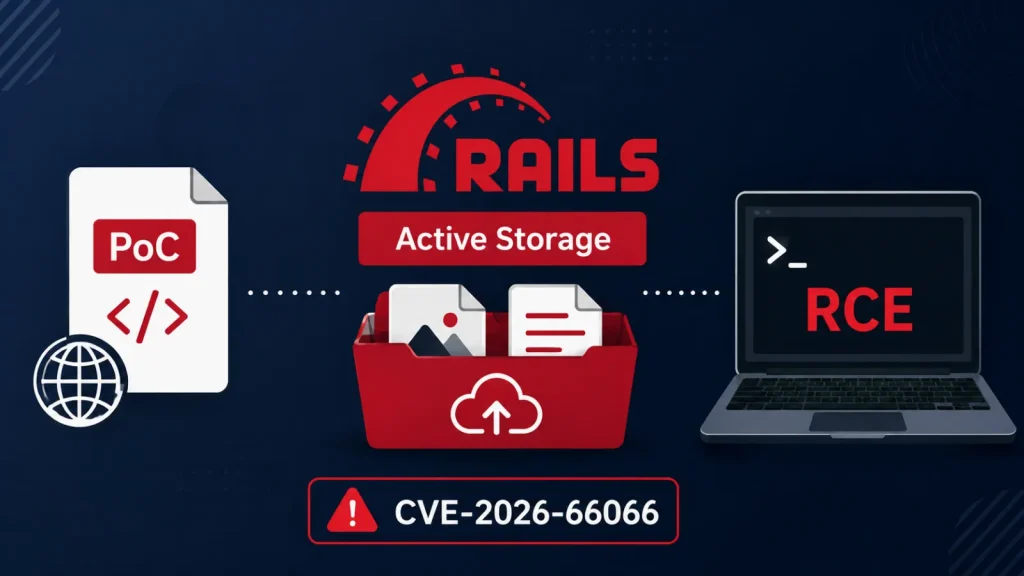
A recently published Proof-of-Concept (PoC) for a critical Remote Code Execution (RCE) vulnerability in Ruby on Rails’ Active Storage component is sending ripples through the cybersecurity community. This development significantly elevates the risk for countless applications, particularly those leveraging cloud services like Amazon Web Services (AWS) to host customer data. The ease of exploitation demonstrated by this PoC means immediate action is paramount for affected organizations.
Understanding the KindaRails2Shell Vulnerability (CVE-2026-66066)
Tracked as CVE-2026-66066, and affectionately dubbed “KindaRails2Shell,” this critical flaw targets Ruby on Rails applications that rely on Active Storage for file uploads. The vulnerability specifically manifests when three conditions are met:
- The application uses Active Storage for managing file uploads.
- The image-processing library libvips is employed within the Active Storage configuration.
- The application accepts file uploads from untrusted users.
When these conditions align, an attacker can upload a specially crafted file that, when processed by libvips, can execute arbitrary code on the underlying server. This provides a direct pathway for gaining full control over the application’s host, leading to potential data breaches, system compromise, and significant operational disruption. The release of a public PoC means the theoretical risk has now become a practical threat, accessible to a broader range of malicious actors.
Impact on Cloud Environments, Especially AWS
The implications of CVE-2026-66066 are particularly concerning for cloud-hosted applications. Many organizations utilize Active Storage to manage user-uploaded content in cloud storage solutions, with AWS S3 being a prominent example. An RCE vulnerability in such a crucial component can lead to:
- Data Exfiltration: Attackers can access and steal sensitive customer data stored within the cloud environment.
- System Compromise: Once RCE is achieved, attackers can pivot to other services and resources within the same AWS account or Virtual Private Cloud (VPC).
- Supply Chain Attacks: Compromised applications could be used as a springboard for further attacks against customers or integrated systems.
- Reputational Damage: A successful breach can severely erode customer trust and brand reputation.
The interconnected nature of cloud services means a breach originating from this vulnerability could have a cascading effect, extending beyond the immediate compromised application.
Remediation Actions and Mitigation Strategies
Given the severity and the public availability of the PoC, immediate action is crucial for all Ruby on Rails applications utilizing Active Storage with libvips. Organizations should prioritize the following:
- Patch Immediately: The most critical step is to apply the official security patch released by the Ruby on Rails team. Always refer to the official Rails security advisories for specific version updates and instructions.
- Audit Active Storage Configuration: Review your Active Storage configurations to determine if libvips is being used for image processing and if user uploads are accepted from untrusted sources.
- Implement Input Validation and Sanitization: While patching is paramount, robust input validation and sanitization for all uploaded files should always be a standard security practice. This can help prevent similar vulnerabilities in the future.
- Restrict File Upload Types: Limit the types of files users can upload to only those absolutely necessary for your application’s functionality. Avoid allowing executable files or potentially malicious file formats.
- Least Privilege Principle: Ensure that the Ruby on Rails application and its associated processes run with the absolute minimum necessary permissions. This can limit the damage an attacker can inflict even if RCE is achieved.
- Network Segmentation: Implement strong network segmentation within your cloud environment (e.g., AWS VPCs and security groups) to isolate the application from other critical resources.
- Monitor for Exploitation Attempts: Enhance logging and monitoring for your Rails applications, specifically looking for unusual file uploads, unexpected process execution, or outbound network connections from the application server.
Detection and Scanning Tools
Proactive scanning and detection are essential for identifying and mitigating vulnerabilities like CVE-2026-66066. Below are some tools that can assist in this effort:
| Tool Name | Purpose | Link |
|---|---|---|
| Brakeman | Static Analysis Security Scanner for Rails applications. Can help identify vulnerable dependencies and insecure configurations. | https://brakemanscanner.org/ |
| OWASP ZAP | Dynamic Application Security Testing (DAST) tool. Can be used to scan web applications for vulnerabilities, including RCE. | https://www.zaproxy.org/ |
| Nessus | Vulnerability scanner that can detect known vulnerabilities in operating systems, applications, and network devices. | https://www.tenable.com/products/nessus |
| Burp Suite | Integrated platform for performing security testing of web applications. Useful for manual and automated vulnerability discovery. | https://portswigger.net/burp |
Key Takeaways for Developers and Security Professionals
The release of a public PoC for the KindaRails2Shell vulnerability (CVE-2026-66066) underscores the persistent challenge of securing applications against RCE flaws. For Ruby on Rails developers and security professionals, this event serves as a stark reminder:
- Proactive patching is non-negotiable for critical vulnerabilities.
- Secure file upload handling, including stringent validation and sanitization, is fundamental.
- Understanding the specific libraries and configurations your application uses is vital for identifying potential weak points.
- Continuous monitoring and robust incident response plans are crucial for mitigating the impact of exploitation.
Remaining vigilant and adopting a defense-in-depth strategy is the most effective approach to protect against evolving threats. Act now to secure your Rails applications against this significant vulnerability.




