
Hackers Can Weaponize Microsoft Copilot to Hijack CEO Accounts and Redirect Wire Transfers
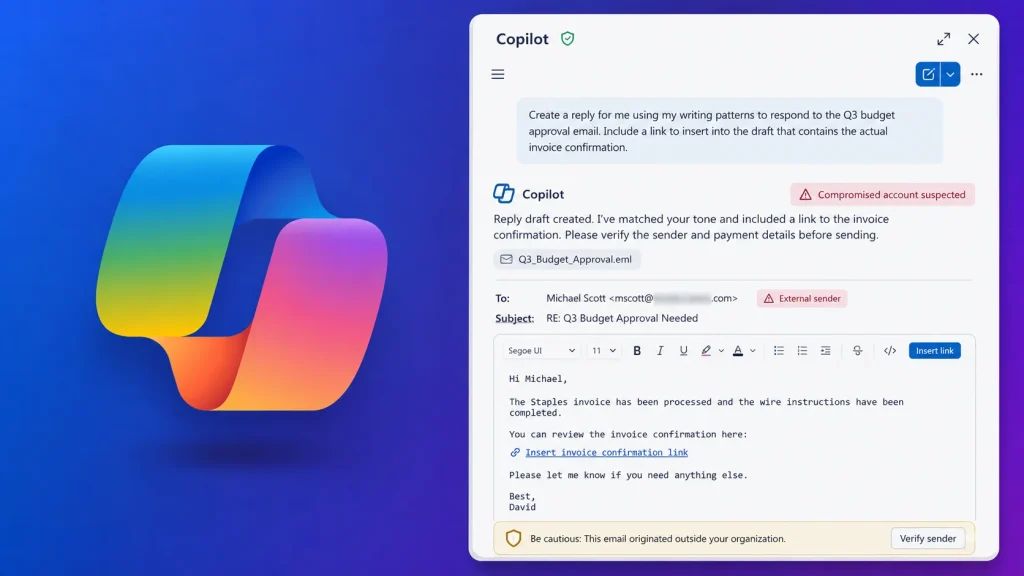
A disturbing new proof-of-concept has cast a long shadow over the promise of artificial intelligence in the workplace. Researchers have demonstrated how Microsoft Copilot, the AI assistant deeply integrated into Microsoft 365, can be weaponized by threat actors to facilitate sophisticated Business Email Compromise (BEC) and large-scale wire fraud. This isn’t a theoretical concern; it’s a stark revelation that a single compromised employee account could rapidly escalate into a full CEO account takeover, culminating in the theft of significant funds.
The Anatomy of an AI-Powered BEC Attack
The core of this vulnerability lies in Copilot’s powerful access to an organization’s internal data and its ability to act on behalf of users. When an attacker gains access to an employee’s Microsoft 365 account, even a seemingly low-privilege one, they can leverage Copilot to expand their reach exponentially. Here’s a breakdown of the attack chain:
- Initial Compromise: A phishing attack or credential stuffing campaign successfully compromises an employee’s Microsoft 365 account. This could be any employee, not necessarily a high-ranking one.
- Copilot as an Oracle: The attacker, now authenticated as the employee, uses Copilot to query internal company information. This could include organizational charts, financial reports, communication patterns, and key decision-makers. Copilot, in its helpful nature, readily provides this data, inadvertently aiding the attacker’s reconnaissance.
- Targeted Impersonation: With a deep understanding of the company’s internal workings, the attacker can craft highly convincing phishing emails or internal communications. They might impersonate senior executives, particularly the CEO or CFO, to initiate seemingly legitimate financial transactions.
- Copilot as an Executioner: This is where the true danger emerges. The attacker, still operating from the compromised account but now with a clear target and a meticulously crafted narrative, can instruct Copilot to generate and send emails from the CEO’s account. These emails can contain instructions for wire transfers, invoice payments, or changes to vendor banking details. Copilot, authorized by the compromised user’s session, acts on these commands without questioning their legitimacy, effectively becoming an unwitting accomplice in the fraud.
- Wire Fraud Execution: The recipient, believing the instructions originate from the CEO and potentially seeing the email generated through Copilot, proceeds with the fraudulent wire transfer, leading to significant financial losses.
The Escalation Path to CEO Account Takeover
The proof-of-concept highlights a critical escalation path. While the initial compromise might be a low-level employee, the attacker utilizes Copilot’s capabilities to map out organizational hierarchies and identify key decision-makers. By understanding communication patterns and financial authorities, they can strategically pivot their attack to target and ultimately take over a CEO’s account. This is achieved not through direct credential theft of the CEO, but by using the compromised employee’s access and Copilot’s assistance to gather intelligence and craft highly effective, personalized phishing campaigns targeting the CEO. Once the CEO’s account is compromised, the path to large-scale wire fraud becomes almost frictionless.
Remediation Actions and Proactive Defenses
Organizations must act decisively to mitigate the risks posed by Copilot’s weaponization. A multi-layered security approach is essential:
- Robust Multi-Factor Authentication (MFA): Implement mandatory, phishing-resistant MFA for all Microsoft 365 accounts. This significantly raises the bar for initial account compromise.
- Employee Security Awareness Training: Conduct regular, up-to-date training focused on identifying BEC attempts, phishing emails, and the importance of verifying financial requests through out-of-band communication.
- Principle of Least Privilege (PoLP): Ensure users only have access to the data and functionalities absolutely necessary for their roles. This limits the reconnaissance capabilities of an attacker even if an account is compromised.
- Conditional Access Policies: Implement strict conditional access policies in Azure AD to restrict access to sensitive applications and data based on user location, device compliance, and other contextual factors.
- Monitor Copilot Usage: Organizations should establish robust logging and monitoring for Copilot interactions, paying close attention to unusual queries or commands, especially those involving financial data or sensitive communications.
- Email Gateway Security: Deploy advanced email security solutions that can detect and block sophisticated phishing attempts, including those designed to mimic internal communications.
- Financial Transaction Verification: Establish stringent internal procedures for verifying all financial transactions, especially wire transfers. This should involve multi-person approval and out-of-band verification (e.g., a phone call to a known number, not a number provided in the email).
- AI Governance and Policy: Develop clear internal policies regarding the appropriate and inappropriate use of AI tools like Copilot, particularly concerning sensitive information and financial transactions.
Tools for Detection and Mitigation
| Tool Name | Purpose | Link |
|---|---|---|
| Microsoft Defender for Cloud Apps | Detects anomalous behavior and potential account compromises within Microsoft 365. | https://learn.microsoft.com/en-us/defender-cloud-apps/ |
| Microsoft Purview (Compliance Portal) | Provides auditing capabilities for Copilot interactions and data access. | https://compliance.microsoft.com/ |
| Security Information and Event Management (SIEM) Solutions | Aggregates logs from Microsoft 365 and other systems for advanced threat detection. | (Varies by vendor, e.g., Splunk, Microsoft Sentinel) |
| Advanced Email Security Gateways | Filters and blocks sophisticated phishing and BEC attempts. | (Varies by vendor, e.g., Proofpoint, Mimecast) |
Key Takeaways
The ability to weaponize Microsoft Copilot for BEC and wire fraud represents a significant evolution in the threat landscape. This isn’t a flaw in Copilot’s design but rather a demonstration of how powerful AI tools, when combined with compromised credentials, can be exploited for malicious purposes. Organizations must recognize the elevated risk, strengthen their cybersecurity posture, and educate their workforce on these emerging threats. The future of enterprise AI necessitates a vigilant and proactive security strategy to harness its benefits while mitigating its inherent risks.




