
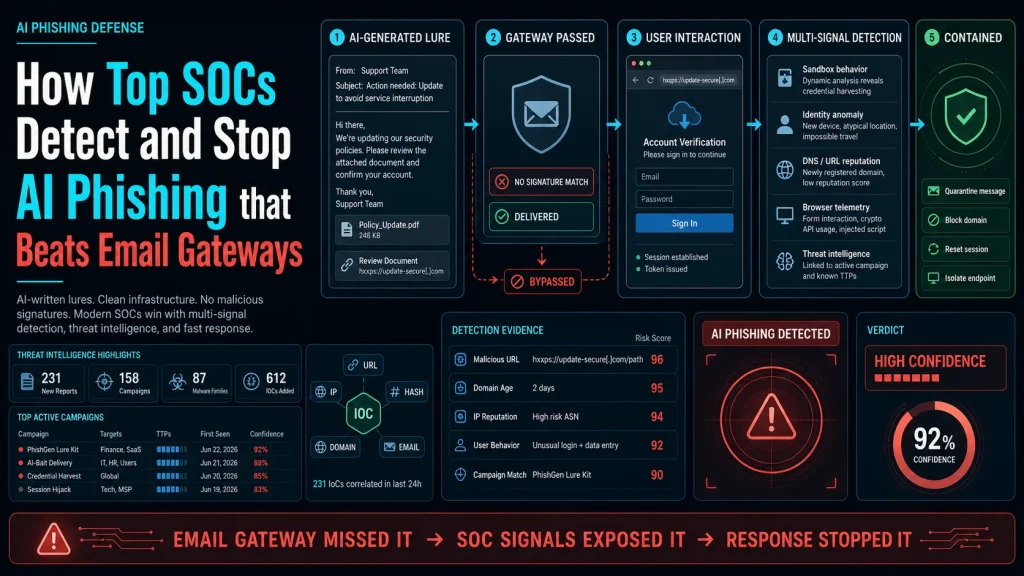
How Top SOCs Detect and Stop AI Phishing that Beats Email Gateways
The AI-Powered Phishing Epidemic: Why Traditional Defenses Are Failing
Phishing remains the most pervasive initial access vector, responsible for a staggering 16% of all breaches, each costing an average of $4.8 million. The landscape of cyber threats is evolving rapidly, with attackers now harnessing the power of Generative AI and advanced Adversary-in-the-Middle (AiTM) kits. These sophisticated tools easily bypass once-robust Multi-Factor Authentication (MFA) and traditional Secure Email Gateways (SEGs), leaving organizations vulnerable.
The speed at which users interact with malicious links is alarming, with a median click time of just 21 seconds. This rapid engagement renders static reputation-filtering mechanisms ineffective against dynamic browser-based threats. Consequently, top-tier Security Operations Centers (SOCs) are recalibrating their strategies to confront this new breed of AI-driven phishing attacks.
Understanding AI-Enhanced Phishing Techniques
Gone are the days of easily identifiable typos and grammatical errors. Generative AI allows threat actors to craft highly convincing phishing emails, mimicking legitimate communication with near-perfect accuracy. These AI-generated lures are indistinguishable from genuine messages, making them incredibly difficult for users and even some automated systems to detect.
Furthermore, AiTM kits amplify this threat. These kits enable attackers to intercept and manipulate legitimate authentication flows, effectively bypassing MFA by relaying credentials and session tokens in real-time. This means that even with MFA enabled, users can be compromised if they interact with a sophisticated phishing site. The immediate consequence is unauthorized access to sensitive accounts and data, often without any immediate red flags for the victim.
The Inadequacy of Traditional Secure Email Gateways
Traditional SEGs primarily rely on signature-based detection, blacklists, and static reputation analysis. While effective against known threats and basic spam, these methods are easily circumvented by AI-generated phishing campaigns and dynamic attack infrastructures. The rapid creation of new domains, IP addresses, and constantly evolving attack methodologies by AI-powered tools means that SEGs struggle to keep pace. Their reactive nature makes them inherently vulnerable to zero-day phishing exploits and polymorphic threats that change their characteristics to evade detection.
How Top SOCs Are Adapting: A Proactive Defense Stance
Leading SOCs are moving beyond purely reactive measures. Their new strategies focus on a multi-layered, proactive defense that accounts for the speed and sophistication of AI-powered attacks:
- Advanced Threat Intelligence Integration: SOCs are prioritizing real-time threat intelligence feeds that provide insights into emerging phishing kits, attack vectors, and attacker infrastructure. This includes data on newly registered domains, compromised credentials, and observed attack patterns.
- Behavioral Analysis and Anomaly Detection: Rather than solely relying on signatures, modern SOCs employ machine learning models to analyze user behavior, email patterns, and network traffic. Anomalies, such as unusual login locations, access attempts to sensitive systems, or deviations from normal email communication, trigger immediate alerts.
- Browser Isolation and Sandboxing: For unknown or suspicious links, top SOCs implement browser isolation technologies. This isolates potentially malicious web content from the user’s endpoint, preventing malware execution and credential harvesting even if the user clicks a malicious link.
- Security Awareness Training with AI Context: User education remains critical, but it’s evolving. Training now explicitly covers the characteristics of AI-generated phishing, emphasizing the difficulty in discerning fake from real and the dangers of AiTM attacks, especially concerning MFA prompts.
- Endpoint Detection and Response (EDR) with Extended Detection and Response (XDR): Integrating EDR and XDR solutions allows for comprehensive visibility across endpoints, networks, cloud environments, and applications. This unified view helps detect post-compromise activity that might bypass initial email gateways, enabling faster incident response.
- AI-Driven Phishing Detection Tools: SOCs are deploying specialized AI and machine learning tools designed to identify subtle indicators of phishing that human eyes or traditional rules-based systems might miss. This includes analyzing linguistic patterns, sender anomalies, and URL structures at scale.
Remediation Actions and Best Practices
To bolster defenses against AI-powered phishing and prevent breaches, organizations must implement a robust and adaptive cybersecurity posture:
- Implement DMARC, DKIM, and SPF: Ensure proper configuration of these email authentication protocols to prevent email spoofing and increase the credibility of legitimate emails. Regularly audit these settings.
- Strengthen MFA Implementations: While AiTM kits can bypass some MFA, push notifications or FIDO2-compliant security keys (e.g., YubiKey) are significantly harder to compromise than SMS-based MFA. Educate users about “MFA fatigue” attacks where attackers repeatedly send MFA prompts.
- Deploy Advanced Anti-Phishing Solutions: Invest in next-generation email security platforms that leverage AI and machine learning for dynamic threat detection, rather than relying solely on static blacklists.
- Regular Security Audits and Penetration Testing: Conduct frequent assessments to identify weaknesses in your email security infrastructure and user awareness programs. Focus on simulating sophisticated phishing attacks.
- Continuous User Education: Beyond basic phishing training, educate users specifically on the new threats posed by AI-generated content and AiTM attacks. Emphasize the importance of verifying sender identities through alternative channels and reporting suspicious emails immediately.
- Segment Networks and Enforce Least Privilege: Limit the blast radius of a successful phishing attack by segmenting your network and adhering to the principle of least privilege, ensuring users only have access to resources absolutely necessary for their role.
- Incident Response Plan Update: Ensure your incident response plan includes specific procedures for detecting, containing, and eradicating AI-powered phishing and AiTM attacks, focusing on rapid account lockout and credential rotation.
The Path Forward: A Resilient Defense
The rise of AI-powered phishing represents a significant escalation in the cyber threat landscape. Traditional defenses are proving inadequate against these sophisticated and rapidly evolving attacks. Top SOCs are demonstrating that a proactive, multi-layered approach, combining advanced threat intelligence, behavioral analytics, robust authentication, and continuous user education, is essential. Organizations must embrace these adaptive strategies to build resilient defenses capable of detecting and stopping AI-driven phishing that bypasses even the most advanced email gateways, safeguarding critical assets and minimizing the financial and reputational damage of successful breaches.




