
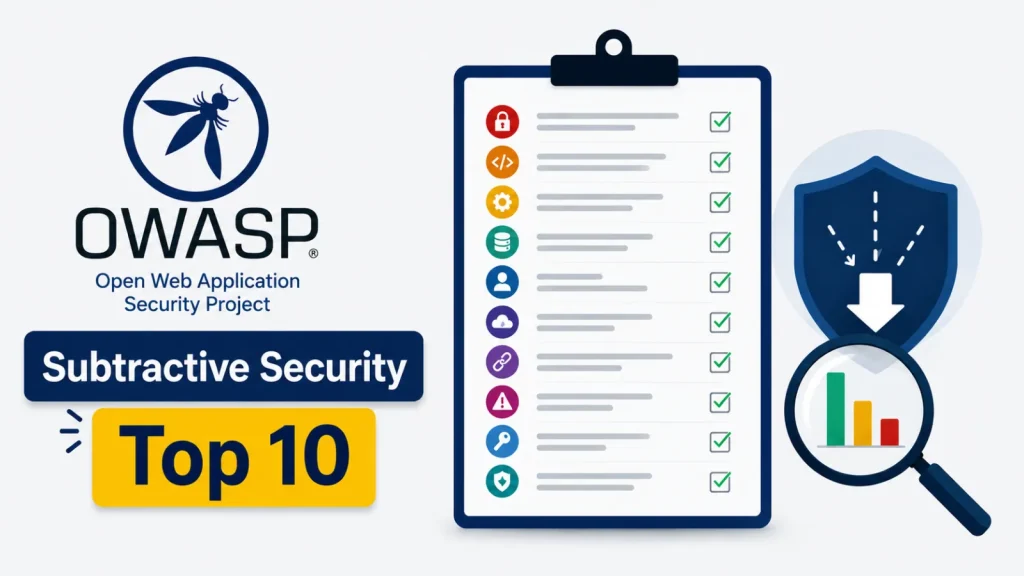
OWASP Subtractive Security Top 10 Project Released to Identify and Reduce Cyber Risks
The relentless pace of cyber threats often leads organizations down a path of additive security. We introduce more products, more alerts, more logging, and more layers of defense, hoping to outpace attackers. But what if the solution wasn’t about adding more, but about intelligently subtracting? The Open Worldwide Application Security Project (OWASP) has launched a groundbreaking initiative that challenges this conventional wisdom: the OWASP Subtractive Security Top 10 Project.
This new project signals a significant shift in thinking, moving beyond mere detection and monitoring to actively eliminate potential attack paths. It’s a proactive, engineering-focused approach designed to reduce the attack surface fundamentally, rather than simply reacting to intrusions. For cybersecurity professionals, developers, and IT leaders, understanding this paradigm shift is crucial for building more resilient and inherently secure systems.
Understanding Subtractive Security
Traditional cybersecurity strategies frequently involve an “add-on” approach. When a new threat emerges or a vulnerability (such as CVE-2023-45678, for example) is discovered, the common response is to deploy another security product: a new firewall rule, an advanced endpoint detection and response (EDR) tool, or additional access controls. While these measures are often necessary, they can lead to complex, unwieldy security architectures that are difficult to manage and prone to misconfigurations.
Subtractive Security, as championed by OWASP, flips this script. Instead of constantly building up defenses, it focuses on identifying and systematically removing elements that attackers could exploit. This means analyzing application design, infrastructure, and operational processes to pinpoint unnecessary functionalities, exposed interfaces, or overly permissive configurations that create potential avenues for compromise. The goal is to reduce the overall attack surface by eliminating components that don’t contribute to essential business functions.
Why the Shift from Additive to Subtractive?
The “more is better” philosophy in cybersecurity has its limits. An overabundance of security tools can lead to:
- Alert Fatigue: A deluge of security alerts, many of them false positives, can overwhelm security teams, causing them to miss genuine threats.
- Increased Complexity: Each new product adds another layer to manage, monitor, and integrate, increasing the chances of misconfiguration and introducing new attack vectors.
- Higher Costs: Licensing fees, maintenance, and the personnel required to operate numerous security tools can become prohibitive.
- Performance Overhead: Many security tools consume system resources, potentially impacting application performance.
The OWASP Subtractive Security Top 10 Project addresses these challenges by advocating for a minimalist approach. By designing systems with fewer attack surfaces from the outset, organizations can achieve a higher level of security with potentially less operational overhead. This proactive stance is particularly relevant in an era where sophisticated attackers constantly probe for any weakness, whether it’s a forgotten API endpoint or an overly broad permission set.
The OWASP Subtractive Security Top 10 Project: A New Framework
While the specific entries for the OWASP Subtractive Security Top 10 are still being developed, the core objective is clear: to provide a structured framework for identifying and mitigating the most common and impactful security weaknesses through elimination rather than augmentation. This project will likely categorize areas where strategic removal of components or simplification of architecture can yield significant security benefits.
Anticipated themes could include:
- Unnecessary Features and Functionality: Removing code or services that are not actively used but could be exploited (e.g., an outdated debugging interface or an unneeded legacy component).
- Excessive Permissions: Stripping down user, system, or service account privileges to the absolute minimum required for operation, following the principle of least privilege.
- Exposed Attack Surfaces: Closing unneeded ports, disabling non-essential protocols, or restricting access to administrative interfaces.
- Dependency Bloat: Reducing the number of third-party libraries and components to minimize exposure to vulnerabilities in external code (e.g., CVE-2024-12345 related to a widely used library).
- Complex Architectures: Simplifying system designs to reduce potential interaction points and attack paths.
This initiative will empower security professionals and developers to systematically audit their environments for these “subtractive” opportunities, thereby creating a more robust defense posture.
Remediation Actions and Best Practices for Subtractive Security
Embracing a subtractive security mindset requires a conscious effort and a shift in how systems are designed, deployed, and maintained. Here are actionable steps organizations can take:
- Conduct Regular Attack Surface Mapping: Understand every entry point, API, and service your application exposes. Tools like network scanners and API discovery platforms can assist. Regularly review these maps for unnecessary exposure.
- Implement Strict Least Privilege: Audit all user, service, and system accounts. Ensure that each entity has only the permissions absolutely necessary to perform its function. Remove any default or inherited overly permissive rights.
- Dependency Management and Pruning: Regularly review and update all third-party libraries and frameworks. Eliminate unused dependencies to reduce your exposure to known vulnerabilities (e.g., from CVE-2023-67890 affecting a common web framework).
- Feature Flag Management: Use feature flags to enable/disable features in production. This allows for rapid disabling of problematic or unneeded functionalities without redeploying code. Ensure unused flags are eventually removed.
- Configuration Hardening: Disable all non-essential services and components on servers and network devices. Remove default credentials, unnecessary guest accounts, and demo applications.
- API Gateway Security: Utilize API gateways to centralize API exposure. Implement strict input validation, rate limiting, and authentication/authorization at the gateway level, eliminating direct access to backend services where possible.
- Data Minimization: Collect and retain only the data absolutely necessary for business operations. Less data means less risk in the event of a breach.
- Regular Code Audits: Perform static and dynamic application security testing (SAST/DAST) to identify and remove unused or vulnerable code paths.
- Network Segmentation and Microsegmentation: Isolate critical assets and services within your network. This limits lateral movement for attackers, reducing the blast radius of a successful breach.
Tools for Implementing Subtractive Security Principles
While subtractive security is a mindset, several tools can aid in its implementation:
| Tool Name | Purpose | Link |
|---|---|---|
| Nmap | Network port scanning, service enumeration to identify exposed services. | https://nmap.org/ |
| OWASP ZAP | Dynamic Application Security Testing (DAST) to find vulnerabilities and unused paths in web applications. | https://www.zaproxy.org/ |
| Snyk | Dependency scanning for known vulnerabilities, helps identify and prune vulnerable libraries. | https://snyk.io/ |
| Cloud Security Posture Management (CSPM) tools | Identifies misconfigurations and overly permissive access in cloud environments (e.g., Azure Security Center, AWS Config). | Various vendor links (e.g., Azure Security Center) |
| OpenSCAP | Security compliance and vulnerability assessment, aids in system hardening by disabling unneeded components. | https://www.open-scap.org/ |
Looking Forward: A More Resilient Security Posture
The OWASP Subtractive Security Top 10 Project represents a mature evolution in cybersecurity thinking. It acknowledges that simply adding more layers of defense is often insufficient and can even introduce new risks. By focusing on intentional removal and simplification, organizations can build inherently more secure systems, reduce their overall attack surface, and ultimately achieve a more resilient security posture. This proactive, engineering-led approach promises to be a critical component in the ongoing battle against cyber threats, moving us closer to systems that are secure by design, not just secured by afterthought.




