
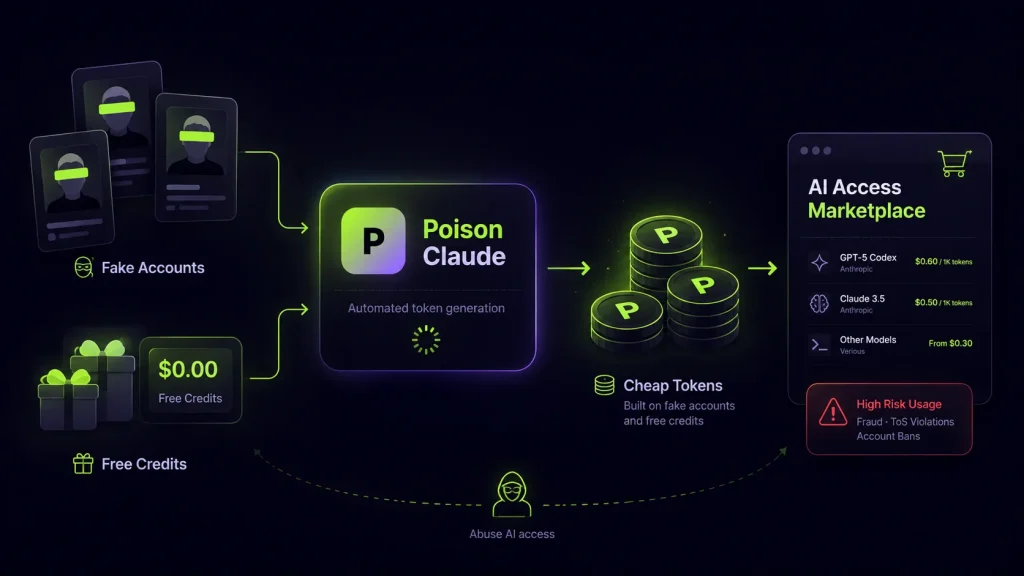
Poison Claude is Selling Cheap AI Tokens Built on Fake Accounts and Free Credits
The Shadow Economy of AI: Unpacking the “Poison Claude” Scam
The burgeoning landscape of artificial intelligence has introduced revolutionary tools, none more impactful for developers and researchers than advanced large language models like Anthropic’s Claude. These powerful AI companions, essential for coding, research, and content generation, often come with a premium price tag. However, a disturbing trend has emerged from the digital underworld: “Poison Claude,” a shadowy online service, is reportedly offering deeply discounted access to these high-value AI tokens. This isn’t a benevolent gesture; cybersecurity researchers indicate these savings are rooted in illicit activities, specifically the fraudulent registration of cloud accounts brimming with free, unearned credits.
How “Poison Claude” Operates: Exploiting Cloud Free Tiers
The core of the Poison Claude operation lies in its exploitation of cloud service providers’ generosity. Major cloud platforms frequently offer substantial free credits to new users, enticing them to explore and adopt their infrastructure. Poison Claude’s perpetrators are allegedly creating numerous fake accounts, often using stolen or fabricated identities, to repeatedly claim these “free bonus credits.” These ill-gotten credits are then used to power Anthropic’s Claude AI models. The resulting AI tokens, effectively acquired at no legitimate cost to the scammers, are then resold at a significant discount on various underground forums and dark web marketplaces. This creates a black market for AI access, undermining legitimate businesses and potentially funding further illicit activities.
The Ripple Effect: Risks Beyond Cheap Tokens
While the allure of cheaper AI access is undeniable, engaging with services like Poison Claude carries substantial risks for individuals and organizations. The most immediate concern is the potential for legal repercussions. Using services derived from fraudulent activities could be construed as aiding and abetting cybercrime, leading to fines or even imprisonment. Furthermore, the security implications are profound:
- Data Exposure: When you input sensitive data, code, or proprietary information into an AI model accessed via an illicit service, you have no guarantee of its privacy or security. Your data could be intercepted, logged, or even sold by the operators of Poison Claude.
- Malware and Backdoors: The platforms offering these cheap tokens might also serve as vectors for malware distribution. Downloading tools or using web interfaces provided by such services could compromise your systems with viruses, ransomware, or spyware.
- Compromised AI Integrity: There’s no assurance that the AI models themselves are unadulterated. While less likely with a direct API access to Claude, any intermediary software provided by Poison Claude could potentially inject bias or malicious logic into your AI interactions.
- Ethical and Reputational Damage: For businesses, associating with illicit services can severely damage reputation and erode trust among customers and partners.
Remediation Actions for AI Users and Cloud Providers
Addressing the threat posed by operations like Poison Claude requires a multi-pronged approach from both users and cloud service providers.
For Individuals and Organizations Using AI:
- Verify Your Sources: Always obtain AI access and tokens directly from official vendors like Anthropic. Avoid third-party resellers offering unusually low prices.
- Educate Your Teams: Train employees on the risks associated with using unofficial or unverified AI services. Emphasize the importance of data security and ethical AI usage.
- Implement Strict Access Control: Ensure that access to legitimate AI APIs and services is managed with strong authentication and least-privilege principles.
- Monitor for Anomalies: Keep an eye on network traffic and billing statements for any unusual activity that might indicate unauthorized AI usage or access attempts.
For Cloud Service Providers and AI Developers:
- Enhanced Fraud Detection: Invest in more sophisticated AI-powered fraud detection systems to identify and block fraudulent account registrations more effectively.
- Strengthen Account Verification: Implement multi-factor authentication (MFA) and more rigorous identity verification processes for new account sign-ups, especially when offering significant free credits.
- Monitor API Usage Patterns: Look for unusual spikes in API requests from specific accounts or IP ranges that might indicate automated, fraudulent activity.
- Collaborate and Share Intelligence: Cloud providers and AI developers should collaborate with cybersecurity firms and law enforcement to share threat intelligence and combat these illicit operations collectively.
The Ongoing Battle Against AI Cybercrime
The emergence of “Poison Claude” is a stark reminder that the advancements in AI technology will inevitably be met by new forms of cybercrime. As AI becomes more integral to our daily lives and business operations, the integrity and security of these powerful tools become paramount. Users must exercise extreme caution, prioritizing security and legality over cost savings, while cloud providers and AI developers must continuously evolve their defenses to thwart these sophisticated fraudulent schemes. The fight to keep AI safe, secure, and ethically accessible is a continuous one, demanding vigilance from all stakeholders.




