
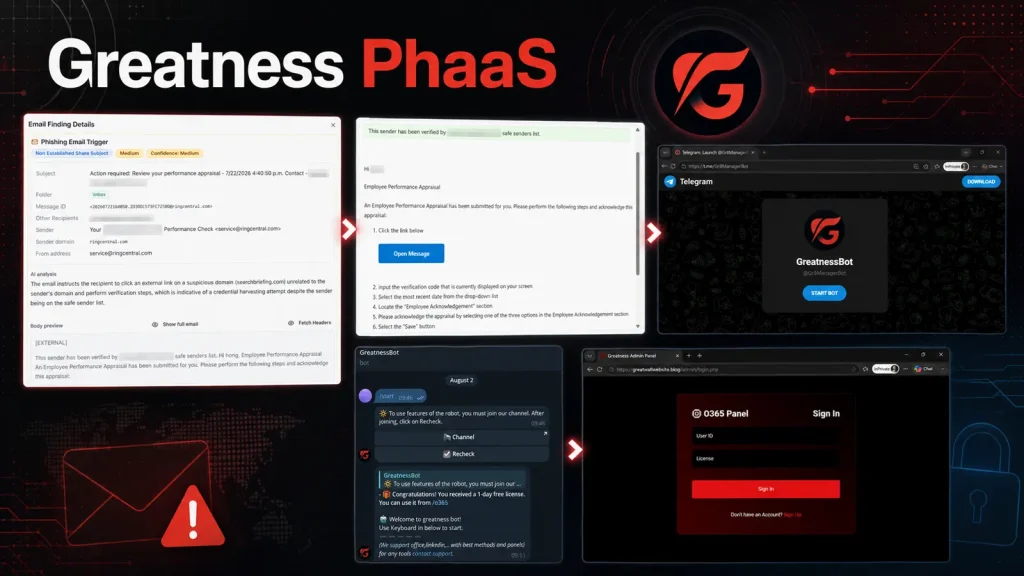
Greatness PhaaS Bypasses Email Security and MFA to Hijack Microsoft 365 Accounts
The digital frontier of enterprise security is constantly shifting, and with each advancement, new threats emerge to challenge our defenses. For years, Multi-Factor Authentication (MFA) has been lauded as a robust shield against account compromise, particularly for critical platforms like Microsoft 365. Yet, a new adversary, dubbed Greatness PhaaS, has stepped into the arena, demonstrating a sophisticated capability to bypass even MFA, turning our perceived strongholds into vulnerable targets. This isn’t just another phishing scam; it’s a significant escalation in the ongoing battle for cloud security.
Understanding Greatness PhaaS: A New Breed of Phishing
Greatness PhaaS (Phishing-as-a-Service) represents a dangerous evolution in cybercrime. Unlike traditional phishing attacks that merely aim to harvest credentials, Greatness operates at a more advanced level. It’s designed to capture valid sign-in tokens, which are essentially digital keys that grant an attacker authenticated access to cloud services as if they were the legitimate user. This bypasses the need for the attacker to know the victim’s password and, more critically, circumvents the protection offered by MFA.
The core innovation behind Greatness PhaaS lies in its ability to facilitate real-time interception of the authentication process. When a user falls for a Greatness phishing lure, they are unknowingly interacting with a proxy server controlled by the attackers. This proxy sits between the user and the legitimate Microsoft 365 login page, capturing the session cookie or sign-in token generated during a successful, MFA-protected login. With this token, attackers gain persistent access to the victim’s Microsoft 365 account, enabling them to read emails, access files, and impersonate the user from within the compromised environment.
The Threat to Microsoft 365 Accounts
Microsoft 365 is a cornerstone for countless businesses, housing sensitive data, critical communications, and essential productivity tools. The compromise of a single Microsoft 365 account can have devastating ripple effects, leading to data breaches, financial fraud, business email compromise (BEC) attacks, and significant reputational damage. Greatness PhaaS specifically targets this platform, making it a high-priority threat for any organization utilizing Microsoft’s cloud services.
Recent campaigns leveraging Greatness have shown remarkable sophistication. For instance, attacks have been observed using spoofed communications appearing to originate from legitimate services like RingCentral. This social engineering tactic preys on user trust, making it difficult for even vigilant employees to distinguish genuine requests from malicious ones. Once an attacker obtains a valid session token, they can maintain access for extended periods, often undetected, allowing them to thoroughly compromise an organization’s cloud environment.
Remediation Actions Against PhaaS and Token Theft
While Greatness PhaaS presents a formidable challenge, organizations are not without defenses. A multi-layered security strategy, coupled with robust user education, is crucial to mitigating this threat.
- Implement Conditional Access Policies: Microsoft 365’s Conditional Access can restrict access based on various factors, such as device compliance, location, IP address, and application. By enforcing policies that require compliant devices or trusted network locations, you can significantly reduce the risk of token replay attacks.
- Monitor for Anomalous Login Behavior: Leverage Microsoft 365 audit logs and security tools to detect unusual login patterns. This includes logins from unfamiliar geographical locations, multiple failed login attempts, or access from non-corporate IP ranges.
- Regularly Review Session Durations: Configure shorter session lifetimes for Microsoft 365 and other cloud services. While slightly less convenient for users, this reduces the window of opportunity for attackers to exploit stolen tokens.
- Enhanced Phishing Awareness Training: Educate users about the evolving nature of phishing attacks, including those that bypass MFA. Train them to recognize sophisticated lures, check sender authenticity, and report suspicious emails immediately. Emphasize that even with MFA, vigilance is paramount.
- Deploy Advanced Threat Protection (ATP) Solutions: Utilize email security gateways and Microsoft Defender for Office 365 to detect and block phishing emails before they reach user inboxes. These solutions often incorporate AI-driven analysis to identify malicious links and attachments.
- Implement Passwordless Authentication (where feasible): Technologies like Windows Hello for Business or FIDO2 security keys can offer stronger protection against token theft by eliminating passwords, which are a primary target for phishing.
- Use Security Information and Event Management (SIEM) Systems: Integrate Microsoft 365 logs into a SIEM solution for centralized monitoring, correlation of events, and faster detection of suspicious activities that might indicate a compromise.
Tools for Detection and Mitigation
Organizations can leverage a variety of tools to enhance their defensive posture against PhaaS platforms like Greatness:
| Tool Name | Purpose | Link |
|---|---|---|
| Microsoft Defender for Office 365 | Advanced email and threat protection, anti-phishing, safe links, safe attachments. | Microsoft Learn |
| Microsoft Conditional Access | Granular access controls based on user, device, location, and application. | Microsoft Learn |
| Microsoft Entra ID Protection | Detects identity-based risks, including suspicious sign-ins and compromised credentials. | Microsoft Learn |
| Phishing Simulation Platforms | Tests user susceptibility to phishing attacks and provides training. | (Varies, e.g., KnowBe4, Cofense) |
Conclusion
The emergence of Greatness PhaaS underscores a critical reality in cybersecurity: no defense, not even MFA, is entirely foolproof. This sophisticated PhaaS platform has demonstrated an ability to bypass standard email security and MFA, allowing attackers to hijack Microsoft 365 accounts by stealing valid session tokens. Protecting against such advanced threats requires a proactive and adaptive security posture. Organizations must move beyond relying solely on MFA, implementing comprehensive strategies that include robust conditional access policies, continuous monitoring for anomalous behavior, advanced threat protection, and rigorous user education. The battle for cloud security is continuous, and staying ahead means understanding not just today’s threats, but also the evolving methodologies of tomorrow’s adversaries.




