
18-Year-Old Linux Kernel SCTP Vulnerability Lets Attackers Gain Full Root on Host
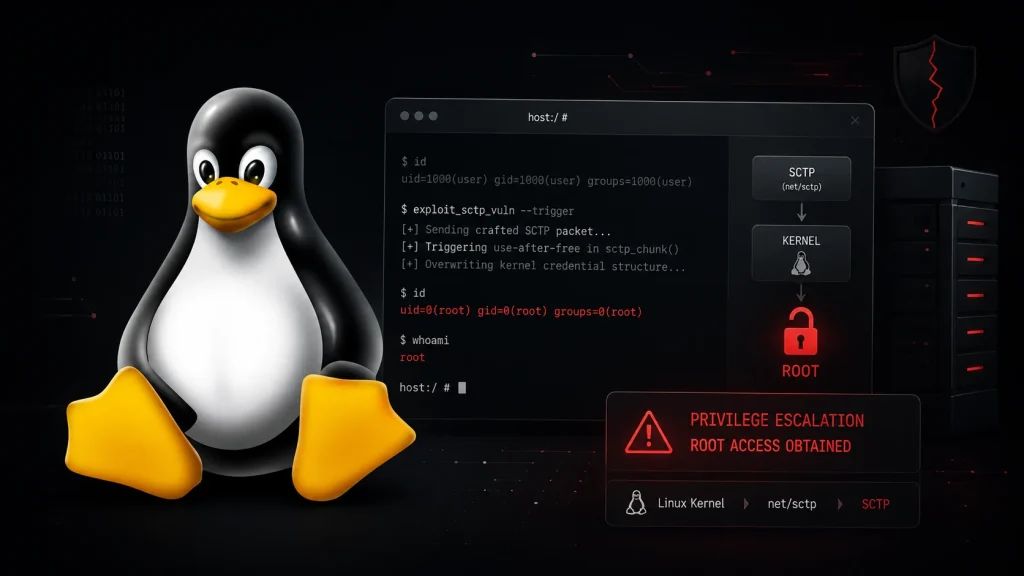
An 18-year-old vulnerability lurking within the Linux kernel’s Stream Control Transmission Protocol (SCTP) implementation has recently come to light, presenting a significant security risk. Dubbed SCTPhantom and officially tracked as CVE-2026-64564, this flaw allows an attacker to escalate privileges from unprivileged local access to full root compromise on a Linux host. More alarmingly, it facilitates container escape, enabling adversaries to break out of isolated environments and gain control of the underlying host system.
The discovery of such a long-standing vulnerability in a critical component of the Linux operating system underscores the persistent challenges in identifying subtle yet impactful flaws, even in well-audited codebases. For system administrators, developers, and security professionals, understanding the nature of SCTPhantom and implementing timely remediation is paramount.
Understanding SCTPhantom and CVE-2026-64564
SCTPhantom (CVE-2026-64564) is classified as a use-after-free (UAF) bug. This particular class of vulnerability arises when a program attempts to use memory after it has been freed, which can lead to unpredictable behavior, including crashes, data corruption, or, in severe cases, arbitrary code execution. In the context of SCTPhantom, the UAF flaw resides within the Linux kernel’s SCTP Dynamic Address Reconfiguration feature.
The Stream Control Transmission Protocol (SCTP) is a transport layer protocol, similar to TCP and UDP, designed for message-oriented communication with features like multi-homing and multi-streaming. While less common than TCP/IP, SCTP is utilized in various applications, particularly those requiring high reliability and resilience, such as telecommunications and some specialized industrial systems. The Dynamic Address Reconfiguration feature, which allows an SCTP endpoint to change its IP addresses during an active association, is where the vulnerability’s root cause lies.
Remarkably, the code responsible for this vulnerability has been present in the Linux kernel for 18 years, making its existence a testament to the complexity of kernel development and the difficulty of detecting certain types of memory safety issues without advanced static analysis or rigorous fuzzing techniques. An attacker exploiting this UAF bug can craft specific sequences of SCTP operations to trigger the vulnerability, leading to memory corruption that can ultimately be leveraged for privilege escalation.
Impact and Severity
The implications of CVE-2026-64564 are severe. A successful exploitation grants an attacker:
- Full Root Access: From an unprivileged local user, an attacker can elevate their privileges to gain complete control over the compromised Linux host. This means they can execute arbitrary code with kernel-level permissions, modify system configurations, and access sensitive data.
- Container Escape: In containerized environments (e.g., Docker, Kubernetes), this vulnerability allows an attacker to break out of the container’s isolation and gain root access to the underlying host system. This is a critical concern for cloud environments and multi-tenant systems where containerization is used to enforce security boundaries.
The ability to achieve full root access and perform container escapes makes SCTPhantom a high-severity vulnerability. Any system exposing the SCTP protocol, especially those running older or unpatched Linux kernels, is at risk.
Remediation Actions
Mitigating the risk posed by CVE-2026-64564 requires immediate attention. Organizations and individuals running Linux systems should take the following steps:
- Update Linux Kernel: The most critical action is to update your Linux kernel to a patched version that addresses this use-after-free vulnerability. Consult your distribution’s security advisories and update procedures.
- Disable SCTP (If Not Needed): If your systems do not explicitly require SCTP for their operations, consider disabling the SCTP module. This can often be done by blacklisting the module or ensuring it’s not loaded at boot. Consult your Linux distribution’s documentation for specific instructions.
- Apply Security Patches Regularly: Establish a robust patch management policy to ensure that all systems receive timely security updates for the operating system and installed software.
- Implement Least Privilege: Ensure that users and applications operate with the minimum necessary privileges. This reduces the impact of a successful exploit, even if a vulnerability exists.
- Monitor System Logs: Regularly review system logs for unusual activity or signs of compromise, especially related to kernel panics or module loading/unloading.
- Container Security Best Practices: For containerized environments, enforce strict security policies, including image scanning, runtime protection, and host-level hardening, in addition to patching the host kernel.
Tools for Detection and Mitigation
While direct detection tools for this specific use-after-free might be complex, general security practices and tools can assist in maintaining system integrity and identifying potential compromise.
| Tool Name | Purpose | Link |
|---|---|---|
| Linux Distribution Package Managers | Updating kernel and system packages (e.g., apt, yum, dnf, zypper) |
N/A (Built-in) |
| Kernel Live Patching Solutions | Applying kernel patches without rebooting (e.g., Canonical Livepatch, SUSE Live Patching) | Canonical Livepatch |
| Lynis | Security auditing and hardening for Unix-like systems, including kernel configuration checks | Lynis |
| Falco | Cloud-native runtime security for detecting anomalous activity, including container escapes | Falco |
| OSSEC | Host-based Intrusion Detection System (HIDS) for log analysis and file integrity monitoring | OSSEC |
Conclusion
The discovery of SCTPhantom (CVE-2026-64564), an 18-year-old Linux kernel SCTP vulnerability, serves as a stark reminder that even mature and widely used software can harbor critical flaws for extended periods. Its potential for unprivileged local attackers to gain full root access and escape containerized environments demands immediate attention. System administrators and security teams must prioritize updating their Linux kernels to patched versions and, where appropriate, disable the SCTP module if it’s not essential for operations. Proactive patch management and adherence to robust security best practices remain the most effective defenses against such deeply embedded vulnerabilities.




