
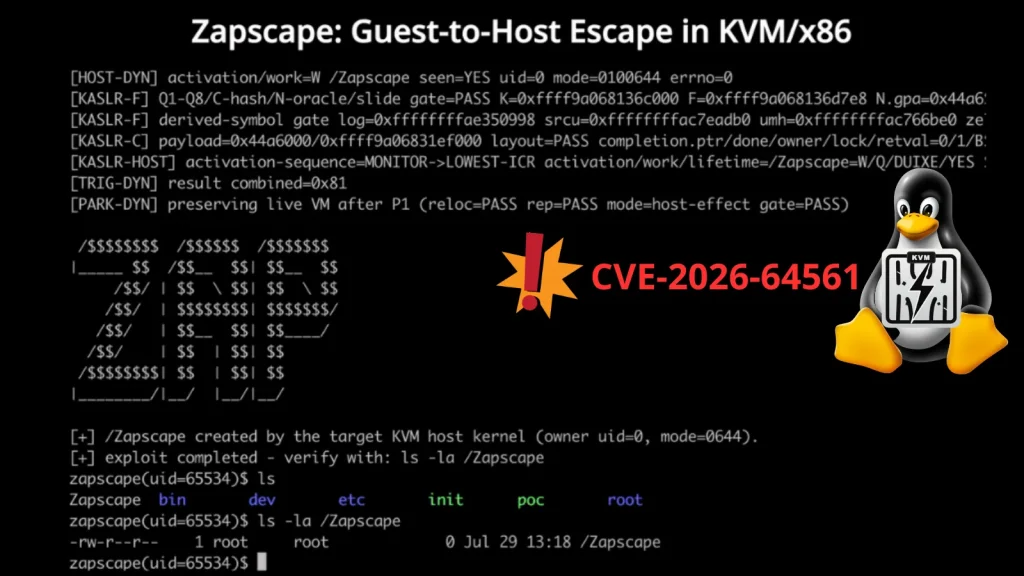
CVE-2026-64561 Zapscape Lets KVM Guests Escape to Linux Host With Root Privileges
The virtualized world offers unparalleled flexibility and resource optimization, but it also introduces unique security challenges. A newly identified vulnerability, tracked as CVE-2026-64561 and dubbed Zapscape, starkly reminds us of these risks. This flaw allows a malicious actor to break out of a KVM virtual machine and seize complete control of the underlying Linux host with root privileges. For cloud providers and enterprises relying heavily on KVM virtualization, this is a critical alert.
Understanding Zapscape: A KVM Escape Vulnerability
Zapscape (CVE-2026-64561) targets the heart of KVM/x86 virtualization technology. KVM (Kernel-based Virtual Machine) is a full virtualization solution for Linux on x86 hardware containing virtualization extensions (Intel VT or AMD-V). It essentially turns the Linux kernel into a hypervisor, allowing multiple isolated guest operating systems to run concurrently on a single physical machine. The core principle of virtualization security hinges on the robust separation between these guest systems and the host. Zapscape directly undermines this principle.
This vulnerability provides a pathway for an attacker operating within a KVM guest to execute arbitrary code with root privileges on the host operating system. Such an escape is the nightmare scenario for any virtualization environment. Once an attacker gains root access to the host, they can:
- Access or modify data from all other virtual machines running on that host.
- Install malware or backdoors on the host.
- Use the host as a launchpad for further attacks on the network.
- Achieve complete control over the physical server, potentially impacting multiple tenants or critical infrastructure.
The Impact on Cloud Providers and Enterprises
The implications of CVE-2026-64561 are particularly severe for environments where multitenancy is common. Cloud providers, by their very nature, host numerous independent customer virtual machines on shared physical infrastructure. A KVM escape like Zapscape means a compromised guest belonging to one customer could potentially lead to a breach of every other customer’s environment on that same physical server. This not only poses a massive data security risk but also a significant reputational and financial threat.
Enterprises leveraging KVM for internal infrastructure, development, or testing are equally vulnerable. A breach through Zapscape could lead to the compromise of critical internal systems, intellectual property theft, or significant operational disruption. The ability for a threat actor to pivot from a contained guest environment to the underlying physical server represents a fundamental breakdown in security architecture.
Remediation Actions for Zapscape (CVE-2026-64561)
Addressing KVM escape vulnerabilities like Zapscape requires immediate and decisive action. Organizations utilizing KVM/x86 virtualization must prioritize patching and apply a multi-layered security approach.
- Prompt Patching: The most crucial step is to apply the security patches released by Linux kernel maintainers and distribution vendors. Monitor official announcements from your specific Linux distribution (e.g., Red Hat, Ubuntu, Debian, SUSE) for updates addressing CVE-2026-64561. Ensure your patch management system is robust and capable of deploying kernel updates quickly across your KVM hosts.
- Isolate and Segment: While patching is paramount, implementing strong network segmentation and isolating virtual machines from each other can limit the blast radius of a successful escape. Even if an attacker escapes, well-designed network controls can prevent lateral movement to other critical systems.
- Principle of Least Privilege: Enforce the principle of least privilege for guest operating systems and applications. Limit the capabilities and network access of VMs to only what is strictly necessary for their function.
- Monitor and Audit: Implement comprehensive logging and monitoring solutions for both KVM guests and hosts. Look for anomalous behavior, unusual system calls, or unexpected network connections that could indicate an attempted or successful escape. Regularly audit configurations for compliance and potential weaknesses.
- Security Hardening: Continuously harden your Linux host operating systems. Disable unnecessary services, remove unneeded software, and configure firewalls to restrict inbound and outbound connections.
Tools for Detection and Mitigation
Effective defense against vulnerabilities like Zapscape involves a combination of proactive security measures and the right toolset. Here are some categories of tools that can assist in detection, scanning, and mitigation:
| Tool Name | Purpose | Link |
|---|---|---|
| Kernel Live Patching Solutions (e.g., Ksplice, Livepatch, KernelCare) | Apply kernel security updates without requiring a reboot, minimizing downtime for critical KVM hosts. | Oracle Ksplice Ubuntu Livepatch KernelCare |
| Vulnerability Scanners (e.g., OpenVAS/Greenbone, Nessus, Qualys) | Scan KVM host operating systems for unpatched vulnerabilities, including those in the kernel. | Greenbone Security Manager Tenable Nessus Qualys VMDR |
| Intrusion Detection/Prevention Systems (IDS/IPS) | Monitor network traffic for suspicious patterns or known attack signatures that might indicate an attempted KVM escape or post-exploitation activity. | Snort Suricata |
| Security Information and Event Management (SIEM) Systems | Aggregate and analyze logs from KVM hosts and guests for security events, enabling early detection of anomalies. | Splunk Elastic SIEM |
Conclusion
The discovery of Zapscape (CVE-2026-64561) serves as a potent reminder that virtualization security is an ongoing battle. A KVM guest escape with root privileges on the host is one of the most critical vulnerabilities an organization can face in a virtualized environment. Immediate patching, robust security hygiene, and continuous monitoring are not merely best practices; they are essential defenses against threats that can fundamentally undermine the security posture of cloud infrastructure and enterprise systems. Staying informed and proactive is the only way to safeguard against such sophisticated attacks.




