
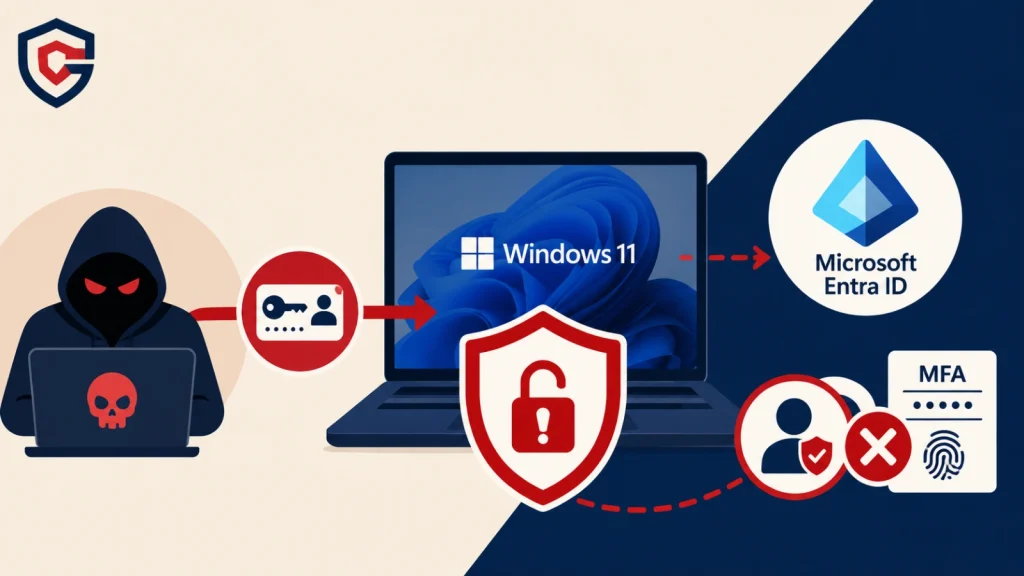
Pass-the-Passkey Attacks Expose Windows 11 and Microsoft Entra ID, Bypassing MFA
Unmasking the Threat: Pass-the-Passkey Attacks Bypass MFA on Windows 11 and Microsoft Entra ID
Multi-Factor Authentication (MFA) has long been the cornerstone of strong identity verification, a digital gatekeeper against unauthorized access. Yet, a new family of attack techniques, aptly named “Pass-the-Passkey,” is challenging this security paradigm. Research from SpecterOps has revealed systemic implementation flaws within the WebAuthn ecosystem, demonstrating how passkey security can be undermined, even when the cryptographic private keys remain securely housed within hardware tokens or trusted enclaves. This development has significant implications for environments leveraging Windows 11 and Microsoft Entra ID, where these attacks can effectively bypass MFA.
Understanding the Pass-the-Passkey Vulnerability
The “Pass-the-Passkey” attacks don’t steal the passkey itself; instead, they exploit how WebAuthn implementations handle the authentication process. The core issue lies in three fundamental vulnerabilities across the WebAuthn ecosystem, leading to over 20 distinct attack techniques. These techniques allow attackers to leverage legitimate session material or authentication tokens derived from a compromised initial authentication, effectively “passing” the passkey without direct access to the private key. This is a crucial distinction, as it means the security of your hardware token isn’t directly compromised, but the system’s reliance on WebAuthn’s implementation details is.
One notable example of such a vulnerability can be tracked under CVE-2023-38144, which highlights issues related to Microsoft Entra ID and WebAuthn authentication bypass. Another, CVE-2023-38143, further elaborates on WebAuthn vulnerabilities in Windows authentication processes.
Impact on Windows 11 and Microsoft Entra ID
The implications for organizations relying on Windows 11 and Microsoft Entra ID are substantial. These attacks directly target the authentication flows within these widely used platforms. When an attacker successfully executes a Pass-the-Passkey technique, they can effectively:
- Bypass MFA: Even with MFA enabled, the compromised authentication session or token grants access, rendering the secondary authentication factor ineffective.
- Gain Unauthorized Access: Attackers can access protected resources, applications, and data within the Microsoft ecosystem.
- Escalate Privileges: In some scenarios, initial access gained through these attacks could be leveraged for further privilege escalation.
This bypass is particularly concerning because it circumvents the very mechanisms designed to protect against credential theft. It’s not about stealing a password or a hardware key; it’s about exploiting the pathways and protocols used for authentication itself.
Remediation Actions
Addressing the Pass-the-Passkey threat requires a multi-faceted approach. Organizations should prioritize the following actions:
- Patch and Update Systems: Ensure all Windows 11 systems, Microsoft Entra ID components, and related authentication services are updated to the latest security patches. Microsoft consistently releases updates to address known vulnerabilities, including those impacting WebAuthn.
- Implement Strong Session Management: Review and strengthen session management policies. Implement shorter session timeouts, enforce frequent re-authentication for sensitive operations, and monitor for anomalous session activity.
- Principle of Least Privilege: Adhere strictly to the principle of least privilege. Limit user permissions and access rights to only what is absolutely necessary for their role. This minimizes the impact of a successful bypass.
- Enhanced Monitoring and Alerting: Deploy robust monitoring solutions that can detect unusual authentication patterns, rapid access attempts, or deviations from normal user behavior. Implement alerts for suspicious activity related to WebAuthn authentication.
- Educate Users: While these attacks don’t rely on traditional phishing for credential theft, user education on recognizing suspicious login prompts or unexpected authentication requests remains vital.
- Regular Security Audits: Conduct regular security audits and penetration tests specifically targeting WebAuthn implementations and authentication flows within your environment.
Tools for Detection and Mitigation
While direct tools to “detect” a Pass-the-Passkey attack in progress might be limited due to their nature, several solutions can aid in mitigation, monitoring, and overall security posture improvement:
| Tool Name | Purpose | Link |
|---|---|---|
| Microsoft Defender for Endpoint | Endpoint detection and response (EDR) for identifying suspicious activity on Windows 11 machines. | Microsoft Defender for Endpoint |
| Microsoft Sentinel | Security Information and Event Management (SIEM) for centralized logging, threat detection, and response across Microsoft Entra ID and other services. | Microsoft Sentinel |
| Azure AD Identity Protection | Detects and remediates identity-based risks in Microsoft Entra ID, including anomalous sign-ins and compromised credentials. | Azure AD Identity Protection |
| Vulnerability Scanners (e.g., Nessus, Qualys) | Identifies unpatched systems and misconfigurations that could be exploited in conjunction with these attacks. | Nessus / Qualys |
Key Takeaways
The emergence of Pass-the-Passkey attacks underscores a critical lesson: even robust cryptographic mechanisms can be undermined by flaws in their implementation or integration. While passkeys offer a significant step forward in secure authentication, organizations must remain vigilant. Prioritizing timely patching, strengthening session management, and implementing comprehensive monitoring are essential steps to defend against these sophisticated bypass techniques and maintain a strong security posture in the face of evolving threats.




