
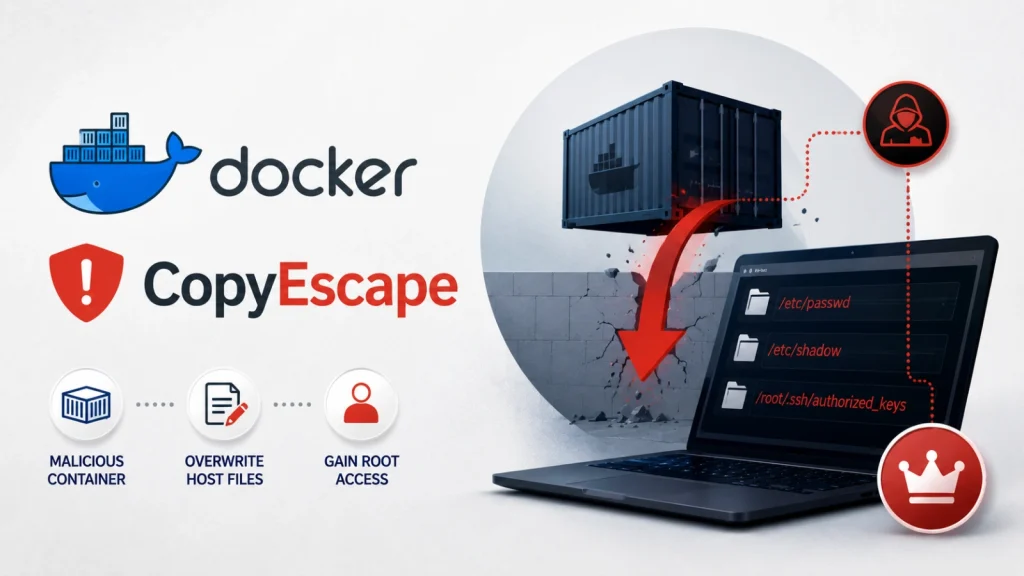
CopyEscape Docker Vulnerability Lets Malicious Containers Overwrite Host Files and Gain Root
Docker containers have revolutionized software deployment, offering unparalleled agility and efficiency. However, this power comes with a critical responsibility: securing the underlying host system. A recently disclosed vulnerability, aptly named “CopyEscape,” threatens to undermine this security by allowing malicious containers to break out of their isolation and compromise the host.
Tracked as CVE-2026-17106, this flaw exposes a serious weakness in Docker’s file copy mechanisms, specifically the docker cp command and its lesser-known counterpart, sbx cp. Discovered by the Imperva Red Team, CopyEscape presents a significant risk to organizations leveraging Docker, potentially leading to unauthorized file overwrites and, under specific configurations, full root code execution on the host machine.
Understanding CopyEscape: The Vulnerability Explained
The essence of CopyEscape lies in a critical flaw within how Docker handles file copying operations between a container and the host. When a user initiates a copy operation using docker cp from a malicious container to the host, the vulnerability can be exploited. Instead of strictly adhering to the intended destination path, a specially crafted container can manipulate the copy process to overwrite arbitrary files on the host system.
This exploitation hinges on a privilege escalation mechanism. In certain Docker configurations, especially those where containers are run with elevated privileges or where the host’s Docker socket is exposed, the ability to overwrite critical system files can pave the way for complete compromise. Imagine a scenario where a malicious container overwrites a system binary, a configuration file, or even a sensitive script with its own payload. The implications are severe, ranging from denial of service to full system control.
Impact of CVE-2026-17106 on Docker Environments
The impact of CVE-2026-17106 is multifaceted and depends on the specific Docker environment and container configurations. However, the potential consequences are always significant:
- Unauthorized File Overwrite: At its core, the vulnerability allows a malicious container to write data to unintended locations on the host. This can corrupt system files, introduce malicious scripts, or alter critical configurations.
- Privilege Escalation: By overwriting files that are executed with elevated privileges (e.g., cron jobs, systemd units, or SUID binaries), an attacker can escalate their privileges from within the container to root on the host.
- Data Exfiltration: While not a direct mechanism for data exfiltration, the ability to execute arbitrary code or modify host files can be leveraged to set up exfiltration channels.
- Denial of Service: Overwriting critical system files with garbage data can render the host system inoperable, leading to significant downtime.
- Compromise of Sensitive Information: If an attacker can overwrite configuration files for other services or applications on the host, they might gain access to sensitive credentials or data.
Organizations running Docker containers, particularly those with publicly accessible services or those allowing untrusted images, should consider this vulnerability a high-priority concern for their cybersecurity posture.
Remediation Actions for CopyEscape
Addressing the CopyEscape vulnerability requires a multi-pronged approach, combining immediate mitigation steps with long-term security best practices. Here are actionable recommendations:
- Update Docker: The most crucial step is to update your Docker Engine to a patched version as soon as it becomes available. Always prioritize official security patches.
- Limit
docker cpUsage: Restrict the use ofdocker cpfrom untrusted containers to the host. If possible, avoid copying files from containers to the host unless absolutely necessary and ensure the source container is trusted. - Principle of Least Privilege: Run containers with the absolute minimum necessary privileges. Avoid running containers as root and use user namespaces if possible.
- Avoid Host Volume Mounts with Write Access: Minimize mounting host directories with write permissions into containers. If write access is essential, restrict it to specific, non-sensitive directories.
- Network Segmentation: Implement strong network segmentation between your Docker hosts and other critical infrastructure.
- Regular Security Audits: Periodically audit your Docker configurations, container images, and host security settings to identify and rectify potential weaknesses.
- Disable Docker Socket Exposure: Never expose the Docker daemon socket (
/var/run/docker.sock) to containers unless absolutely necessary and with extreme caution, as this grants containers control over the Docker daemon itself.
Tools for Docker Security and Vulnerability Management
Implementing effective security measures for Docker requires a robust set of tools. Here’s a table of useful tools for detection, scanning, and mitigation related to container vulnerabilities like CopyEscape:
| Tool Name | Purpose | Link |
|---|---|---|
| Docker Scout | Container image analysis, vulnerability scanning, and supply chain insights. | https://www.docker.com/products/docker-scout/ |
| Trivy | Comprehensive vulnerability scanner for container images, file systems, and Git repositories. | https://aquasecurity.github.io/trivy/ |
| Clair | Open-source static analysis tool for vulnerabilities in appc and Docker containers. | https://github.com/quay/clair |
| Falco | Runtime security monitoring for containers and hosts, detects anomalous behavior and potential threats. | https://falco.org/ |
| OpenSCAP | Provides a community-driven catalog of security content to enforce compliance and security policies. | https://www.open-scap.org/ |
Protecting Your Docker Ecosystem
The disclosure of CVE-2026-17106, or “CopyEscape,” underscores the continuous need for vigilance in container security. While Docker offers immense benefits, neglecting its security implications can lead to severe compromises. Organizations must prioritize immediate patching, enforce robust security configurations, and integrate comprehensive vulnerability management into their continuous integration and deployment (CI/CD) pipelines. Proactive monitoring and adherence to the principle of least privilege are not just good practices; they are essential defenses against sophisticated container escape vulnerabilities like CopyEscape.




