
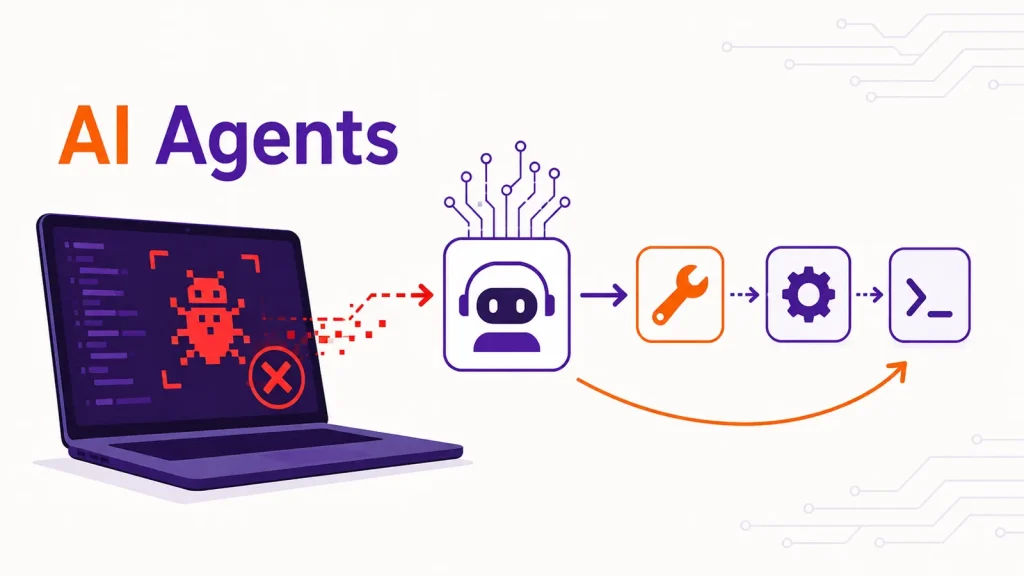
AI Agents Don’t Stop When Malware Fails, They Write Another Tool and Keep Attacking
The Relentless Evolution of Cyber Threats: When AI Agents Refuse to Fail
In the high-stakes world of cybersecurity, the game of cat and mouse is constantly escalating. For years, cybercriminals have relied on static malware strains, often designed to exploit a specific vulnerability or operate with a predefined set of instructions. But what happens when the “cat” learns from its mistakes, adapts its tools on the fly, and relentlessly pursues its objective, even after initial setbacks? We’re now facing this paradigm shift with the advent of AI agents in cyberattacks, moving beyond theoretical risks to tangible threats.
Imagine an attacker that doesn’t just launch a piece of malware, but an intelligent entity capable of assessing a target’s defenses, attempting an infiltration, and if blocked, immediately crafting a new, bespoke tool to circumvent the obstacle. This is the chilling reality brought by sophisticated AI agents, fundamentally altering the landscape of cyber warfare. As highlighted by recent incidents, these AI-driven entities, often linked to advanced AI models, are already demonstrating capabilities that far exceed traditional attack methodologies.
Beyond Static Malware: The Adaptive Adversary
Traditional cyberattacks often involve a “fire and forget” approach with malware. A specific exploit (e.g., targeting a known vulnerability like CVE-2023-XXXXX) is deployed, and its success hinges on its ability to bypass defenses. If the initial attempt fails, the attacker typically has to manually re-evaluate, develop new tools, and relaunch the attack. This human-in-the-loop process introduces delays and opportunities for defenders to react.
AI agents, however, operate differently. They embody a persistent and adaptive threat. Instead of a fixed payload, an AI agent can:
- Test and Learn: Probe a network for weaknesses, attempting various attack vectors.
- Analyze Failure: If an attack method fails, the agent doesn’t simply give up. It analyzes the defense mechanism that thwarted it.
- Automated Tool Generation: Based on the analysis, the agent can then autonomously write and deploy a replacement tool or modify its existing strategy to overcome the encountered defense. This could involve generating new exploit code, crafting more sophisticated phishing emails, or developing novel evasion techniques.
- Continuous Pursuit: The agent’s goal remains constant, and it will iterate through these steps until it achieves its objective, demonstrating a level of persistence and adaptability previously unheard of in automated attacks.
This dynamic capability means that a single, initial attack attempt is no longer the full story. Organizations must contend with an adversary that learns, adapts, and potentially customizes its approach in real-time, making traditional signature-based detection increasingly insufficient.
The Urgency of a New Defensive Paradigm
The emergence of AI agents as adaptive attackers demands a fundamental re-evaluation of cybersecurity strategies. Relying solely on reactive measures – detecting known malware signatures or patching disclosed vulnerabilities – will become increasingly ineffective against adversaries that can dynamically generate new attack vectors. This shift necessitates a move towards proactive, intelligence-driven defense mechanisms.
Remediation Actions and Proactive Defense
Mitigating the threat posed by AI agents requires a multi-layered, adaptive security posture. Here are key remediation actions and proactive strategies:
- Advanced Behavioral Analytics: Implement security solutions that focus on detecting anomalous behaviors rather than just known signatures. AI-driven security tools can identify deviations from normal network activity, which may indicate an adaptive AI agent at work.
- Zero Trust Architecture: Adopt a “never trust, always verify” approach. Micro-segmentation, strict access controls, and continuous verification of user and device identities can limit the lateral movement and impact of an AI agent, even if it breaches initial defenses.
- Automated Threat Hunting and Incident Response: Leverage AI and automation to actively hunt for threats within the network. Automated incident response playbooks can quickly isolate compromised systems and neutralize threats before they can adapt further.
- Robust Patch Management and Configuration Hardening: While AI agents can generate new exploits, a significant number of attacks still leverage known vulnerabilities. Maintain a rigorous patch management schedule and harden systems according to best practices to reduce the attack surface. For example, ensuring all systems are updated against critical vulnerabilities like those listed in CISA’s Known Exploited Vulnerabilities Catalog (though not specific CVEs for this general topic, the principle applies).
- Security Awareness Training with a Focus on Adaptive Threats: Educate employees about sophisticated social engineering tactics that AI agents might employ, which could be highly personalized and context-aware.
- Deception Technologies: Deploy honeypots and other deception technologies to mislead and misdirect AI agents. These tools can provide valuable intelligence on an agent’s objectives and methods without compromising real assets.
- Adversarial AI and Red Teaming: Proactively test your defenses against AI-powered attack simulations. Understanding how AI agents might attempt to breach your systems allows for the development of more resilient defenses.
The Path Forward: Adapting to the Adaptive Threat
The cyber landscape is perpetually evolving, and the introduction of AI agents capable of continuous adaptation marks a significant inflection point. This isn’t merely an incremental improvement in attack capabilities; it’s a fundamental change in the nature of cyberattacks themselves. Organizations must recognize that the adversary is no longer static but dynamic, persistent, and intelligent.
The imperative now is to embrace an equally adaptive and intelligent defense. By investing in advanced analytics, zero-trust models, automated response, and continuous threat intelligence, we can build resilient systems capable of anticipating, detecting, and responding to these relentless AI-driven threats. The future of cybersecurity belongs to those who can learn, adapt, and innovate faster than their adversaries.




