
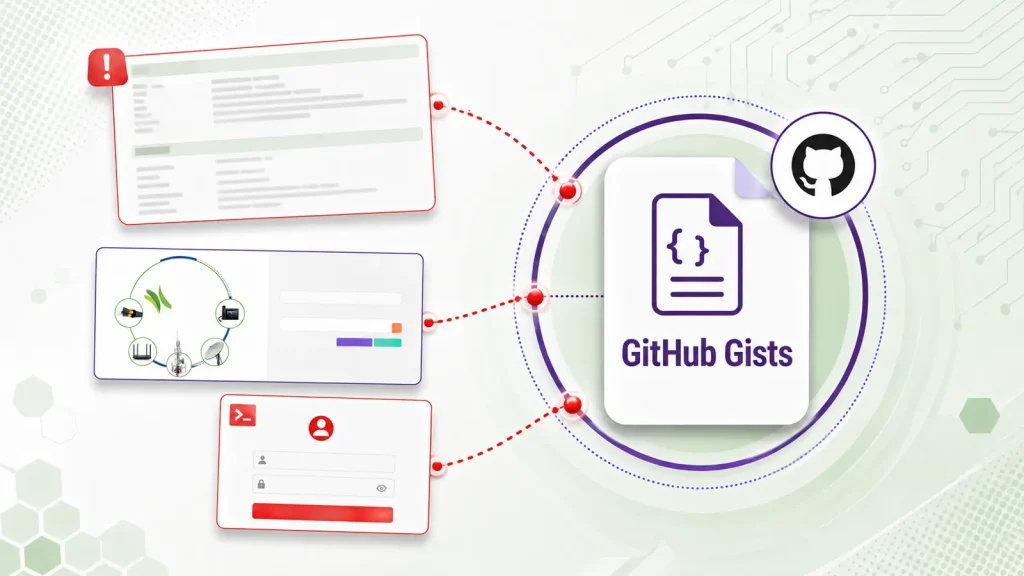
HACKERAI Malware Turns GitHub Gists Into a Command-and-Control Channel
HACKERAI Malware Leverages GitHub Gists for Covert Command and Control
The digital threat landscape is perpetually shifting, with adversaries continually refining their tactics to evade detection. A recent discovery has brought to light a sophisticated new malware framework, dubbed HACKERAI C2 Agent, which employs an insidious method for command-and-control (C2) operations: GitHub Gists. This innovative approach allows threat actors to seamlessly blend malicious traffic with legitimate network activity, posing a significant challenge for traditional security mechanisms. The identification of HACKERAI emerged from an in-depth investigation into a broader espionage campaign targeting critical sectors, including telecom and government entities.
Understanding HACKERAI’s GitHub Gist C2 Mechanism
HACKERAI’s core innovation lies in its use of GitHub Gists as an unconventional C2 channel. GitHub Gists are essentially miniature repositories or snippets of code that can be publicly shared. For many organizations, access to GitHub and its associated services is a fundamental requirement for development and operational teams. This widespread legitimate usage makes Gists an ideal cover for malicious communication.
- Covert Communication: The malware communicates with its operators by reading and writing to specific GitHub Gists. This activity often appears as benign web traffic to GitHub’s legitimate infrastructure, making it difficult to flag as suspicious.
- Data Exfiltration: Stolen data, ranging from sensitive documents to system configurations, can be exfiltrated by embedding it within Gists or by using Gists as pointers to other exfiltration methods.
- Command Delivery: Malicious commands are delivered to compromised systems by updating Gists that the HACKERAI agent periodically monitors. These commands can instruct the malware to perform various actions, such as downloading additional payloads, modifying system settings, or establishing persistence.
The Espionage Campaign Context
The discovery of the HACKERAI C2 Agent was not an isolated incident. It was part of a larger, coordinated espionage effort. The focus on high-value targets like telecom and government organizations suggests a state-sponsored or highly sophisticated actor. The use of an established and trusted platform like GitHub Gists indicates a deliberate strategy to prolong dwell time and circumvent existing security controls.
While specific CVEs related to HACKERAI’s core functionality have not been publicly assigned as of this writing, the underlying principles of abusing legitimate services for C2 are well-documented. For instance, the general category of “abuse of trusted services for C2” has been observed in various campaigns. For broader context on such tactics, researchers often refer to frameworks like MITRE ATT&CK, specifically T1102 – Web Service, which encompasses the use of legitimate web services for C2 communication.
Remediation Actions and Defensive Strategies
Mitigating the threat posed by HACKERAI and similar C2 tactics requires a multi-layered defense strategy. Focusing solely on blocking GitHub would be counterproductive for most organizations; instead, a more nuanced approach is necessary.
- Network Traffic Analysis: Implement deep packet inspection and behavioral analysis on network traffic. Look for unusual patterns of communication with GitHub, such as excessively frequent requests to Gists, or Gist content that deviates from typical code snippets.
- Endpoint Detection and Response (EDR): Deploy robust EDR solutions to monitor endpoint activity for suspicious processes, file modifications, and network connections. EDR can help identify the HACKERAI agent itself or its actions on a compromised system.
- Threat Intelligence Integration: Subscribe to and integrate up-to-date threat intelligence feeds. These feeds can provide indicators of compromise (IoCs) associated with HACKERAI, such as specific Gist IDs, file hashes, or C2 domains used in conjunction with Gists.
- User and Entity Behavior Analytics (UEBA): Leverage UEBA solutions to detect anomalies in user or system behavior. Unusual access patterns to GitHub, especially from non-developer accounts or systems, could indicate compromise.
- Security Awareness Training: Educate employees, particularly developers, about the risks of phishing and social engineering attacks that could lead to initial compromise.
- Principle of Least Privilege: Enforce the principle of least privilege for all user accounts and systems. Restrict unnecessary access to external services and sensitive data.
- Regular Security Audits: Conduct regular security audits and penetration tests to identify weaknesses in your existing defenses that could be exploited by sophisticated malware like HACKERAI.
Detection and Analysis Tools
While no specific tools are universally dedicated to detecting HACKERAI by name, the following types of tools are crucial for identifying and mitigating threats that leverage legitimate services like GitHub Gists for C2.
| Tool Name | Purpose | Link |
|---|---|---|
| Network Intrusion Detection/Prevention Systems (NIDS/NIPS) | Monitors network traffic for suspicious patterns and known attack signatures. | Snort / Suricata |
| Endpoint Detection and Response (EDR) Solutions | Provides real-time visibility into endpoint activity, detecting and responding to threats. | CrowdStrike Falcon Insight / Microsoft Defender for Endpoint |
| Security Information and Event Management (SIEM) Systems | Aggregates and analyzes security logs from various sources to detect threats and incidents. | Splunk / Elastic SIEM |
| Traffic Analysis Tools | Allows for deep inspection and analysis of network packets. | Wireshark |
| Threat Intelligence Platforms (TIPs) | Aggregates, normalizes, and contextualizes threat intelligence from various sources. | MISP |
Key Takeaways for Strengthening Your Defenses
The emergence of the HACKERAI C2 Agent underscores a critical evolution in adversary tactics: the increasing sophistication in using legitimate services for malicious ends. Organizations must move beyond signature-based detection and embrace behavioral analytics to identify these stealthy threats. Maintaining vigilance, investing in advanced security tools, and fostering a strong security posture across all layers of the IT infrastructure are paramount to defending against such advanced persistent threats. The challenge isn’t just about blocking known bad, but identifying abnormal within the seemingly normal.




