
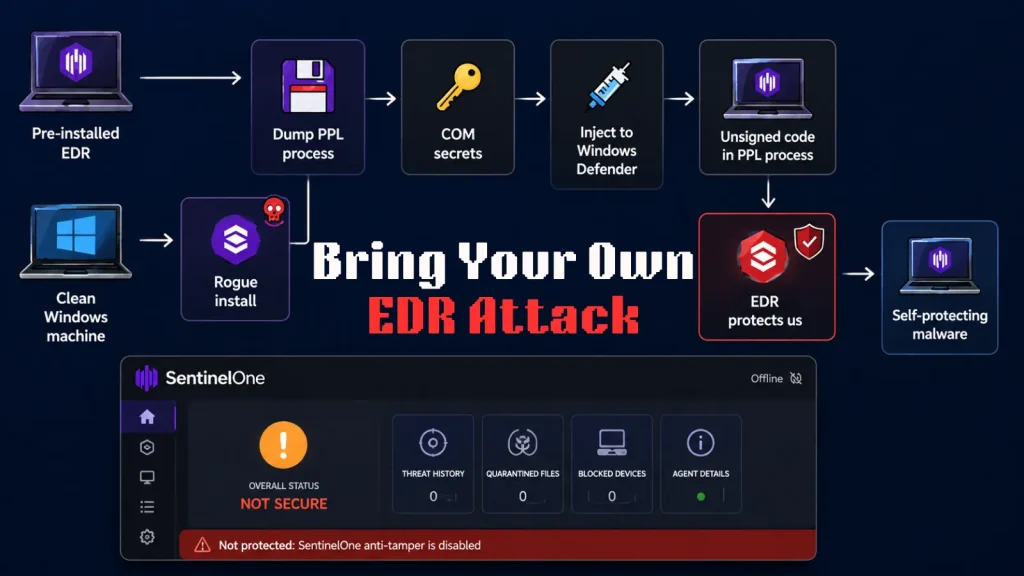
Bring Your Own EDR Attack Turns SentinelOne Into PPL-Protected Trojan Horse to Shield Malware
Endpoint Detection and Response (EDR) solutions are the bedrock of modern cybersecurity, offering unparalleled visibility and control over an organization’s digital assets. They operate with deep system privileges, scrutinizing every process and file to halt threats before they inflict damage. But what happens when the very tools designed to protect become a conduit for attack? Recent research presented at DEF CON 34 unveiled a sophisticated technique dubbed “Bring Your Own EDR” (BYOEDR), demonstrating how attackers can weaponize trusted EDR components, specifically SentinelOne, to shield their malicious activities.
This alarming discovery transforms a robust defense mechanism into a sophisticated camouflage, highlighting a critical new vector for advanced persistent threats (APTs). Understanding this attack paradigm is crucial for IT professionals, security analysts, and developers tasked with safeguarding digital infrastructures.
The “Bring Your Own EDR” Attack Explained
The “Bring Your Own EDR” attack capitalizes on the inherent trust and elevated privileges granted to EDR solutions. In this particular instance, researchers demonstrated how SentinelOne’s legitimate, signed components could be manipulated. The core idea is to leverage the EDR agent’s legitimate operations, which include powerful features like process protection (often referred to as PPL – Protected Process Light), to protect malicious payloads. Instead of bypassing the EDR, attackers essentially trick it into protecting their malware.
This isn’t about exploiting a traditional vulnerability in the EDR’s code that allows for arbitrary code execution. Rather, it’s a logical abuse of its intended functionality. By carefully orchestrating events, an attacker can coerce the SentinelOne agent into “adopting” their malicious process. Once this occurs, the malware benefits from the same PPL protection as the EDR itself, making it incredibly difficult for other security tools or even manual analysis to terminate or inspect the malicious process.
The impact of such an attack is profound: malware running under PPL protection becomes virtually immune to standard removal techniques. This grants attackers persistence, stealth, and a formidable shield against detection and remediation efforts, essentially turning the EDR into a Trojan horse for their operations.
SentinelOne’s Response and Remediation
Upon responsible disclosure by the researchers, SentinelOne promptly addressed the reported issue. The company released a fix in Agent version 26.1.1, mitigating the specific vectors used in the BYOEDR attack. This rapid response underscores the importance of ongoing security research and vendor collaboration to fortify cybersecurity defenses against novel attack techniques.
While the specific details of the vulnerability exploited in older versions of SentinelOne agents are not publicly detailed with a CVE number in the provided source, the principle remains a critical consideration for all EDR users. It highlights the need for continuous vigilance and prompt updates for all security software.
Remediation Actions and Best Practices
For organizations utilizing SentinelOne and other EDR solutions, immediate action is paramount to protect against similar attack methodologies. Here are critical remediation steps and best practices:
- Update EDR Agents Immediately: Ensure all SentinelOne agents are updated to version 26.1.1 or newer. This is the most crucial step to address the specific vulnerability demonstrated by the BYOEDR attack. Regularly check for and apply all security updates from your EDR vendor.
- Implement Least Privilege: While EDRs require high privileges to function, review and enforce least privilege principles wherever possible for other applications and user accounts. Minimize the attack surface that could potentially be exploited to manipulate EDR components.
- Robust Configuration Management: Regularly audit and review your EDR configurations. Ensure that default settings are hardened and that any custom rules are thoroughly tested and secure.
- Behavioral Monitoring: Beyond signature-based detection, emphasize behavioral analytics within your EDR and SIEM solutions. Look for unusual process relationships, unexpected process parents, or anomalies in how processes interact with legitimate EDR components.
- Regular Penetration Testing: Conduct regular penetration tests and red team exercises that specifically aim to test the resilience of your EDR and other security controls against advanced attack techniques, including attempts to abuse trusted software.
- Employee Training: Educate employees about social engineering and phishing tactics, which are often the initial vector for delivering malware that could then leverage BYOEDR techniques.
Tools for Enhanced Detection and Mitigation
While EDRs are primary defenders, a layered security approach with complementary tools is essential. Here are some categories of tools that can aid in detecting and mitigating sophisticated threats:
| Tool Category | Purpose | Examples/Link |
|---|---|---|
| Endpoint Detection & Response (EDR) | Primary defense for real-time threat detection, investigation, and response. | SentinelOne, Microsoft Defender for Endpoint, CrowdStrike Falcon |
| Security Information and Event Management (SIEM) | Aggregates and analyzes security logs from various sources for threat detection and compliance. | Splunk, Elastic SIEM, IBM QRadar |
| Vulnerability Management Solutions | Identifies and helps prioritize software vulnerabilities across the IT environment. | Tenable Nessus, Rapid7 InsightVM |
| Threat Intelligence Platforms (TIP) | Provides context and insights into known threats, attack techniques, and indicators of compromise (IOCs). | Palo Alto Networks Unit 42, Recorded Future |
Key Takeaways
The “Bring Your Own EDR” attack vector is a stark reminder that even the most trusted security tools can be leveraged in unforeseen ways by determined adversaries. The research at DEF CON 34 specifically targeting SentinelOne’s components underscores a critical evolution in attack methodologies – moving from bypassing security controls to co-opting them. While SentinelOne promptly addressed the issue, the broader implication is clear: organizations must remain vigilant, prioritize timely updates, and adopt a multi-layered security strategy that includes robust configuration management, behavioral monitoring, and continuous security testing. Our defenses must not only prevent attacks but also anticipate ingenious ways attackers might turn our strengths into their weapons.




