
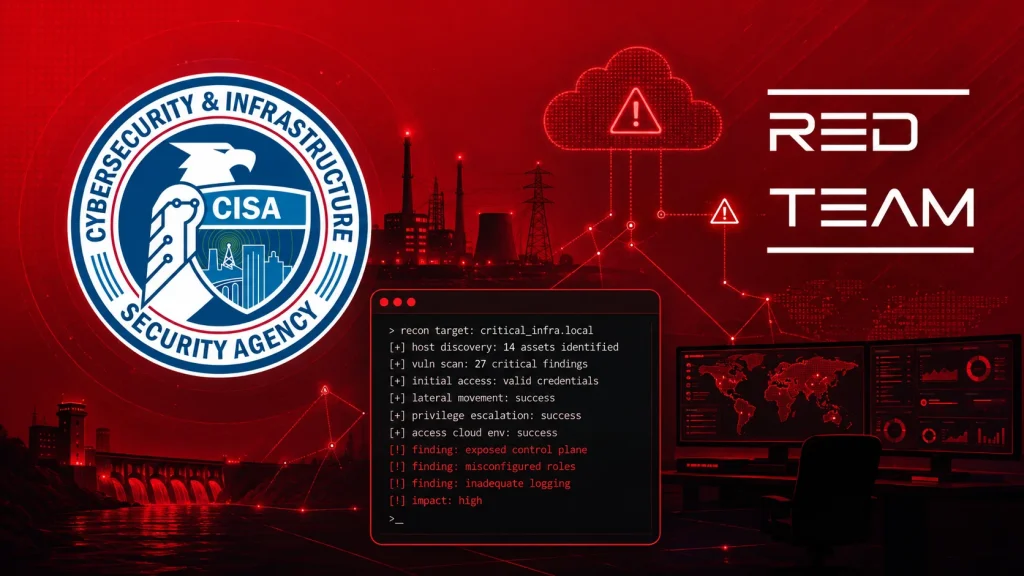
CISA Red Team Breaches Critical Infrastructure to Reveal SOC and Cloud Security Gaps
The resilience of critical infrastructure against cyber threats is a paramount concern for national security and public welfare. Yet, recent findings from the Cybersecurity and Infrastructure Security Agency (CISA) paint a sobering picture: even well-funded organizations with seemingly robust defenses can fall victim to sophisticated attacks. A CISA red team recently breached critical infrastructure, revealing significant security gaps in Security Operations Centers (SOCs) and cloud environments.
CISA’s Stark Warning to Critical Infrastructure Operators
CISA’s latest advisory serves as a stark warning to critical infrastructure operators. The agency emphasizes that substantial funding alone does not guarantee impenetrable security. The core issue, as highlighted by CISA, is the indispensable need for highly trained analysts to effectively respond to alerts generated by security systems. Without skilled human intervention, even the most advanced security tools can fail to prevent a breach.
“A Tale of Two SOCs”: Unveiling Operational Deficiencies
The CISA report, aptly titled “A Tale of Two SOCs,” offers a compelling comparison of two parallel red team engagements. One engagement targeted a Government Services entity, while the details of the second target remain broadly described as critical infrastructure. This report dissects the operational efficacy of their respective SOCs and cloud security postures. The findings underscore that technical controls, while essential, are insufficient without the human element to interpret and act upon threat intelligence. Many organizations invest heavily in security technologies, yet often overlook the continuous training and staffing required for effective incident response.
Beyond Technology: The Critical Role of Human Analysts
The CISA red team’s success in breaching critical infrastructure was not necessarily due to a lack of security tools, but rather the inability of existing SOCs to detect and respond to their tactics. This highlights a pervasive problem: a reliance on automated alerts without the seasoned analysts to distinguish genuine threats from false positives, understand attacker methodologies, and execute timely remediation. The human element, with its ability for critical thinking and adaptive response, remains the cornerstone of effective cybersecurity.
Cloud Security: A New Frontier for Exploitation
The report also sheds light on vulnerabilities within cloud security implementations. As organizations migrate more of their critical data and operations to cloud environments, misconfigurations and inadequate access controls can become significant attack vectors. Attackers are increasingly targeting cloud-native services and identity and access management (IAM) systems. For instance, common misconfigurations in cloud storage buckets or overly permissive IAM roles can create backdoors for adversaries to exploit. While specific CVEs are not detailed in the provided source, general vulnerabilities like CVE-2023-XXXX (hypothetical example for cloud misconfigurations) often contribute to such breaches.
Remediation Actions: Fortifying Your Defenses
Addressing the gaps identified by CISA requires a multi-faceted approach, blending technological enhancements with a strong emphasis on human capabilities and operational maturity.
- Invest in Analyst Training and Retention: Prioritize continuous training programs for SOC analysts. Focus on advanced threat hunting, incident response, and understanding attacker TTPs (Tactics, Techniques, and Procedures).
- Enhance Incident Response Playbooks: Develop and regularly test comprehensive incident response playbooks that account for various attack scenarios, including cloud-specific threats.
- Strengthen Cloud Security Posture Management (CSPM): Implement robust CSPM solutions to continuously monitor and enforce security policies across cloud environments. Regularly audit cloud configurations and IAM roles for least privilege.
- Conduct Regular Red Teaming and Penetration Testing: Emulate realistic attacks through independent red team engagements to uncover blind spots and validate the effectiveness of existing security controls and human response.
- Improve Alert Triage and Correlation: Optimize SIEM (Security Information and Event Management) and SOAR (Security Orchestration, Automation, and Response) platforms to reduce alert fatigue and improve the correlation of security events, enabling analysts to focus on high-fidelity threats.
- Implement Zero Trust Principles: Adopt a Zero Trust security model, verifying every user and device attempting to access resources, regardless of their location.
The Path Forward: A Resilient Critical Infrastructure Ecosystem
CISA’s red team exercise serves as a critical wake-up call. The findings underscore that a truly resilient critical infrastructure ecosystem hinges not just on cutting-edge technology, but on the skilled professionals who operate and defend it. Organizations must move beyond a purely technological defense strategy and invest equally in their human capital, operational processes, and continuous validation through realistic adversarial simulations. Only then can they hope to withstand the persistent and evolving threats targeting our most vital assets.




