
WhatsApp Passkeys Reach 1 Billion Users as Two-Step Verification Gets Stronger Passwords
The Passwordless Revolution: WhatsApp’s Billion-User Passkey Milestone
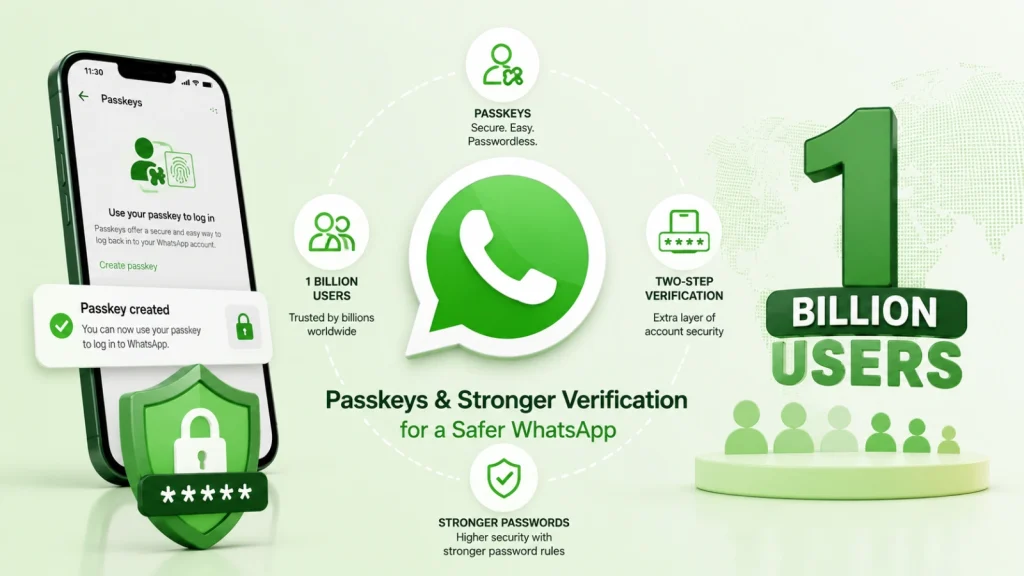
In a significant shift towards enhanced digital security, WhatsApp has confirmed that over one billion users now leverage passkeys for logging into the popular messaging application. This landmark achievement represents one of the most substantial passwordless authentication rollouts in the history of consumer technology, signaling a powerful move away from traditional password-based systems. This initiative, coupled with a critical upgrade to WhatsApp’s two-step verification process, fortifies user accounts against an array of cyber threats.
Passkeys: A New Era of Authentication
Passkeys offer a modern, more secure alternative to conventional passwords. Instead of memorizing complex character strings, users authenticate using biometric data (like fingerprint or facial recognition) or a device PIN, which are tied to a cryptographic key pair. This method significantly reduces the risk associated with phishing, credential stuffing, and brute-force attacks, as the secret key never leaves the user’s device.
- Enhanced Security: Passkeys are phishing-resistant, as the authentication process is tied to the physical device and a secure cryptographic protocol.
- User Convenience: Eliminates the need to remember complex passwords, simplifying the login experience.
- Industry Standard: Built on FIDO Alliance standards, promoting interoperability and broad adoption across platforms.
Strengthening Two-Step Verification: Beyond the Six-Digit PIN
Alongside the passkey integration, WhatsApp is implementing a substantial upgrade to its two-step verification (2SV) mechanism. Historically reliant on a six-digit PIN, the platform is transitioning to a more robust alphanumeric password system. This crucial enhancement provides users with the ability to create stronger, more intricate secondary authentication factors, making accounts significantly harder to compromise.
While the original six-digit PIN offered a layer of protection, its susceptibility to dictionary attacks or social engineering was a concern. The move to alphanumeric passwords directly addresses this vulnerability, allowing for greater entropy and complexity. For instance, a six-digit PIN has a maximum of 1 million permutations, whereas an alphanumeric password of even modest length offers exponentially more possibilities, thus greatly increasing the computational resources required for a successful brute-force attack.
Implications for Cybersecurity and User Trust
The widespread adoption of passkeys by a platform as ubiquitous as WhatsApp carries significant implications for the broader cybersecurity landscape. It notonly educates a massive user base on advanced authentication methods but also pushes other technology providers to accelerate their own passwordless initiatives. This mass adoption can lead to a more secure internet ecosystem, where the weakest link—often the user’s password—is replaced by more resilient mechanisms.
Furthermore, by bolstering its two-step verification, WhatsApp demonstrates a proactive approach to protecting user data and maintaining trust. In an era where data breaches and account compromises are frequent, these security enhancements are vital for user confidence and platform integrity.
Recommendations for Users and Organizations
For individuals and organizations managing digital identities, the implications of WhatsApp’s security advancements are clear:
- Enable Passkeys: If available, immediately activate passkeys for all supported applications, including WhatsApp.
- Strengthen 2SV: For applications that still rely on password-based 2SV, choose strong, unique alphanumeric passwords.
- Educate Users: Organizations should actively educate their employees on the benefits of passkeys and the importance of robust two-step verification.
- Implement FIDO Standards: Developers and IT teams should explore integrating FIDO-based authentication methods into their own applications and systems to leverage these advanced security protocols.
Conclusion: A More Secure Digital Future
WhatsApp’s milestone of one billion passkey users, coupled with the upgrade to stronger two-step verification passwords, marks a pivotal moment in consumer cybersecurity. This move not only enhances the security posture of individual users but also propels the industry toward a future where passwordless authentication is the norm. As cyber threats continue to evolve, platforms like WhatsApp are setting a crucial precedent for robust, user-friendly security measures that are essential for protecting our digital lives.




