
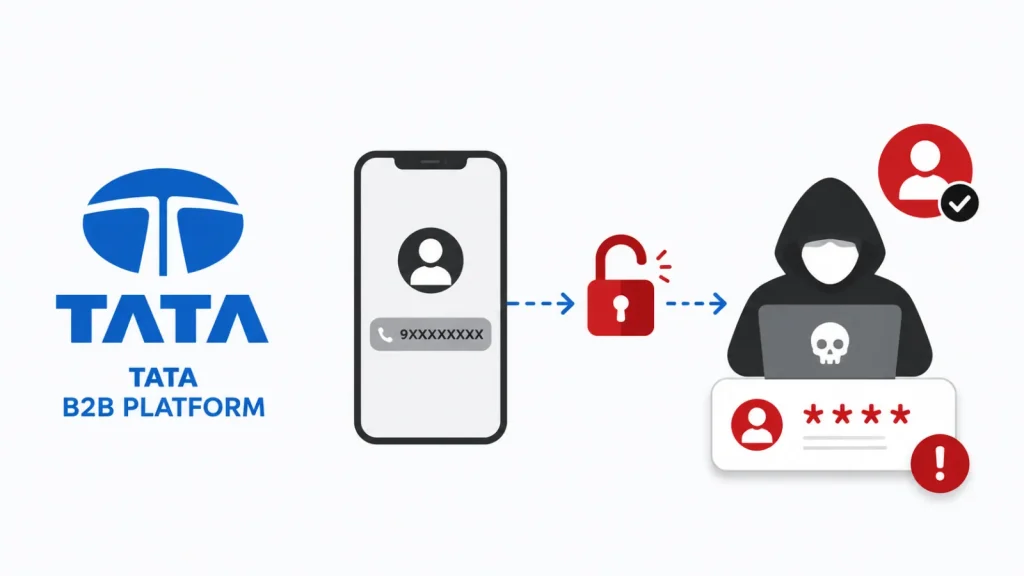
Tata’s B2B Platform Flaw Enables Account Takeover Just by Knowing Victim’s Phone Number
A disturbing revelation has shaken the B2B landscape, underscoring the persistent vulnerabilities that plague even well-established platforms. Tata Nexarc, a critical procurement platform serving small and medium businesses across India, recently harbored a severe authentication flaw. This vulnerability allowed malicious actors to compromise accounts with alarming ease, requiring nothing more than a victim’s registered mobile number. The implications for data security and business continuity are significant, demanding immediate attention from IT professionals and security analysts alike.
The Critical Authentication Bypass: How It Worked
The core of this vulnerability lay in a fundamental breakdown of secure authentication practices. Traditionally, a one-time password (OTP) sent via SMS acts as a second factor of authentication, ensuring that only the legitimate owner of the mobile number can access an account. However, in the case of Tata Nexarc, the platform reportedly exposed this crucial OTP within its API response. This meant that an attacker, upon initiating a login attempt with a victim’s phone number, could intercept the OTP not from the victim’s SMS, but directly from the platform’s API traffic.
The API response, although seemingly encrypted or obfuscated, contained the OTP in a decryptable format. This fatal flaw effectively bypassed the need for any complex social engineering or SMS interception. An attacker merely needed to know a user’s registered mobile number, trigger the login process, capture the API response, and extract the OTP to gain unauthorized access. This type of vulnerability falls under the broader category of broken authentication and session management, a persistent threat highlighted in various security guidelines.
Impact and Risks of Account Takeover
The consequences of such an account takeover are far-reaching, particularly for a B2B platform handling procurement and potentially sensitive business data. Malicious actors gaining access to a business account could:
- Access Sensitive Business Data: View proprietary information, pricing strategies, supplier lists, and financial records.
- Manipulate Orders and Transactions: Create fraudulent orders, divert shipments, or alter payment details, leading to significant financial losses and operational disruptions.
- Impersonate Businesses: Conduct phishing attacks or other scams by impersonating the compromised business, damaging reputation and trust.
- Disrupt Operations: Lock legitimate users out of their accounts, paralyzing procurement processes and supply chain management.
For small and medium businesses relying on platforms like Tata Nexarc for their daily operations, such a breach could be catastrophic, potentially leading to financial ruin and irreparable reputational damage. This incident serves as a stark reminder that even seemingly minor flaws in authentication mechanisms can have major repercussions.
Remediation Actions for Platform Providers and Users
Addressing such vulnerabilities requires a multi-pronged approach, involving both platform providers and their users.
For Platform Providers (e.g., Tata Nexarc):
- Secure API Design: Never expose sensitive information, such as OTPs, in API responses, even if encrypted. OTPs should always be transmitted directly to the user’s registered device via a secure channel (e.g., SMS, dedicated authenticator app).
- Stronger Encryption and Obfuscation: Implement robust, industry-standard encryption protocols for all data in transit and at rest. Avoid easily decryptable methods.
- Input Validation and Rate Limiting: Implement strict input validation to prevent common attack vectors and rate limiting on login attempts to thwart brute-force or enumeration attacks.
- Regular Security Audits and Penetration Testing: Conduct frequent and thorough security assessments by independent third parties to identify and rectify vulnerabilities proactively.
- Incident Response Plan: Develop and regularly test a comprehensive incident response plan to quickly detect, contain, and mitigate security breaches.
For Users of B2B Platforms:
- Be Vigilant for Suspicious Activity: Monitor account activity for any unusual logins, transactions, or changes.
- Report Suspected Vulnerabilities: If you discover a potential flaw, report it responsibly to the platform provider through their designated security channels.
- Enable Multi-Factor Authentication (MFA): Where available, always enable MFA. While the reported flaw bypassed SMS OTP, other MFA methods like hardware tokens or authenticator apps offer stronger protection.
- Strong and Unique Passwords: Even with OTPs, strong and unique passwords add another layer of defense against other types of attacks.
Relevant Tools for Detection and Mitigation
While the specific vulnerability in Tata Nexarc was an authentication bypass, understanding relevant tools can help both developers and security teams prevent similar issues.
| Tool Name | Purpose | Link |
|---|---|---|
| OWASP ZAP | Web application security scanner, ideal for finding vulnerabilities like broken authentication in API responses. | https://www.owasp.org/www-project-zap/ |
| Burp Suite | Intercepting proxy for web application security testing, used to analyze and manipulate API requests and responses. | https://portswigger.net/burp |
| Postman (with API Security Testing features) | API development and testing tool, increasingly offering security testing capabilities for API vulnerabilities. | https://www.postman.com/ |
| Veracode Static Analysis | Static Application Security Testing (SAST) tool to identify vulnerabilities in source code before deployment. | https://www.veracode.com/ |
Conclusion
The Tata Nexarc authentication flaw serves as a powerful reminder of the intricate challenges in securing modern web applications and APIs. The ease with which an account could be compromised, merely by knowing a phone number and observing API traffic, highlights critical shortcomings in secure development practices. For businesses leveraging such platforms, and for the platforms themselves, continuous vigilance, rigorous security testing, and adherence to best practices in authentication and data handling are not optional – they are absolutely imperative for safeguarding business operations and user trust.




