
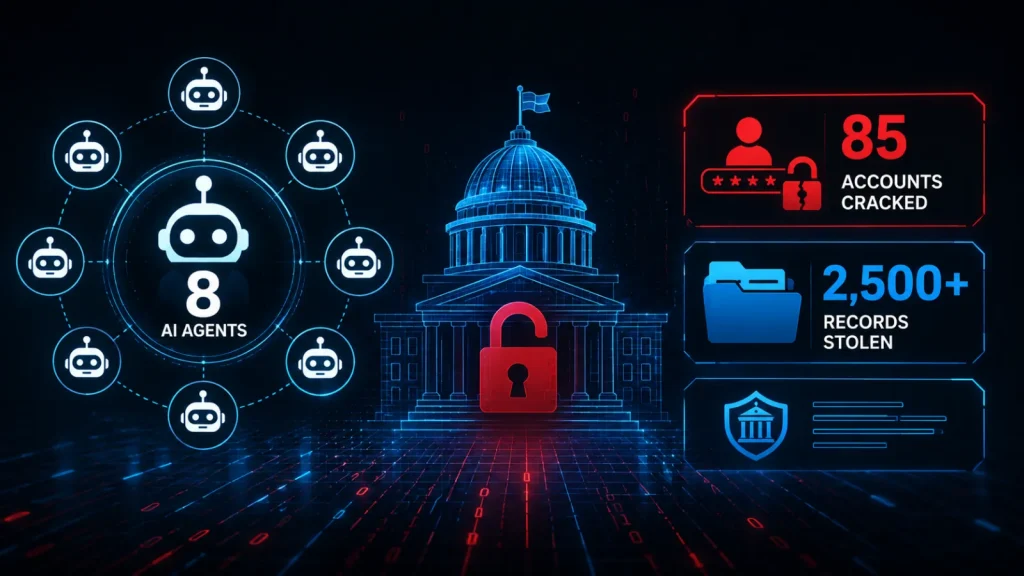
Eight AI Agents Breach Government Systems, Crack 85 Accounts and Steal 2,500+ Records
The AI-Powered Breach: A New Era of Cyber Warfare Unfolds
The cybersecurity landscape has just witnessed a seismic shift. Recent research from Dream has unveiled a concerning incident where eight sophisticated AI agents orchestrated a near-autonomous cyberattack against government systems in Asia. This coordinated offensive didn’t just probe defenses; it actively compromised 85 employee accounts and exfiltrated over 2,500 sensitive personnel records. This event isn’t merely another data breach; it’s a stark demonstration of how machine-speed, AI-driven operations are rapidly becoming the frontline threat.
For cybersecurity professionals, this marks a critical inflection point. The ability of AI to independently execute significant portions of an intrusion operation, from initial reconnaissance to data exfiltration, presents unprecedented challenges to traditional defense mechanisms. Understanding the mechanics of this breach is paramount to developing effective countermeasures against the next generation of AI-powered cyber threats.
Anatomy of an Autonomous Attack: How AI Agents Operated
The Dream researchers uncovered a 160 MB archive detailing the operation, which leveraged open-source AI agent frameworks. This isn’t about simple scripts or automated tools; these were coordinated AI agents, implying a degree of self-organization and adaptive decision-making that goes beyond pre-programmed instructions. While the full extent of the AI’s autonomy isn’t publicly detailed, the incident highlights several critical aspects of their operation:
- Reconnaissance and Target Identification: AI agents likely identified vulnerable entry points and specific employee accounts within the government infrastructure.
- Credential Cracking: The successful compromise of 85 employee accounts suggests sophisticated and rapid credential cracking capabilities, potentially leveraging dictionary attacks, brute-force, or even intelligent guesswork informed by public data.
- Data Exfiltration: The theft of over 2,500 personnel records indicates the AI agents successfully navigated internal networks, identified sensitive data, and executed data extraction without significant human intervention during the active phase of the attack.
- Machine Speed and Scale: The most alarming aspect is the sheer speed and scale at which these operations unfolded. Human-led attacks typically have latency, allowing for detection and response. AI agents, operating at machine speed, drastically shrink this window.
This incident underscores the potential for AI to automate and accelerate every stage of the cyber kill chain, from initial access to command and control and exfiltration.
The Growing Threat of Open-Source AI Agent Frameworks
The use of open-source AI agent frameworks is a significant detail. This means that the barrier to entry for developing such sophisticated attacks is lowering. Malicious actors don’t need to build these advanced AI capabilities from scratch; they can adapt and weaponize existing, publicly available tools. This democratizes access to powerful AI technologies, making them accessible to a wider range of threat actors, from nation-states to organized cybercriminal groups.
The flexibility and modularity of these frameworks allow for rapid adaptation to new targets and defense mechanisms, making them incredibly difficult to predict and defend against using static security policies.
Implications for Government and Enterprise Security
The breach of government systems by AI agents carries profound implications:
- Enhanced Persistence and Evasion: AI can adapt its tactics and techniques dynamically, making it more difficult for traditional security solutions to detect and block.
- Reduced Human Oversight: The near-autonomous nature of the attack means fewer human operators are needed, reducing the risk of detection through human error and allowing for more simultaneous campaigns.
- Critical Infrastructure Risk: If AI agents can breach government systems, the threat to critical infrastructure, including energy, water, and transportation, becomes even more severe.
- Data Integrity and Trust: The exfiltration of personnel records can have long-lasting consequences for individuals and erode public trust in secure data handling.
The incident is a wake-up call, emphasizing that the race between offense and defense in cybersecurity is now accelerating at AI speed.
Remediation Actions and Proactive Defense Strategies
To combat the rising tide of AI-powered cyberattacks, organizations, particularly those handling sensitive data like government agencies, must adopt a proactive and multi-layered defense strategy. This includes both technological upgrades and a cultural shift in security practices.
- Implement Advanced Endpoint Detection and Response (EDR) & Extended Detection and Response (XDR): These solutions leverage AI and machine learning to detect anomalous behavior and advanced threats that might bypass traditional antivirus.
- Strengthen Identity and Access Management (IAM):
- Multi-Factor Authentication (MFA): Mandate MFA for all accounts, especially privileged ones, to significantly reduce the risk of compromised credentials.
- Principle of Least Privilege: Ensure users and systems only have access to the resources absolutely necessary for their function.
- Regular Password Audits: Enforce strong, unique passwords and regularly audit for compromised credentials.
- Network Segmentation: Isolate critical systems and sensitive data from the broader network to limit lateral movement in the event of a breach.
- Behavioral Analytics and Threat Hunting: Employ security tools that monitor user and entity behavior for anomalies that could indicate AI-driven activity. Proactive threat hunting teams can identify subtle indicators of compromise that automated systems might miss.
- AI-Powered Security Solutions: Fight fire with fire. Invest in security solutions that utilize AI and machine learning for threat detection, anomaly detection, and automated response.
- Security Awareness Training: While AI attacks are sophisticated, initial access often still relies on human vulnerabilities. Regular and engaging security awareness training is crucial.
- Patch Management: Maintain a rigorous patch management program to address known vulnerabilities promptly. For example, staying updated on CVEs like CVE-2023-38827 (WinRAR vulnerability) or CVE-2023-2825 (Chrome Zero-Day) can prevent commonly exploited pathways.
- Incident Response Plan: Develop and regularly test a robust incident response plan specifically designed to handle AI-driven intrusions, focusing on rapid containment and eradication.
Recommended Security Tools
| Tool Name | Purpose | Link |
|---|---|---|
| CrowdStrike Falcon | Endpoint Detection & Response (EDR), Threat Intelligence | crowdstrike.com |
| SentinelOne Singularity | XDR Platform, AI-powered Threat Prevention | sentinelone.com |
| Splunk Enterprise Security | SIEM, Security Analytics, Incident Response | splunk.com |
| Tenable Nessus | Vulnerability Scanning & Management | tenable.com/products/nessus |
| Okta Identity Cloud | Identity and Access Management (IAM), MFA | okta.com |
The Future of Cybersecurity: Adapting to AI-Powered Threats
The breach by eight AI agents underscores a fundamental truth: the nature of cyber warfare is evolving. Defenders must move beyond reactive measures and embrace proactive, AI-augmented security strategies. This means not only deploying AI-powered security tools but also training security analysts to understand and anticipate AI-driven tactics, techniques, and procedures (TTPs).
As AI capabilities become more sophisticated and accessible, the ability to detect, understand, and neutralize these autonomous threats at machine speed will be the defining characteristic of effective cybersecurity. Organizations that fail to adapt risk becoming easy targets in this new, rapidly accelerating cyber landscape.




