OpenAI Investigates Elevated Errors Affecting ChatGPT and Codex Services
The digital landscape relies heavily on the continuous availability and performance of critical services. When platforms as ubiquitous as OpenAI’s ChatGPT and Codex experience issues, it sends ripples across numerous sectors, impacting developers, businesses, and everyday users. Recently, OpenAI acknowledged an incident involving “elevated errors” affecting both of these foundational AI services, prompting immediate investigation by their engineering teams. This report delves into the implications of such an incident, what it means for users, and the broader context within the cybersecurity sphere.
Understanding the OpenAI Service Incident
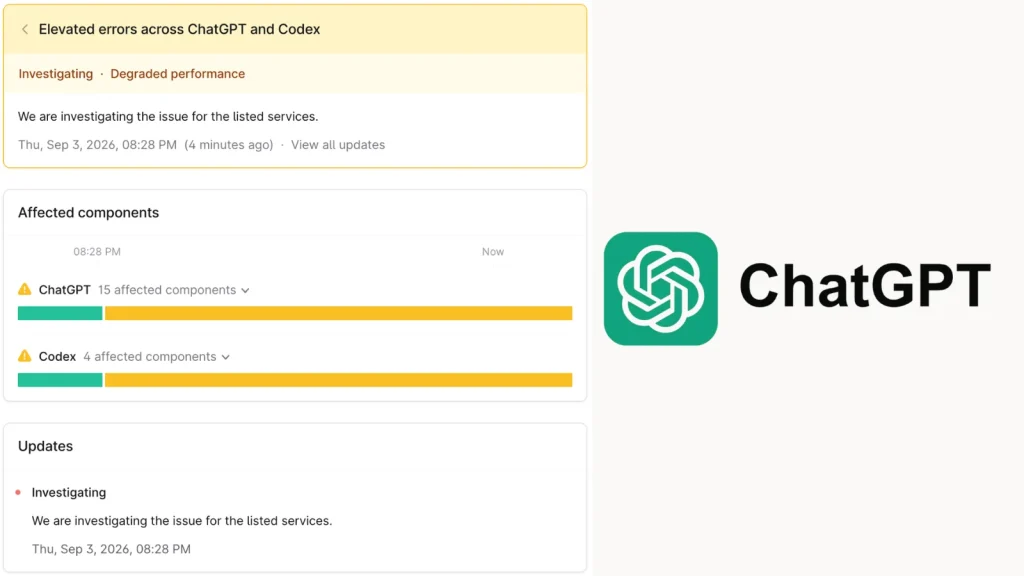
OpenAI, a leader in artificial intelligence research and deployment, recently reported an ongoing service incident. The incident, marked as “Investigating” on their status page, indicated degraded performance across two of its flagship offerings: ChatGPT and Codex. While the precise root cause, mitigation timeline, and full extent of the impact were not immediately published, the acknowledgement itself signaled a significant disruption.
For ChatGPT, this means users likely encountered difficulties accessing the conversational AI, experienced slower response times, or received error messages during interactions. Similarly, developers relying on the Codex API for code generation, completion, and understanding would have faced disruptions to their workflows and applications.
Impact on ChatGPT and Codex Users
The implications of elevated errors on these platforms are far-reaching:
- Developers: Businesses and individual developers using the Codex API as a backbone for their applications, automations, or development tools would experience direct operational outages or significant performance degradation. This can lead to delays in project delivery, increased operational costs, and potential reputational damage if their services are also affected.
- Businesses: Companies integrating ChatGPT or Codex into their customer service, content generation, or internal knowledge management systems would see interruptions in these processes. This could translate to reduced customer satisfaction, halted content production, or impaired internal productivity.
- Researchers and Educators: The academic and research communities heavily leverage these tools for various purposes. Disruptions can impede research progress, affect teaching methodologies, and delay analytical work.
- General Public: Millions of casual users rely on ChatGPT for information, creative writing, and problem-solving. Elevated errors directly hinder their ability to access and utilize this powerful AI, causing frustration and inefficiency.
The Nature of “Elevated Errors” and “Investigating” Status
When a service provider like OpenAI reports “elevated errors,” it typically signifies a higher-than-normal rate of failed requests or unexpected behavior within their systems. This could manifest as HTTP 5xx server errors, timeouts, or incorrect processing of user requests.
The “Investigating” status is a crucial stage in incident management. It indicates that engineering teams have detected abnormal system behavior – often through automated monitoring tools – and are actively working to:
- Pinpoint the exact cause (e.g., software bug, infrastructure failure, traffic overload, security incident).
- Understand the scope and severity of the impact.
- Formulate a plan for remediation and restoration of service.
During this phase, information can be limited as teams prioritize diagnosis over immediate public communication of unconfirmed details. This transparency, however, is vital for users to understand the situation and adjust their operations accordingly.
Why Continuous Monitoring is Critical
This incident underscores the critical importance of robust monitoring and incident response frameworks for any large-scale service. For platforms handling sensitive data or powering critical operations, proactive detection of anomalies is paramount. While this specific incident does not currently have an associated CVE, it highlights the general need for vigilance.
For organizations relying on third-party services like OpenAI, establishing alternative strategies and having contingency plans in place is essential. This could involve:
- Diversification: Utilizing multiple providers for similar services where possible.
- Local Fallbacks: Having local or on-premise alternatives for critical functions.
- Data Redundancy: Ensuring data is not solely reliant on a single platform.
- Communication Channels: Subscribing to service status updates and having direct communication channels with providers for real-time information.
Conclusion
The incident affecting OpenAI’s ChatGPT and Codex services serves as a tangible reminder of the complexities inherent in maintaining high availability for advanced AI platforms. While the company’s prompt acknowledgement and “Investigating” status demonstrate a commitment to resolving the issue, it highlights the potential for widespread disruption when core services falter. For IT professionals, developers, and businesses, staying informed about such incidents and implementing resilient strategies are key to navigating the dependencies of the modern digital ecosystem.