Microsoft Unveils Project Zenith Windows PCs That Can Run 30B+ AI Models Locally
The Dawn of Local AI: Microsoft’s Project Zenith Reshapes Development
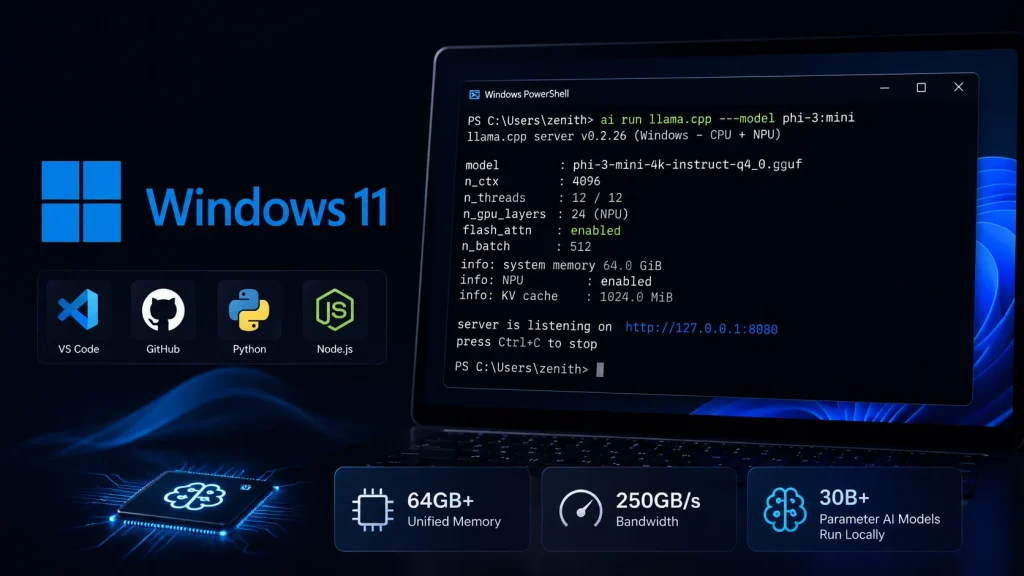
The landscape of artificial intelligence development is experiencing a pivotal shift. For years, the immense computational demands of large AI models have tethered developers to cloud infrastructure. Now, Microsoft is spearheading a revolution with Project Zenith, an initiative poised to liberate AI development from constant cloud reliance. This bold move introduces a new class of Windows PCs specifically engineered to run advanced AI models, including those exceeding 30 billion parameters, directly on-device. This isn’t just about faster processing; it represents a fundamental change in how AI applications will be built, tested, and deployed, offering unprecedented levels of privacy, security, and efficiency for developers.
Understanding Project Zenith: High-Memory PCs for AI Power
Project Zenith isn’t merely a software update; it’s a holistic approach integrating specialized hardware with an optimized Windows 11 experience. Announced as a crucial follow-up to commitments made at Build 2026, this initiative directly addresses the growing need for robust, local AI development environments. The core concept revolves around developer-class hardware equipped with substantial memory – a critical component for handling the massive datasets and complex computations inherent in large language models (LLMs) and other advanced AI architectures.
The ability to execute 30B+ AI models locally signifies a monumental leap. Previously, such operations were almost exclusively the domain of high-performance cloud GPUs. By bringing this capability to the desktop, Microsoft aims to democratize access to cutting-edge AI development, fostering innovation and reducing the operational costs associated with continuous cloud usage. This also has profound implications for data privacy, as sensitive models and data can remain within the confines of a local machine rather than traversing external networks.
The Shift from Cloud-Dependent AI Workflows
For too long, AI development has been synonymous with cloud computing. While cloud platforms offer scalability and access to powerful resources, they also introduce inherent challenges: latency issues, persistent data transfer costs, and concerns about data sovereignty and security. Project Zenith directly confronts these limitations by empowering developers with on-device AI model execution.
This shift enables:
- Enhanced Privacy and Security: Sensitive data and proprietary AI models can remain on local hardware, significantly reducing exposure to external threats and compliance burdens.
- Reduced Latency: Real-time AI inference and model iteration become dramatically faster when computations occur directly on the local machine, eliminating network roundtrips.
- Cost Efficiency: Minimizing reliance on expensive cloud GPU instances can lead to substantial cost savings, particularly during intensive development and testing phases.
- Offline Capabilities: Developers can continue to build and refine AI applications even without a constant internet connection, crucial for remote work or environments with limited connectivity.
This paradigm shift allows for rapid prototyping, more frequent iteration, and a more streamlined development lifecycle for sophisticated AI applications.
Implications for Developers and the Cybersecurity Landscape
For developers, Project Zenith opens up a new realm of possibilities. Imagine training smaller, specialized models or fine-tuning larger ones directly on a local workstation, significantly accelerating development cycles. This also fosters experimentation, as the barrier to entry for running complex AI models is lowered.
From a cybersecurity perspective, the implications are equally significant:
- Reduced Attack Surface: Keeping AI models and their training data local inherently reduces the network attack surface that cloud-based solutions present. This can mitigate risks associated with data breaches during transit or storage in third-party cloud environments.
- Improved Compliance: For industries with strict data residency and privacy regulations (e.g., healthcare, finance), local AI execution offers a more straightforward path to compliance.
- Edge AI Development: Project Zenith paves the way for more robust edge AI applications, where AI models operate directly on devices closer to the data source, enabling faster decision-making and reduced reliance on centralized cloud infrastructure.
While the focus is on local execution, it’s crucial for developers to maintain strong local security practices. This includes robust endpoint protection, secure coding practices for AI applications, and vigilant patching of the underlying Windows 11 operating system. Developers must remain aware of potential vulnerabilities that could affect local AI environments, such as those related to model integrity or data poisoning attacks.
The Future of AI Development: A Hybrid Approach
Project Zenith does not signal the demise of cloud AI; rather, it heralds a more balanced, hybrid approach. Large-scale training of foundational models will likely continue to leverage the immense power of cloud infrastructure. However, the subsequent stages of fine-tuning, application development, and deployment will increasingly benefit from the localized capabilities offered by Project Zenith PCs.
This initiative underscores Microsoft’s commitment to empowering developers with the tools necessary to build the next generation of AI-powered applications. By bridging the gap between cloud and edge, Project Zenith is set to redefine efficiency, security, and innovation in the AI development ecosystem.
Conclusion: A New Era for AI on Windows
Microsoft’s Project Zenith represents a significant leap forward in making advanced AI development more accessible, secure, and efficient. By enabling high-memory Windows PCs to run 30B+ AI models locally, Microsoft is empowering developers to break free from cloud dependency for many critical tasks. This initiative promises to accelerate innovation, enhance data privacy, and foster a new generation of powerful, on-device AI applications. The future of AI development is becoming increasingly decentralized, and Project Zenith is at the forefront of this transformative shift.