
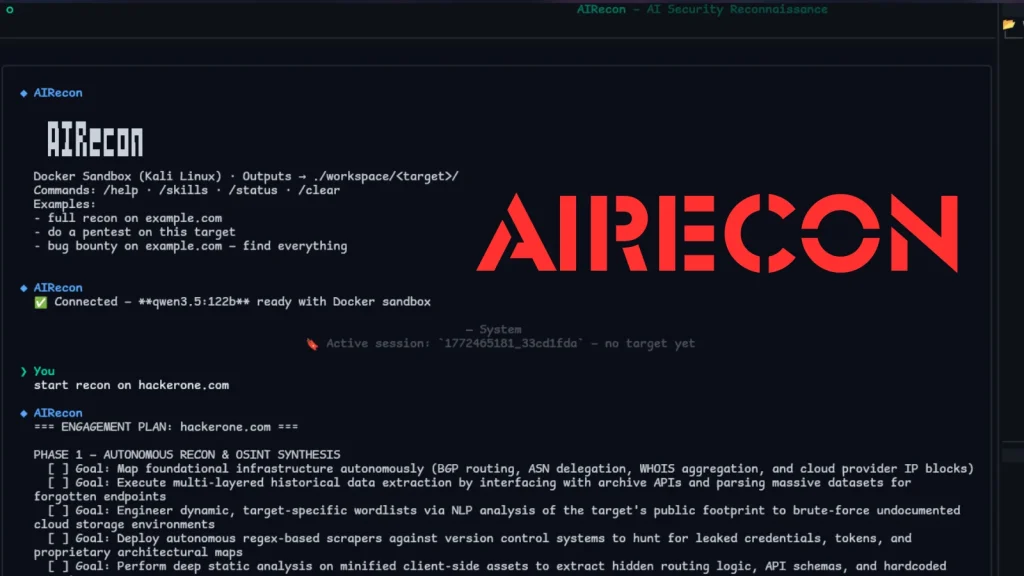
AIRecon: AI-Powered Penetration Testing Tool with Kali Linux Sandbox
The cybersecurity landscape is constantly evolving, demanding innovative approaches to defense. Traditional penetration testing, while crucial, often faces limitations in scalability, cost, and data privacy. Enter AIRecon, an autonomous AI-powered penetration testing tool designed to revolutionize security assessments. This groundbreaking solution addresses many of these challenges, offering a robust, offline, and cost-effective method for identifying vulnerabilities.
What is AIRecon?
AIRecon stands as a testament to the power of artificial intelligence in cybersecurity. Developed by researcher pikpikcu, this tool primarily functions as an autonomous penetration testing agent. Its core innovation lies in its ability to conduct end-to-end security assessments without relying on external cloud services or expensive API-based models. This independence is a significant differentiator, enhancing both data privacy and operational efficiency.
The Offline Advantage: Data Privacy and Cost-Effectiveness
One of AIRecon’s most compelling features is its completely offline operational model. Unlike many AI-driven tools that integrate with cloud-hosted large language models (LLMs) like GPT-4 or Claude, AIRecon utilizes a self-hosted Ollama LLM. This architectural choice is critical for several reasons:
- Enhanced Data Privacy: By keeping all assessment data on-premises, organizations eliminate concerns about sensitive information being transmitted to or stored by third-party cloud providers. This is particularly vital for industries with strict regulatory compliance requirements.
- Reduced Costs: The prohibitive costs associated with commercial API calls for recursive reconnaissance workflows are circumvented. AIRecon offers a solution that minimizes operational expenses, making advanced penetration testing more accessible.
- Independence: Operating offline ensures that security assessments can proceed without internet connectivity, offering resilience and flexibility in various testing environments.
Kali Linux Docker Sandbox: A Secure Testing Environment
AIRecon integrates a Kali Linux Docker sandbox, providing a contained and robust environment for its operations. This integration is strategic for several reasons:
- Isolation: The Docker sandbox isolates the penetration testing activities from the host system, preventing potential contamination or unintended side effects.
- Reproducibility: Docker containers ensure a consistent environment, making test results more reproducible and reliable across different deployments.
- Access to Tools: Kali Linux is renowned for its comprehensive suite of security tools. By leveraging it within a Docker container, AIRecon gains access to a vast array of utilities for reconnaissance, vulnerability scanning, exploitation, and more, all within a controlled setting.
How AIRecon Automates Security Assessments
AIRecon’s autonomous nature allows it to orchestrate and execute complex penetration testing workflows. While specific details of its internal processes were not fully elaborated in the provided reference, the general principle involves:
- Reconnaissance: Automatically gathering information about target systems and networks.
- Vulnerability Identification: Using its integrated tools and LLM to identify potential weaknesses.
- Exploitation (Controlled): Potentially simulating attacks to confirm vulnerabilities in a secure, sandboxed environment.
- Reporting: Generating insights and potential remediation suggestions for discovered issues.
This end-to-end automation significantly reduces the manual effort traditionally required for penetration testing, allowing security teams to focus on more strategic tasks.
Implications for Cybersecurity Professionals
AIRecon represents a significant step forward for cybersecurity professionals. It offers:
- Efficiency: Automating repetitive tasks frees up valuable analyst time.
- Scalability: The ability to conduct numerous assessments in parallel or on demand.
- Consistency: Standardized testing procedures ensure consistency in results.
- Cost Savings: Eliminating reliance on expensive commercial APIs.
Tools like AIRecon are not intended to replace human expertise but rather to augment it, empowering security teams with advanced capabilities to identify and mitigate risks more effectively.
Remediation Actions
While AIRecon itself is a tool for identification, the vulnerabilities it uncovers will require specific remediation. It’s crucial for organizations to:
- Prioritize Findings: Address critical vulnerabilities first, especially those with publicly known exploits (e.g., CVE-2023-XXXXX – *Note: This is a placeholder; specific CVEs would be listed based on AIRecon’s findings*).
- Implement Patches and Updates: Regularly apply security patches and update software to their latest versions.
- Strengthen Configuration: Review and harden system and application configurations, adhering to security best practices.
- Network Segmentation: Implement robust network segmentation to limit the lateral movement of potential attackers.
- Regular Audits: Continually audit systems and networks, leveraging tools like AIRecon for ongoing assessment.
Conclusion
AIRecon emerges as a compelling solution for the modern cybersecurity landscape. By combining an offline, self-hosted LLM with a Kali Linux Docker sandbox, it provides an autonomous, cost-effective, and privacy-conscious approach to penetration testing. This tool empowers organizations to enhance their security posture significantly, moving towards a more proactive and automated defense strategy.




