
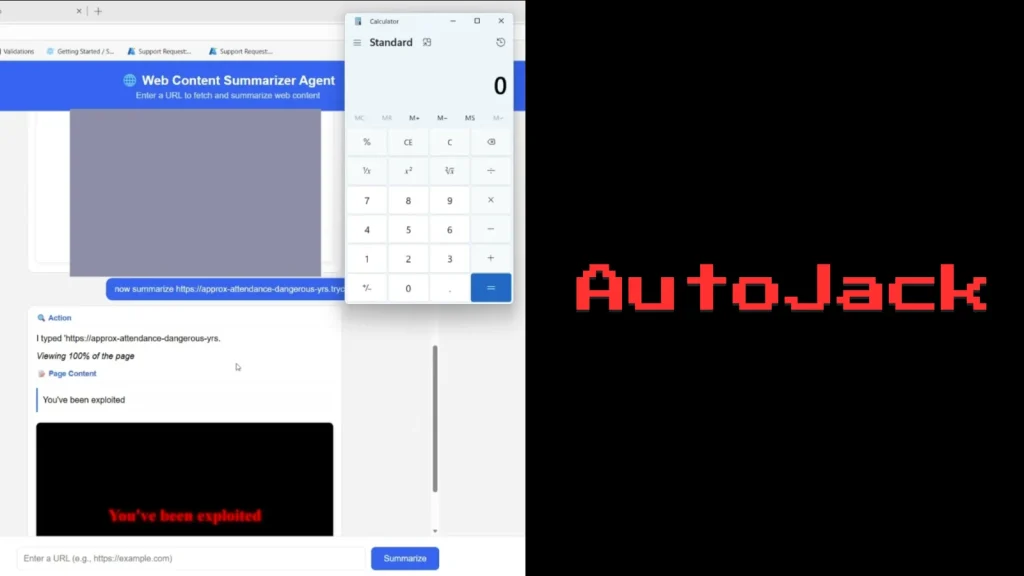
AutoJack – A Single Web Page Can Hijack Your AI Agent to Execute Malicious Code
Imagine a scenario where a single malicious web page, casually browsed by an AI agent, could grant an attacker complete control over your host machine. This isn’t a dystopian sci-fi plot; it’s the stark reality revealed by AutoJack, a critical exploit chain targeting Microsoft’s AutoGen Studio.
The discovery of AutoJack underscores a growing concern in the realm of AI security: the vulnerability of AI agents to nuanced attacks that leverage their intended functionalities. This exploit chain demonstrates a novel method for hijacking AI browsing agents and achieving arbitrary code execution, all without requiring any direct user interaction beyond the initial submission of a URL. For IT professionals, security analysts, and developers working with multi-agent AI systems, understanding AutoJack is paramount to securing their environments.
What is AutoGen Studio?
Microsoft Research’s AutoGen Studio serves as an open-source prototyping UI for multi-agent AI systems. It provides a user-friendly interface for developing, testing, and deploying AI agent interactions. Its design facilitates rapid iteration and experimentation, making it a valuable tool for researchers and developers pushing the boundaries of AI capabilities. However, like any complex software, AutoGen Studio can possess vulnerabilities that, if exploited, pose significant risks.
Unpacking the AutoJack Exploit Chain
AutoJack is not a single vulnerability but a sophisticated three-vulnerability exploit chain that targets specific weaknesses within AutoGen Studio’s browsing agent. This chain allows an attacker to transition from a seemingly innocuous web page interaction to full control of the underlying system.
The Three-Phase Attack
The AutoJack exploit chain leverages a combination of vulnerabilities to achieve its objectives:
- Initial Compromise through Malicious URL: The attack begins when the AutoGen Studio browsing agent is directed to a specially crafted malicious web page. This page exploits a vulnerability that allows for initial code injection or manipulation within the browsing agent’s context.
- Privilege Escalation within the Agent: Building upon the initial compromise, the attacker then exploits a second vulnerability to escalate privileges within the AI agent itself. This step is crucial for gaining the necessary permissions to interact with the host operating system.
- Arbitrary Code Execution on the Host: The final stage involves exploiting a third vulnerability, leveraging the escalated privileges to execute arbitrary code directly on the host machine running AutoGen Studio. This could lead to data exfiltration, system compromise, or further network penetration.
While specific CVEs for the individual components of the AutoJack chain were not explicitly detailed in the initial public disclosure, the overarching concern regarding similar vulnerabilities in browsing agents is reflected in general categories like CVE-2023-34062 (Arbitrary Code Execution in various browsers via crafted web content) or CVE-2023-28251 (privilege escalation issues). Specific CVEs for AutoGen Studio vulnerabilities would be critical for tracking and patching efforts.
Impact and Implications of AutoJack
The successful exploitation of AutoJack carries severe consequences:
- Complete System Compromise: An attacker can gain full control over the host machine running AutoGen Studio, leading to data theft, installation of malware, or complete system disruption.
- Lateral Movement: With host machine access, an attacker can pivot to other systems within the network, escalating the breach from a single workstation to the entire infrastructure.
- Sensitive Data Exposure: AI agents often handle sensitive data during their operations. AutoJack could expose this data to unauthorized access.
- Reputational Damage: For organizations utilizing AutoGen Studio, a successful AutoJack exploitation could lead to significant reputational damage and loss of trust.
Remediation Actions for AutoGen Studio Users
While detailed patch information for AutoJack specifically would likely come directly from Microsoft Research, users of AutoGen Studio should adopt a proactive security posture. Here are immediate and long-term remediation actions:
- Immediate Patching: Regularly monitor official Microsoft Research and AutoGen Studio channels for security advisories and promptly apply all available patches and updates. This is the most critical step to address known vulnerabilities.
- Isolate AI Agent Environments: Run AutoGen Studio and its browsing agents in isolated virtualized environments or containers. This can significantly limit the blast radius of a successful exploit.
- Principle of Least Privilege: Configure AutoGen Studio and its agents with the absolute minimum necessary privileges on the host system. Avoid running them with administrative rights.
- Network Segmentation: Implement strong network segmentation to restrict communication between AI agent environments and critical production systems.
- Input Validation and Sanitization: While AutoGen Studio development is ongoing, developers using its framework should meticulously validate and sanitize all external inputs, especially URLs and dynamic content, to prevent injection attacks.
- Security Audits and Penetration Testing: Conduct regular security audits and penetration tests on AutoGen Studio deployments and any custom agents built upon it to identify and address potential weaknesses before they can be exploited.
- Educate Users: Ensure that users interacting with AutoGen Studio understand the risks associated with untrusted URLs and content, even when processed by an AI agent.
Tools for Detection and Mitigation
While specific tools for “AutoJack detection” may not yet exist as a dedicated category, general cybersecurity tools play a crucial role in safeguarding environments where AutoGen Studio might operate:
| Tool Name | Purpose | Link |
|---|---|---|
| Endpoint Detection and Response (EDR) Solutions | Detects and responds to anomalous behavior and malicious code execution on host machines. | (Varies by vendor, e.g., CrowdStrike, SentinelOne) |
| Vulnerability Scanners | Identifies known vulnerabilities in operating systems, applications, and network devices. | Nessus |
| Network Intrusion Detection/Prevention Systems (NIDS/NIPS) | Monitors network traffic for suspicious patterns and blocks known attack signatures. | Snort |
| Container Security Platforms | Secures containerized environments used for isolating AI agents from the host OS. | Palo Alto Networks Prisma Cloud |
| Web Application Firewalls (WAFs) | Protects web applications (like AutoGen Studio’s UI) from various web-based attacks. | Cloudflare WAF |
Key Takeaways
The AutoJack exploit chain serves as a stark reminder that even innovative AI development tools are not immune to sophisticated attacks. The ability of a single malicious web page to hijack an AI agent and execute arbitrary code highlights the critical need for robust security practices within AI system development and deployment. Proactive patching, stringent access controls, environment isolation, and continuous security monitoring are essential for mitigating such advanced threats and securing the evolving landscape of AI agents.




