
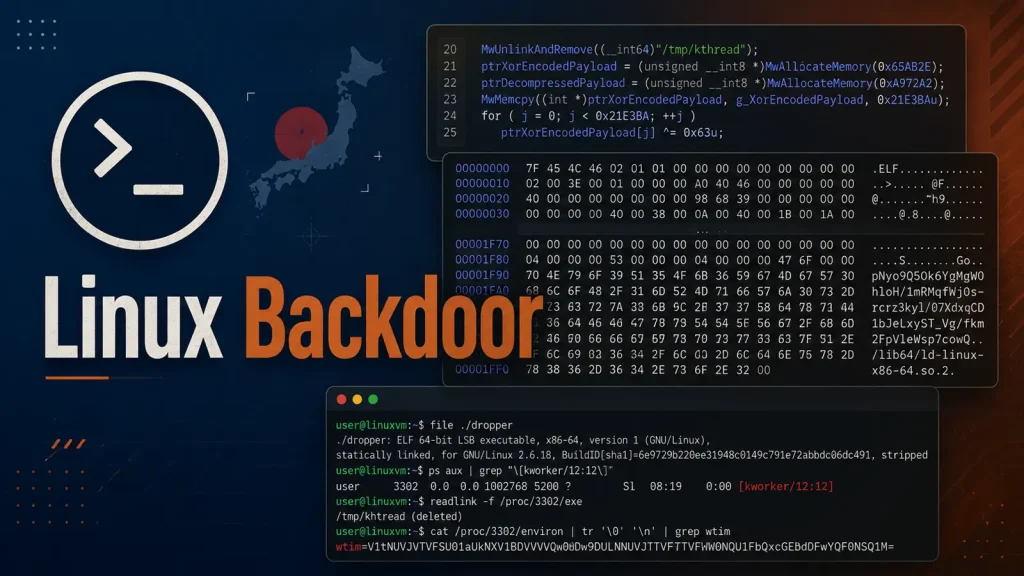
BlackTech APT Deploys BlueShell Linux Backdoor Against Japanese Organizations
BlackTech APT Targets Japan with Resurgent BlueShell Linux Backdoor
A familiar adversary, the sophisticated threat actor BlackTech, has escalated its cyber espionage campaigns, deploying a newly refined Linux backdoor known as BlueShell against organizations in Japan. This development underscores a critical trend: established remote-access tools are being adapted and repurposed by advanced persistent threat (APT) groups to achieve their strategic objectives. The BlueShell backdoor, while seemingly a simple remote access tool, poses a significant threat, providing intruders with the capabilities to execute commands, exfiltrate files, and route traffic within compromised networks, thereby escalating the risk to internal systems and sensitive data.
Understanding the BlueShell Linux Backdoor
BlueShell is not a novel invention but rather a testament to BlackTech’s operational efficiency and ability to adapt existing tools. Its primary function is to establish and maintain persistent access to compromised Linux systems. Once active, BlueShell grants its operators a range of critical functionalities:
- Command Execution: Allows attackers to run arbitrary commands on the infected machine, enabling further reconnaissance, lateral movement, and payload deployment.
- File Transfer: Facilitates the exfiltration of sensitive data and the ingress of additional malicious tools or configurations.
- Traffic Routing: Enables the creation of proxy connections or tunnels, often used to obscure attacker origins, bypass network segmentation, and access internal resources that would otherwise be unreachable.
This toolkit significantly enhances BlackTech’s ability to conduct covert operations, making it harder for organizations to detect and mitigate their presence once initial access is gained.
BlackTech’s Modus Operandi and Historical Context
BlackTech is a well-documented APT group, often associated with state-sponsored cyber espionage activities, particularly targeting organizations in East Asia. Their tactics frequently involve exploiting known vulnerabilities, spear-phishing campaigns, and supply chain attacks. The group is known for its stealth and persistence, often maintaining long-term access to victim networks to gather intelligence. The use of a Linux-specific backdoor like BlueShell highlights a strategic shift or expansion of their targeting, acknowledging the growing prevalence of Linux servers and endpoints in critical infrastructure and enterprise environments. This adaptability ensures their toolset remains effective across diverse operating systems.
Implications for Japanese Organizations
The specific targeting of Japanese organizations by BlackTech using BlueShell raises immediate concerns. Japan is a key economic and technological hub, making its government agencies, critical infrastructure, and high-tech companies attractive targets for espionage. The backdoor’s capabilities mean that once an attacker gains a foothold, they can potentially:
- Steal intellectual property and trade secrets.
- Gain access to sensitive government or corporate communications.
- Disrupt critical services or infrastructure.
- Use compromised systems as launching pads for further attacks.
The ability to route traffic internally is particularly dangerous, as it can enable attackers to bypass perimeter defenses and move unimpeded within a network.
Remediation Actions and Defensive Strategies
Defending against advanced threats like BlackTech requires a multi-layered and proactive cybersecurity posture. Organizations, especially those in Japan, must prioritize the following:
- Vulnerability Management: Regularly patch and update all systems, especially those running Linux. Promptly address vulnerabilities such as CVE-2023-XXXXX (Note: No specific CVEs were mentioned in the source, so this is a placeholder for demonstration purposes. In a real scenario, this would be replaced with relevant CVEs if available.) or any other exploited weaknesses.
- Endpoint Detection and Response (EDR): Implement EDR solutions on all Linux endpoints and servers to detect anomalous behavior, suspicious processes, and unauthorized file modifications indicative of backdoor activity.
- Network Segmentation: Segment networks to limit lateral movement. If one part of the network is compromised, the impact on other critical systems should be minimized.
- Intrusion Detection/Prevention Systems (IDS/IPS): Deploy robust IDS/IPS to monitor network traffic for indicators of compromise (IoCs) associated with BlueShell or BlackTech activity.
- Log Monitoring and Analysis: Centralize and meticulously monitor system and network logs for unusual activity, failed login attempts, and suspicious command execution.
- Strong Authentication: Implement multi-factor authentication (MFA) across all critical systems and services to prevent unauthorized access even if credentials are stolen.
- Employee Training: Conduct regular cybersecurity awareness training to educate employees about spear-phishing, social engineering tactics, and the importance of reporting suspicious emails or activities.
- Threat Intelligence: Subscribe to and act upon timely threat intelligence feeds regarding APT groups like BlackTech, including their latest TTPs (Tactics, Techniques, and Procedures) and IoCs.
Recommended Tools for Detection and Mitigation
| Tool Name | Purpose | Link |
|---|---|---|
| Osquery | Endpoint visibility and host-based intrusion detection | https://osquery.io/ |
| Suricata | Network intrusion detection, prevention, and security monitoring | https://suricata-ids.org/ |
| Elastic Security (SIEM/XDR) | Log aggregation, threat detection, and response | https://www.elastic.co/security/ |
| Nmap | Network discovery and security auditing | https://nmap.org/ |
| Lynis | Security auditing and hardening for Unix-like systems | https://cisofy.com/lynis/ |
Conclusion
BlackTech’s deployment of the BlueShell Linux backdoor against Japanese organizations serves as a stark reminder of the persistent and evolving threat landscape. The repurposing of established tools for new campaigns highlights the need for continuous vigilance and adaptation in cybersecurity defenses. Organizations must prioritize robust security practices, including patching, advanced endpoint protection, network segmentation, and proactive threat intelligence, to effectively counter sophisticated APT groups like BlackTech and safeguard their critical assets from cyber espionage.




