
BugHunter – Bug Bounty Toolkit Powered by Claude and Free AI Providers
Unleashing AI Power in Bug Bounty Hunting: Introducing BugHunter
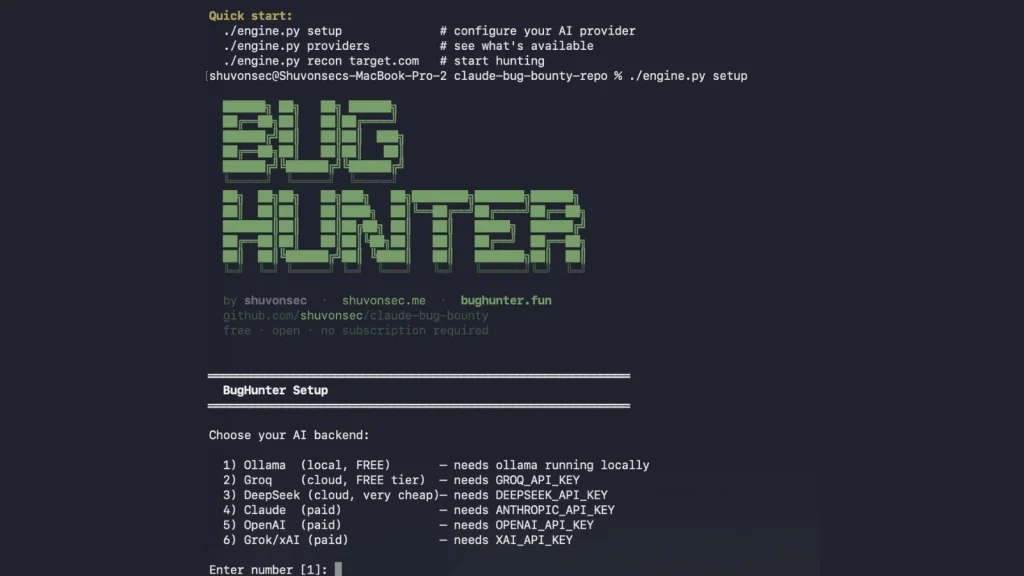
The landscape of cybersecurity is relentlessly dynamic, with new threats emerging daily. For security researchers and bug bounty hunters, efficiency and automation are paramount to staying ahead. Enter BugHunter, an innovative open-source toolkit poised to revolutionize vulnerability discovery and reporting. Initially developed leveraging Anthropic’s Claude Code, BugHunter has now expanded its capabilities to integrate with free AI providers like Ollama and Groq, making advanced bug bounty automation more accessible than ever.
This powerful tool, created by security researcher Shuvon Md Shariar Shanaz, is rapidly gaining traction within the security community. It automates critical aspects of the bug bounty workflow, from initial vulnerability identification to the final stages of report generation, promising to enhance the speed and efficacy of ethical hacking efforts.
What is BugHunter? Automating the Vulnerability Lifecycle
BugHunter is designed as a comprehensive toolkit for bug bounty hunters. Its core strength lies in its ability to harness the power of large language models (LLMs) to perform tasks traditionally requiring significant manual effort. By integrating with advanced AI, BugHunter aims to streamline and accelerate the entire vulnerability discovery and reporting pipeline.
Key functionalities that BugHunter automates include:
- Vulnerability Identification: Leveraging AI to analyze code, configurations, and application behavior for potential weaknesses.
- Exploit Generation Assistance: Aiding in the creation of proof-of-concept exploits based on identified vulnerabilities.
- Report Generation: Auto-generating detailed and structured vulnerability reports, a crucial but often time-consuming part of bug bounty hunting.
The Evolution of BugHunter: From Claude to Open AI Providers
BugHunter’s journey began with its integration of Anthropic’s Claude Code, a sophisticated AI model known for its code analysis capabilities. This initial integration provided a robust foundation for automating complex security tasks. Recognizing the demand for broader accessibility and diverse AI options, the toolkit has since been extended to support free and open-source AI providers such as Ollama and Groq.
This expansion is a significant development for the bug bounty community. It democratizes access to powerful AI-driven tools, allowing researchers to utilize BugHunter without relying solely on commercial AI services. The support for Ollama, for instance, enables local execution of various open-source LLMs, providing greater control and flexibility. Groq, with its focus on high-speed inference, offers another compelling option for rapid analysis.
Enhancing Bug Bounty Programs with AI-Driven Efficiency
The integration of AI, particularly through tools like BugHunter, represents a paradigm shift in how bug bounty programs can operate. For organizations, this means faster identification of vulnerabilities, potentially reducing their attack surface before exploits can be weaponized. For bounty hunters, it means increased efficiency, allowing them to focus on more complex logical flaws rather than repetitive scanning and reporting tasks.
Consider the detection of a common vulnerability like a Cross-Site Scripting (XSS) flaw, often categorized under CVE-2023-38545 (a general XSS identifier, specific CVEs vary). While manual detection is possible, an AI-powered tool can scan vast amounts of code and user input fields more rapidly and consistently, proposing potential injection points and even aiding in crafting a proof-of-concept payload. Similarly, for SQL Injection vulnerabilities (CVE-2024-XXXXX – replace XXXXX with a relevant, recent example after checking CVEs), AI can analyze database queries and identify vulnerable parameters with high precision.
Remediation Actions for Identified Vulnerabilities
While BugHunter excels at identification and reporting, proactive remediation remains an organization’s responsibility. When vulnerabilities are pinpointed by AI-driven tools, immediate and structured remediation is crucial.
- Input Validation and Sanitization: For web vulnerabilities like XSS and SQL Injection, rigorously validate and sanitize all user input at the server-side to prevent malicious data from being processed or rendered.
- Parameterized Queries/Prepared Statements: Implement parameterized queries for all database interactions to prevent SQL injection by separating code from data.
- Least Privilege Principle: Ensure that all system components, users, and applications operate with the minimum necessary permissions.
- Security Headers: Implement appropriate HTTP security headers (e.g., Content Security Policy, X-XSS-Protection, X-Frame-Options) to mitigate common attack vectors.
- Regular Security Audits and Code Reviews: Complement automated tools with manual security assessments and peer code reviews to catch subtle logic flaws.
- Patch Management: Keep all software, frameworks, and operating systems updated to their latest versions to protect against known vulnerabilities.
The Future of Bug Bounty with AI Integration
BugHunter represents a significant step towards a more intelligent and automated approach to bug bounty hunting. As AI models become more sophisticated and open-source contributions continue to flourish, we can expect to see even more advanced capabilities emerge. This not only empowers individual security researchers but also elevates the overall security posture of applications and systems globally by identifying and addressing weaknesses more effectively.
The toolkit’s open-source nature fosters community collaboration, ensuring its continuous improvement and adaptation to new threats and technologies. This collaborative spirit, combined with the power of artificial intelligence, is truly shaping the next generation of cybersecurity defense.




