
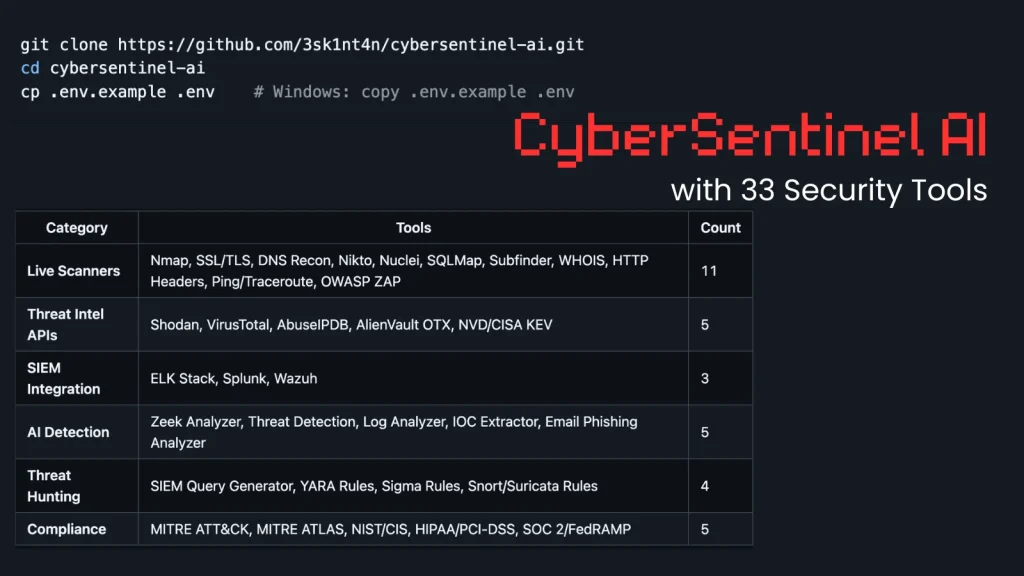
CyberSentinel AI with 33 Security Tools, Including Nmap, SQLMap, ZAP, and uses Claude, GPT
Unleashing Autonomous Security: A Deep Dive into CyberSentinel AI v3.0
The landscape of cybersecurity is continuously evolving, demanding increasingly sophisticated and automated solutions. Traditional security tools, while powerful, often require significant manual intervention and expertise. This bottleneck is precisely what a new open-source platform aims to address. Enter CyberSentinel AI v3.0, a significant development in autonomous security tooling that promises to revolutionize how security professionals approach penetration testing and threat intelligence.
Unlike conventional AI security assistants that merely suggest commands, CyberSentinel AI v3.0 integrates a provider-agnostic AI engine with 33 real-world penetration testing and threat intelligence tools. This powerful combination allows for more proactive and less labor-intensive security operations. The platform’s modular design and broad AI compatibility make it a compelling choice for businesses and security teams striving for enhanced defensive capabilities.
What is CyberSentinel AI v3.0?
CyberSentinel AI v3.0 is an open-source cybersecurity platform designed to automate and augment security tasks. It acts as an intelligent orchestrator, leveraging a diverse set of established security tools to perform reconnaissance, vulnerability scanning, exploitation, and threat intelligence gathering. The core innovation lies in its ability to harness advanced AI models to drive these operations, moving beyond simple command generation to intelligent execution.
The platform’s open-source nature fosters community collaboration and allows for continuous improvement, ensuring it remains at the forefront of cybersecurity innovation. This collaborative model is critical in adapting to new threats and expanding its capabilities.
The Power of Integrated Tools: Nmap, SQLMap, ZAP, and More
One of CyberSentinel AI’s standout features is its integration with a comprehensive suite of 33 industry-standard security tools. These aren’t new, unproven utilities, but rather the tried-and-true workhorses of penetration testing and vulnerability assessment. This integration means security professionals can leverage the full power of these tools, guided by AI, without needing to manually switch contexts or interpret disparate outputs.
- Nmap (Network Mapper): Essential for network discovery and security auditing. CyberSentinel AI can orchestrate Nmap scans to identify open ports, services, operating systems, and potential vulnerabilities across networks.
- SQLMap: An automated SQL injection and database takeover tool. The AI engine can intelligently identify potential SQL injection points and use SQLMap to test and exploit them, significantly reducing manual analysis time for web application penetration testing.
- OWASP ZAP (Zed Attack Proxy): A widely used integrated penetration testing tool for finding vulnerabilities in web applications. CyberSentinel AI can direct ZAP to perform automated scans, spidering, and active scanning to uncover common web vulnerabilities like XSS, CSRF, and broken authentication.
- Other Integrated Tools: The platform’s expansive toolkit likely includes tools for various security domains, such as exploit frameworks (e.g., Metasploit, if integrated), vulnerability scanners, forensic tools, and OSINT (Open Source Intelligence) utilities. This breadth ensures attackers have a comprehensive arsenal at their disposal, guided by intelligent automation.
This integration simplifies complex workflows, allowing security analysts to focus on higher-level strategic analysis rather than granular tool execution and result correlation.
Provider-Agnostic AI: Flexibility and Control
CyberSentinel AI v3.0’s commitment to flexibility is evident in its provider-agnostic AI engine. This means users are not locked into a single AI model or provider. The platform supports a range of cutting-edge AI technologies:
- Claude: Known for its robust conversational capabilities and code generation, Claude can contribute to intelligent analysis and report generation.
- GPT-4o: OpenAI’s highly capable language model offers advanced reasoning, code interpretation, and data synthesis, invaluable for vulnerability assessment and threat analysis.
- OpenRouter: A platform that allows users to access and compare various large language models, providing even more flexibility and cost optimization.
- Fully Offline Local Inference via Ollama: This is a critical feature for organizations with strict data privacy requirements or operating in environments with limited internet connectivity. Ollama enables the execution of large language models locally, ensuring data never leaves the controlled environment. This capability significantly enhances the security and autonomy of the platform.
This multi-AI approach allows organizations to select the models best suited to their specific needs, budget, and compliance requirements, showcasing a forward-thinking design philosophy.
Driving Autonomous Security Operations
The true potential of CyberSentinel AI v3.0 lies in its ability to drive autonomous security operations. Instead of security analysts manually configuring and launching scans, then painstakingly correlating results, the AI engine can take the lead. It can:
- Intelligently plan attack paths: Based on initial reconnaissance, the AI can formulate a strategy using its integrated tools.
- Automate tool execution: Launching Nmap, then SQLMap, then ZAP in a logical sequence, adapting to outcomes.
- Analyze and prioritize findings: The AI can process vast amounts of data from different tools, identifying critical vulnerabilities and prioritizing them for remediation.
- Generate actionable reports: Distilling complex technical data into understandable reports, potentially even suggesting remediation steps.
This capability offers tremendous efficiency gains, allowing security teams to cover more ground and respond faster to emerging threats.
Remediation Actions: Leveraging AI for Better Security Posture
While CyberSentinel AI excels at identification, the ultimate goal is always remediation. The insights gleaned from the platform’s autonomous operations provide concrete data for improving an organization’s security posture. Here are key remediation actions:
- Patch Management: Proactively apply security patches to software and operating systems identified as vulnerable by CyberSentinel AI’s scans.
- Configuration Hardening: Implement security best practices by hardening configurations of servers, network devices, and applications, addressing weaknesses discovered through penetration tests.
- Input Validation and Output Encoding: Specifically for web applications, address vulnerabilities like SQL Injection and XSS by enforcing strict input validation and proper output encoding. Tools like ZAP, driven by CyberSentinel AI, will highlight these issues.
- Access Control Review: Regularly review and restrict user access privileges to the principle of least privilege, especially for systems targeted by the AI during simulation.
- Network Segmentation: Isolate critical systems and sensitive data using network segmentation to limit lateral movement, even if an initial compromise occurs.
- Security Awareness Training: Educate employees about common social engineering tactics and secure coding practices, which can prevent many of the human-factor vulnerabilities exploited by sophisticated attacks.
- Regular Penetration Testing: Use CyberSentinel AI as part of a continuous penetration testing strategy, identifying and addressing new vulnerabilities as the environment changes.
- Incident Response Plan Refinement: Use the findings from the AI-driven simulations to refine and test existing incident response plans, ensuring preparedness for actual breaches.
Conclusion: The Future of Autonomous Cybersecurity
CyberSentinel AI v3.0 represents a significant leap forward in autonomous cybersecurity. By seamlessly integrating the power of 33 established security tools with a flexible, provider-agnostic AI engine, it empowers security professionals to identify and address vulnerabilities with unprecedented efficiency. The ability to leverage models like Claude and GPT-4o, alongside secure offline inference via Ollama, offers a robust and adaptable solution for diverse organizational needs.
This platform holds the potential to transform security operations, enabling proactive threat hunting, continuous vulnerability management, and ultimately, a more resilient digital defense. As the cybersecurity threat landscape continues its relentless expansion, tools like CyberSentinel AI will become indispensable for staying ahead of malicious actors.




