
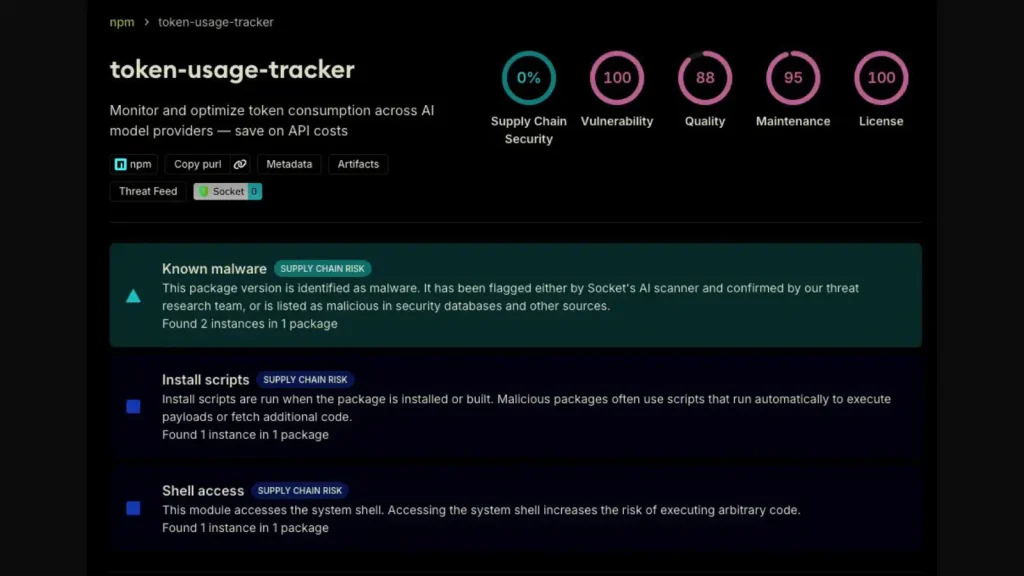
Hackers Compromised 34 Packages in npm, PyPI, and Crates in New Supply Chain Attack
A disturbing new campaign, dubbed “TrapDoor,” has cast a long shadow across the software supply chain, compromising 34 distinct packages and over 384 related versions across popular registries like npm, PyPI, and Crates.io. This active attack is meticulously engineered to steal developer credentials and cryptocurrency wallets, posing a significant risk to the integrity of countless projects and the financial security of developers.
The attackers behind TrapDoor are not casting a wide net; their focus is laser-sharp. They are explicitly targeting developers steeped in the crypto, DeFi, Solana, and AI communities. This precision is evident in their choice of malware disguise: seemingly innocuous developer tools and security scanners. This sophisticated approach underscores a growing trend of adversaries exploiting trusted development ecosystems to gain a foothold.
The Anatomy of the TrapDoor Campaign
The TrapDoor campaign represents a sophisticated evolution in supply chain attacks. Instead of brute-forcing or simply exploiting known vulnerabilities, these threat actors pre-position malicious code within packages that developers routinely integrate into their workflows. Once a poisoned package is installed, the malware springs to life, often remaining dormant until specific conditions are met, such as the detection of cryptocurrency wallet files or developer credentials.
The sheer volume of compromised packages and versions—34 distinct packages and over 384 related versions—highlights the extensive reach of this campaign. These packages, masquerading as legitimate utilities, are readily available on widely used public registries, making them easily discoverable and integrable by unsuspecting developers. The trust inherent in these package managers is being aggressively exploited, blurring the lines between beneficial open-source contributions and malicious payloads.
Targeted Communities and Modus Operandi
The explicit targeting of developers involved in cryptocurrency, Decentralized Finance (DeFi), Solana, and Artificial Intelligence is a critical aspect of the TrapDoor campaign. These sectors represent high-value targets due to the potential for significant financial gain through stolen digital assets or the compromise of valuable intellectual property. The attackers leverage social engineering alongside technical trickery, often relying on the assumed legitimacy of package names and descriptions to entice downloads.
The malware’s primary objective is data exfiltration. Upon execution, it scans for sensitive information, including API keys, private keys for cryptocurrency wallets, seed phrases, and other credentials that could grant access to high-value accounts. The disguising of malicious code as “generic developer tools” or “security scanners” is a clever tactic, playing directly into the needs and routines of the target audience. Developers, constantly seeking efficiencies and security solutions, are unfortunately ripe for such deception.
The Peril of Supply Chain Attacks
Supply chain attacks, like TrapDoor, are particularly insidious because they leverage the inherent trust within collaborative development environments. A single compromised component can ripple through an entire ecosystem, affecting countless applications and users downstream. Organizations that rely heavily on open-source components are especially vulnerable, as the vetting of every dependency and sub-dependency becomes an increasingly complex and resource-intensive task.
The earliest origins of this specific campaign are still under investigation, but the sophistication suggests a well-resourced and persistent threat actor or group. Their ability to maintain a presence across multiple package registries and to continuously update malicious versions demonstrates a sustained effort to evade detection and maximize impact.
Remediation Actions and Proactive Defense
Protecting against a campaign like TrapDoor requires a multi-layered approach, combining vigilant practices with robust security tools. Developers and organizations must shift from reactive responses to proactive preventative measures.
- Vet Dependencies Rigorously: Before integrating any new package, verify its authenticity, maintainer reputation, and community activity. Look for signs of suspicious behavior, such as very new packages with few downloads or sudden changes in maintainership.
- Implement Software Composition Analysis (SCA): Utilize SCA tools to automatically scan your codebase for known vulnerabilities and malicious dependencies. These tools can identify compromised packages within your project’s dependency tree.
- Use Strong Access Controls: Implement multi-factor authentication (MFA) for all developer accounts on package registries and source code repositories. Rotate API keys and credentials regularly.
- Isolate Development Environments: Consider using sandboxed or containerized development environments to limit the blast radius of a potential compromise.
- Monitor Network Traffic: Implement network monitoring to detect unusual outbound connections or data exfiltration from development machines.
- Stay Informed: Keep abreast of the latest cybersecurity threats and advisories, especially those related to supply chain attacks. Subscribe to security news feeds and follow reputable security researchers.
Recommended Tools for Supply Chain Security
| Tool Name | Purpose | Link |
|---|---|---|
| OWASP Dependency-Check | Identifies project dependencies and checks for known vulnerabilities. | https://owasp.org/www-project-dependency-check/ |
| Snyk | Developer security platform for finding and fixing vulnerabilities in code, dependencies, and containers. | https://snyk.io/ |
| Dependabot | Automatically updates dependencies and alerts about vulnerabilities within GitHub repositories. | https://github.com/dependabot |
| Trivy | A comprehensive open-source security scanner that finds vulnerabilities in containers, file systems, Git repositories, and more. | https://aquasecurity.github.io/trivy/ |
| Socket | Analyzes open-source packages for supply chain risks, malware, and sensitive behavior. | https://socket.dev/ |
Moving Forward: A Call for Vigilance
The TrapDoor campaign is a stark reminder that the software supply chain remains a prime target for malicious actors. The continuous assault on trusted package registries underscores the critical need for enhanced security measures at every stage of the software development lifecycle. Developers, now more than ever, must view security not as an afterthought but as an integral part of their daily workflow.
By understanding the tactics, techniques, and procedures (TTPs) of campaigns like TrapDoor, and by adopting a proactive security posture, the developer community can collectively raise the bar against these sophisticated threats. Vigilance, verification, and robust tooling are our strongest defenses in this ongoing battle for digital integrity.




