
Mallory Unifies Threat Intelligence, Exposure Context, and Response Into One Architecture for Security Teams
The AI Advantage: Unifying Threat Intelligence, Exposure, and Response with Mallory
The speed of modern cyberattacks is staggering. As advanced persistent threats (APTs) leverage artificial intelligence to compress exploitation timelines to mere hours, security teams face an unprecedented challenge. Traditional, siloed security operations often struggle to keep pace, leading to critical gaps between threat detection, understanding exposure, and executing a timely, effective response. This disconnect leaves organizations vulnerable and reactive.
Enter Mallory, an AI-native Threat and Exposure Management platform that promises to revolutionize how security teams operate. Recently introduced, Mallory’s unified architecture integrates live adversary intelligence, exposure context, and automated response capabilities, transforming disparate security functions into a cohesive, proactive defense system. This blog post delves into Mallory’s innovative approach, exploring how it empowers security professionals to turn live threat intelligence into prioritized, policy-governed action across their existing security tools.
Mallory’s Unified Architecture: A Paradigm Shift
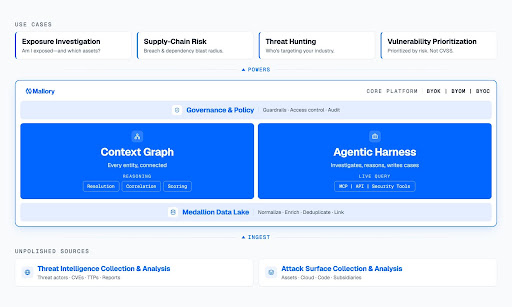
At the core of Mallory’s offering is a singular, unified context and intelligence layer. This architecture fundamentally changes how security data is processed and acted upon. Instead of disparate tools generating alerts that security analysts must manually correlate, Mallory provides a holistic view, directly linking observed threats to an organization’s specific vulnerabilities and assets. This integration is critical for moving beyond reactive defense to proactive threat mitigation.
The platform’s architecture is built upon three foundational pillars, designed to address the challenges posed by AI-assisted attackers:
- Threat Intelligence Fusion: Mallory ingests and processes live adversary intelligence, moving beyond static threat feeds to provide dynamic, real-time insights into attacker tactics, techniques, and procedures (TTPs). This includes understanding current campaigns, emerging attack vectors, and the specific threats most relevant to an organization’s sector and asset profile.
- Exposure Context Mapping: This pillar focuses on understanding an organization’s attack surface in relation to the fused threat intelligence. Mallory maps real-time threats against an organization’s specific vulnerabilities, misconfigurations, and accessible assets. This contextual awareness prioritizes risks, moving away from generic vulnerability scores to an attacker’s probable exploitation paths.
- Policy-Governed Response Automation: The ultimate goal is to translate intelligence and context into action. Mallory integrates with existing security tools—firewalls, EDR solutions, SIEMs, and identity management systems—to orchestrate automated, policy-driven responses. This ensures that remediation actions are not only swift but also aligned with organizational security policies, minimizing human error and maximizing efficiency.
The Interplay of Intelligence and Exposure for Prioritized Action
The critical innovation within Mallory lies in its ability to seamlessly connect threat intelligence with an organization’s unique exposure context. This isn’t just about identifying vulnerabilities; it’s about understanding which vulnerabilities are actively being exploited by current threats relevant to the organization. For example, if a new zero-day vulnerability like CVE-2023-XXXXX (placeholder) emerges, Mallory wouldn’t just flag its existence. It would assess if the organization’s assets are exposed to it, if threat actors are actively leveraging it, and then recommend or automate specific remediation actions based on pre-defined policies.
This contextual prioritization allows security teams to focus their efforts on the most critical risks, rather than chasing every alert. It moves security from a “whack-a-mole” approach to a strategically focused defense, ensuring resources are allocated where they can have the greatest impact against sophisticated adversaries.
Response Automation: From Insight to Action
Generating insights without the ability to act on them quickly renders the intelligence less effective. Mallory’s emphasis on policy-governed response automation addresses this directly. By integrating with existing security infrastructure, it acts as an orchestration layer, translating prioritized risks into actionable commands for various security tools. This might include:
- Automatically isolating compromised endpoints identified by an EDR solution.
- Updating firewall rules to block newly identified malicious IPs or domains.
- Triggering patching cycles for critical vulnerabilities on specific systems.
- Adjusting access controls based on real-time threat intelligence.
The “policy-governed” aspect is crucial. It means that while responses can be automated, they are executed within predefined parameters set by the security team, ensuring actions are appropriate, compliant, and do not inadvertently disrupt business operations. This provides a balance between automation speed and human oversight.
Why Mallory Matters for Security Teams
For IT professionals and security analysts, Mallory represents a significant step forward in combating advanced cyber threats. Its unified approach offers several compelling benefits:
- Reduced Mean Time To Respond (MTTR): By automating the link between intelligence, context, and action, organizations can drastically reduce the time it takes to detect and neutralize threats.
- Improved Prioritization: Focus security resources on the highest-impact risks, optimizing operational efficiency and effectiveness.
- Enhanced Proactive Defense: Shift from a reactive stance to a more proactive posture, anticipating and mitigating threats before they can cause significant damage.
- Leveraging Existing Investments: Mallory is designed to integrate with an organization’s current security stack, maximizing the value of existing tools rather than requiring wholesale replacement.
- Mitigating AI-Assisted Attacks: By bringing AI-driven insights to the defense, Mallory helps security teams counter the advanced capabilities of AI-assisted attackers.
The Future of Threat and Exposure Management
Mallory’s introduction signals a clear direction for the future of cybersecurity: one where intelligence, context, and automated response are seamlessly interwoven into a single, intelligent architecture. As the sophistication of cyber threats continues to escalate, particularly with the widespread adoption of AI by malicious actors, security platforms that can unify these critical functions will become indispensable. Mallory’s approach promises to arm security teams with the clarity and agility needed to defend against the next generation of cyberattacks, ensuring that live adversary intelligence translates directly into effective, policy-driven protection.




