
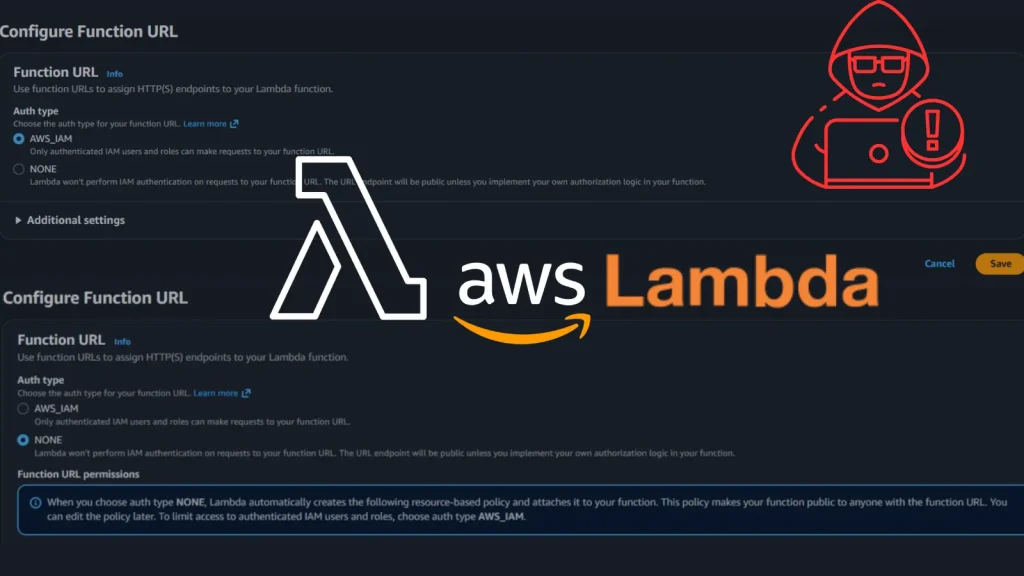
HazyBeacon Weaponizes AWS Lambda Function URLs for Stealth Command-and-Control Relays
The landscape of cyber warfare is constantly shifting, with attackers finding innovative ways to exploit legitimate cloud services for nefarious purposes. A recent and particularly insidious example is the HazyBeacon campaign, identified by Qualys Security researchers. This sophisticated cyber-espionage operation, tracked as CL-STA-1020, has been observed weaponizing AWS Lambda Function URLs to establish stealthy command-and-control (C2) relays, primarily targeting sensitive government networks in Southeast Asia.
Understanding AWS Lambda Function URLs and Their Abuse
AWS Lambda Function URLs are a powerful feature, designed to provide developers with a dedicated HTTPS endpoint for their Lambda functions. This allows for direct invocation of functions via a standard web request, simplifying integration with web applications and APIs. However, as HazyBeacon demonstrates, this very convenience can be twisted into a formidable weapon.
The attackers behind HazyBeacon are leveraging these URLs as covert C2 relays. Instead of relying on traditional, easily identifiable malicious domains or IPs, they are blending their reconnaissance and exfiltration traffic with legitimate AWS infrastructure. This makes detection significantly harder, as security teams often trust traffic originating from or routing through well-known cloud providers.
The Stealthy Mechanics of HazyBeacon
HazyBeacon’s methodology relies on two critical components: misconfigured serverless features and stolen cloud credentials. By gaining access to legitimate AWS accounts, likely through phishing or other credential theft techniques, the attackers can provision and configure Lambda functions. They then set up Function URLs for these malicious functions. These functions, once invoked by compromised systems within the target network, act as intermediaries, relaying commands from the attacker’s true C2 server and exfiltrating data back. This creates a highly obfuscated communication channel.
Traditional malware often involves direct connections to attacker-controlled infrastructure, leaving clear forensic trails. HazyBeacon, however, uses the seemingly innocuous AWS Lambda Function URLs to effectively “hide in plain sight.” The malicious traffic appears to be part of normal AWS service interactions, making it extremely challenging for an organization’s security tools to flag it as suspicious.
Targeting and Impact
The primary targets of the HazyBeacon campaign are government networks in Southeast Asia. This focus on governmental entities suggests a motive aligned with state-sponsored espionage, aiming to collect sensitive political, economic, or national security intelligence. The stealthy nature of this attack vector means that compromise could persist undetected for extended periods, allowing for deep infiltration and prolonged data exfiltration.
Remediation Actions and Mitigations
Defending against advanced threats like HazyBeacon requires a multi-layered approach focusing on cloud security best practices and proactive monitoring. Organizations need to assume compromise and implement robust detection and response mechanisms.
- Implement Strong Identity and Access Management (IAM): Enforce least privilege principles for all AWS users and roles. Regularly rotate access keys and use multi-factor authentication (MFA) for all accounts, especially root and administrative users.
- Monitor CloudTrail Logs: Continuously analyze AWS CloudTrail logs for suspicious activities, such as the creation or modification of Lambda functions and Function URLs by unusual identities or from unusual locations. Look for patterns in invocation requests that deviate from normal behavior.
- Vulnerability Management and Patching: Ensure all applications and operating systems interfacing with your cloud environment are regularly patched and free of known vulnerabilities. Attackers often exploit CVEs to gain initial access.
- Network Segmentation and Microsegmentation: Segment your cloud networks to limit the blast radius of a potential compromise. Isolate sensitive resources and apply strict egress filtering to prevent unauthorized outbound connections.
- Behavioral Analytics: Deploy tools that can detect anomalous behavior within your AWS environment. This includes unusual Lambda function invocations, data transfer patterns, and resource provisioning activities.
- Regular Security Audits: Conduct regular security audits of your AWS configurations, paying close attention to serverless functions and their associated permissions and endpoints.
- Employee Training: Educate employees about phishing tactics and social engineering to prevent credential theft, often the initial compromise vector.
Tools for Detection and Mitigation
| Tool Name | Purpose | Link |
|---|---|---|
| AWS CloudTrail | Logging and monitoring API calls and actions within AWS accounts. Essential for identifying suspicious Lambda function activity. | https://aws.amazon.com/cloudtrail/ |
| AWS GuardDuty | Intelligent threat detection service that continuously monitors for malicious activity and unauthorized behavior to protect AWS accounts. | https://aws.amazon.com/guardduty/ |
| AWS Config | Assesses, audits, and evaluates the configurations of your AWS resources, including Lambda functions, for compliance and security. | https://aws.amazon.com/config/ |
| Qualys Cloud Agent | Provides continuous visibility and security of assets, including those deployed in cloud environments like AWS, aiding in vulnerability management. | https://www.qualys.com/cloud-agent/ |
| (Your WAF/IDS Solution) | Web Application Firewall (WAF) and Intrusion Detection System (IDS) solutions can help detect and block suspicious outbound traffic from compromised AWS instances. Specific vendor varies. | (Vendor Specific) |
Key Takeaways
The HazyBeacon campaign serves as a stark reminder that attackers are constantly evolving their tactics. Abusing legitimate cloud services like AWS Lambda Function URLs for C2 relays presents a significant challenge to traditional security controls. Organizations must adopt a cloud-native security mindset, focusing on robust IAM, continuous monitoring of cloud activity, and architectural design that minimizes attack surfaces. Proactive threat hunting and a strong understanding of how adversaries are leveraging cloud infrastructure are no longer optional but essential for modern cyber defense.




