
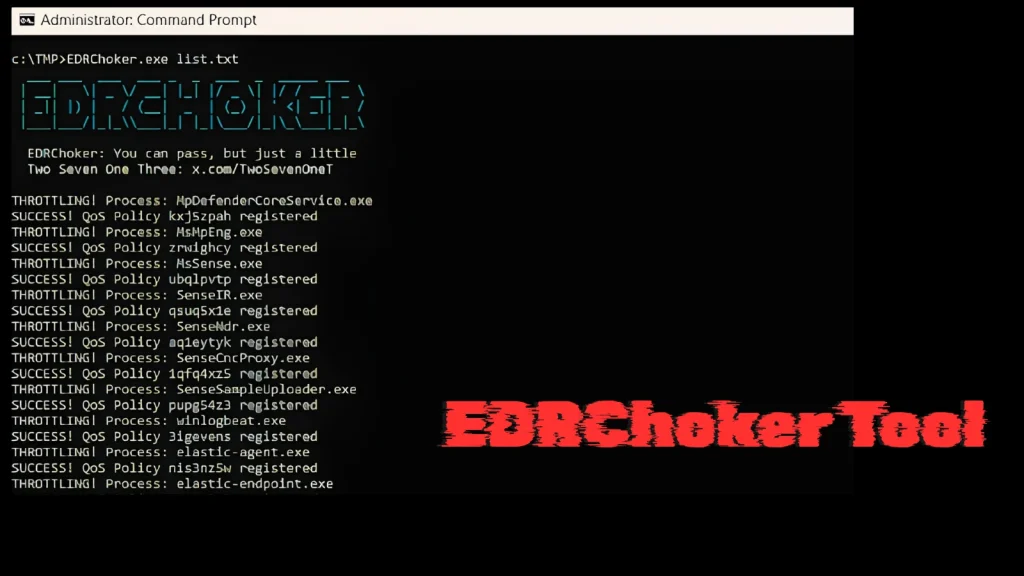
New EDRChoker Tool Uses Policy-Based Quality of Service to Block EDR Processes
Unmasking EDRChoker: The Silent Threat to Endpoint Security
In the relentless cat-and-mouse game of cybersecurity, red teamers and threat actors are continuously innovating. A newly unveiled open-source tool, EDRChoker, exemplifies this innovation by introducing a stealthy method to neutralize cloud-connected Endpoint Detection and Response (EDR) agents. This isn’t about outright process termination or complex code injection; instead, EDRChoker leverages an often-overlooked Windows feature to quietly cripple EDR communication, effectively blinding defenders without raising alarms.
What is EDRChoker and How Does It Work?
Developed by the security researcher @TwoSevenOneT, EDRChoker is a red team tool designed to disrupt the efficacy of modern EDR solutions. Traditional methods of bypassing EDR often involve attempting to kill EDR processes, inject malicious code into them, or exploit vulnerabilities directly within the EDR agent itself. These approaches, while sometimes effective, can be noisy and may trigger alerts dueaking the EDR’s self-protection mechanisms or anomalous process behavior.
EDRChoker takes a dramatically different, more subtle approach. It exploits Windows’ native Policy-Based Quality of Service (QoS) engine. Quality of Service is a feature designed to manage network traffic and prioritize certain applications or services. By specifically targeting the network communication of EDR agents, EDRChoker can configure QoS policies to throttle their bandwidth to near-zero. This effectively “chokes” the EDR agent’s ability to communicate with its cloud backend, where real-time analysis, threat intelligence, and centralized logging occur.
The implications are significant: an EDR agent that cannot communicate with its command and control (C2) server is severely handicapped. It might still be running locally, but its ability to upload telemetry, receive updated policies, or report detected threats is functionally impaired. This creates a critical window of opportunity for attackers to operate undetected, as the EDR’s protective capabilities are severely diminished.
The Power of Policy-Based QoS Exploitation
Windows Policy-Based QoS allows administrators to define rules for network traffic management based on various criteria, such as application name, IP address, port number, or even user. EDRChoker weaponizes this legitimate system feature. Instead of wrestling with memory or process handles, it manipulates network priorities at a system level, making the attack difficult to detect through standard process monitoring or memory forensics.
The beauty (from an attacker’s perspective) of this technique lies in its subtlety. The EDR process continues to run, consuming CPU and memory resources as expected. There are no obvious crashes, no rogue injections, and no direct tampering with the EDR’s executable. The disruption is purely at the network layer, making it a sophisticated form of denial of service specifically targeting the EDR’s communication lifeline to the cloud. This technique underscores the need for robust network monitoring alongside endpoint protection.
Remediation Actions and Protective Measures
While EDRChoker presents a novel challenge, organizations can implement several strategies to mitigate its impact and detect such sophisticated attacks:
- Enhanced Network Telemetry and Monitoring: Implement deep packet inspection and network flow monitoring (e.g., NetFlow, IPFIX) to detect unusual bandwidth reductions or communication failures from EDR agents. Look for sudden drops in expected data egress from endpoints, specifically from processes associated with EDR solutions.
- Regular EDR Health Checks: Many EDR solutions offer built-in health monitoring. Ensure these checks are configured and actively monitored for connectivity issues, agent status, and data upload anomalies.
- Baseline Network Activity: Establish a baseline of normal network activity for EDR agents. Any significant deviation from this baseline, such as drastically reduced outbound traffic, should trigger an alert for investigation.
- Principle of Least Privilege for QoS Policies: Review and restrict who has the ability to create or modify QoS policies on endpoints. In most enterprise environments, standard users should not have privileges to alter system-wide network QoS settings.
- Tamper Protection for EDR: Ensure that your EDR solution’s tamper protection features are fully enabled and configured to prevent unauthorized modification of its processes, configuration files, and network settings. While EDRChoker doesn’t directly tamper with the EDR process, robust tamper protection can make it harder to modify system-level network configurations that affect the EDR.
- Implement Zero Trust Principles: Apply a Zero Trust architecture where every connection, even internal ones, is verified. This can help isolate and detect compromised endpoints that might be attempting to cut off their EDR’s communication.
The Evolving Landscape of EDR Evasion
The emergence of tools like EDRChoker highlights a crucial trend: attackers are moving beyond direct confrontation with security tools and exploring more indirect, system-level manipulation techniques. This emphasizes the need for a multi-layered security approach that doesn’t solely rely on endpoint agents but also integrates robust network visibility, centralized logging, and continuous behavioral analysis across the entire IT infrastructure.
Cybersecurity professionals must remain vigilant, constantly adapting their defenses to counter these evolving evasion tactics. Understanding how tools like EDRChoker operate is key to building more resilient and capable detection and response strategies.




