
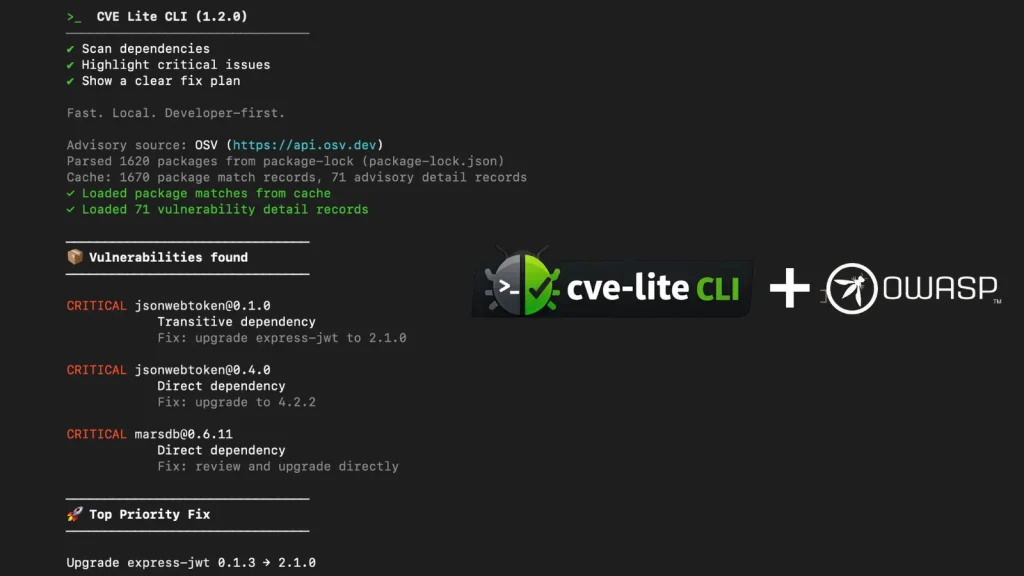
OWASP CVE Lite CLI – New Tool to Scan for Vulnerabilities in Your Projects
Developers and cybersecurity professionals alike understand the critical importance of identifying vulnerabilities early in the software development lifecycle. The traditional approach often pushes security scans to the tail end, creating bottlenecks and increasing remediation costs. This is where the OWASP CVE Lite CLI steps in, offering a transformative shift by embedding dependency security directly into the development workflow.
This powerful, free, and open-source tool, officially recognized as an OWASP Incubator Project, brings vulnerability scanning right to your terminal. No longer are developers tethered to the complexities of CI pipelines for basic security checks. Maintained by Sonu Kapoor, and backed by the same organization responsible for the renowned OWASP Top 10, CVE Lite CLI fills a crucial gap, empowering developers with immediate feedback on the security posture of their project dependencies.
What is OWASP CVE Lite CLI?
The OWASP CVE Lite CLI is a command-line interface tool designed to scan your project’s dependencies for known vulnerabilities. Its core strength lies in its ability to quickly analyze various project types and report on Common Vulnerabilities and Exposures (CVEs) present in third-party libraries and frameworks. By integrating early, it enables a “shift-left” security approach, catching issues before they become deeply embedded and expensive to fix.
Unlike comprehensive, resource-intensive security suites, CVE Lite CLI focuses on providing relevant, actionable vulnerability data at the developer’s fingertips. This lightweight approach ensures minimal disruption to the development process while maximizing the impact of early detection.
Key Features and Benefits
The OWASP CVE Lite CLI offers several compelling features that make it an invaluable addition to any developer’s toolkit:
- Direct Terminal Integration: Run scans directly from your command line, receiving immediate feedback without needing complex CI/CD pipeline configurations.
- Open-Source and Free: Being open-source means transparency, community-driven improvements, and no licensing costs.
- OWASP Endorsed: Its status as an OWASP Incubator Project lends significant credibility, indicating adherence to high security standards and best practices.
- Dependency Scanning: Accurately identifies vulnerabilities within your project’s various dependencies.
- Cross-Platform Compatibility: Likely compatible with major operating systems, catering to diverse development environments.
- Shift-Left Security: Promotes early detection of vulnerabilities, reducing the cost and effort of remediation later in the development cycle.
How CVE Lite CLI Works
The operational mechanism of CVE Lite CLI is straightforward. When executed, it analyzes your project’s dependency files (e.g., package.json for Node.js, pom.xml for Maven, requirements.txt for Python). It then cross-references these dependencies against known vulnerability databases, primarily leveraging CVE data. If a vulnerable version of a dependency is identified, the tool reports it, often alongside information like the CVE ID, severity, and sometimes a link to more details.
For instance, if your project uses a version of a library known to be affected by CVE-2023-XXXXX (a hypothetical example), CVE Lite CLI would highlight this, allowing you to take corrective action promptly. This direct feedback loop is crucial for maintaining a strong security posture from the ground up.
Integrating CVE Lite CLI into Your Workflow
Adopting the OWASP CVE Lite CLI is designed to be seamless. Developers can incorporate it into their daily routine by running a quick scan before committing code or merging branches. While it’s not a replacement for comprehensive CI/CD pipeline scans, it acts as an excellent first line of defense, catching common issues proactively.
Consider running cve-lite scan (or similar command, depending on the tool’s exact syntax) as part of your pre-commit hooks or local development scripts. This ensures that every developer on the team is empowered to identify and address dependency vulnerabilities without waiting for a centralized build process.
Remediation Actions for Identified Vulnerabilities
When CVE Lite CLI flags a vulnerability, the remediation process generally follows these steps:
- Identify the Vulnerable Dependency: The tool will clearly state which dependency and version are affected.
- Consult CVE Details: Use the provided CVE ID (e.g., CVE-2023-12345) to research the specifics of the vulnerability on the official CVE database or NVD. Understand the impact and the nature of the flaw.
- Upgrade the Dependency: The most common and effective solution is to upgrade to a non-vulnerable version of the library or framework. Always check the release notes for breaking changes before upgrading.
- Replace the Dependency: If an upgrade is not feasible or the vulnerability persists in the latest versions, consider replacing the dependency with an alternative that offers similar functionality and has a better security track record.
- Patch Manually (Last Resort): In rare and critical cases where immediate upgrade or replacement is not possible, a targeted patch might be applied. This is generally discouraged due to maintenance complexities and the risk of introducing new issues.
- Isolate and Mitigate: If a fix isn’t immediately available, consider isolating the affected component and implementing compensating controls to reduce the attack surface or potential impact.
Conclusion
The OWASP CVE Lite CLI represents a significant step forward in making vulnerability management more accessible and integrated into the daily lives of developers. Its open-source nature, OWASP endorsement, and focus on immediate, actionable feedback position it as a vital tool for fostering a stronger security culture within development teams. By shifting security left and empowering developers to take ownership of their dependencies’ security, CVE Lite CLI helps build more resilient and secure software from the ground up. This tool is a testament to the ongoing efforts within the cybersecurity community to democratize security and integrate it seamlessly into the developer workflow, moving beyond traditional, late-stage vulnerability discovery.




