Phishing Powers 80% of Attacks on US Companies: How SOCs Can Detect It Early
The Silent Epidemic: Why Phishing Still Dominates US Cyberattacks
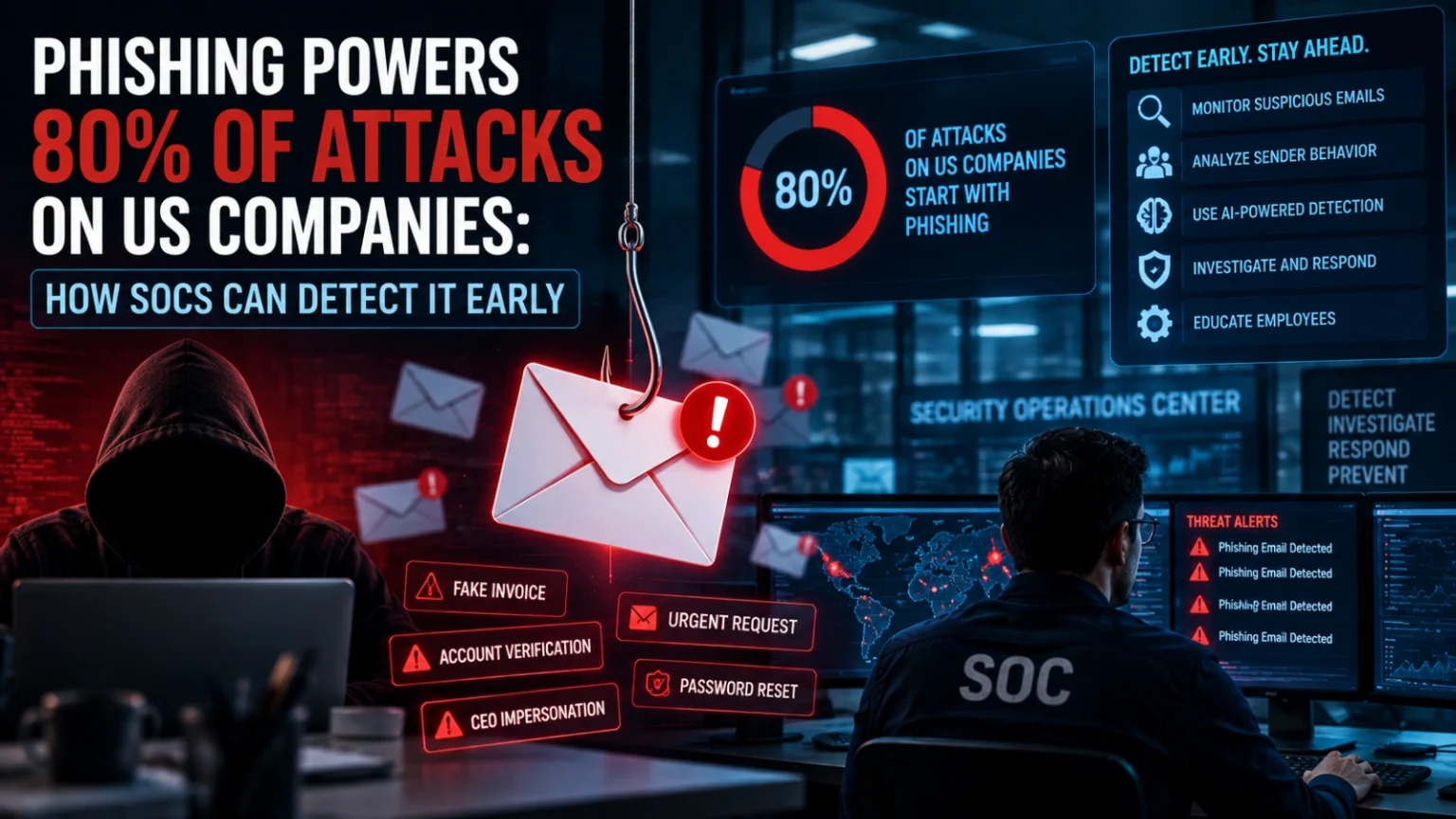
The numbers don’t lie. Phishing isn’t just a nuisance; it’s a foundational threat, powering a staggering 80% of cyberattacks targeting US companies. For security operations centers (SOCs), this isn’t just a statistic; it’s a call to action. From 2013 to 2023, the FBI reported an alarming 158,436 US victims of Business Email Compromise (BEC), leading to over $20 billion in losses. The FBI specifically highlights phishing as the primary vector for credential theft and network infiltration. Despite significant investments in security technologies, this pervasive threat continues to evolve, making early detection by SOCs more critical than ever.
Understanding Phishing’s Enduring Effectiveness
Phishing’s success lies in its exploitation of human nature. Attackers craft seemingly legitimate emails, messages, or websites to trick individuals into divulging sensitive information or performing actions that compromise security. These tactics can range from generic “reset your password” prompts to sophisticated spear-phishing campaigns targeting specific high-value individuals within an organization. The sheer volume and increasing sophistication of these attacks make them difficult to filter and detect at the perimeter, pushing the responsibility further into the SOC’s domain.
The Evolution of Phishing Techniques
While the core concept remains, phishing methodologies are constantly adapting. SOCs must be aware of these evolving threats:
- Spear Phishing: Highly targeted attacks tailored to specific individuals or organizations, often leveraging publicly available information for increased credibility.
- Whaling: A form of spear phishing aimed at senior executives (“whales”) within an organization, often seeking to authorize large financial transfers or sensitive data disclosures.
- Smishing (SMS Phishing): Phishing attempts delivered via text messages, often containing malicious links or requests for personal information.
- Vishing (Voice Phishing): Social engineering attacks conducted over the phone, where attackers impersonate legitimate entities to extract information or manipulate victims.
- BEC (Business Email Compromise): A highly lucrative form of phishing where attackers impersonate a CEO, executive, or vendor to trick employees into making fraudulent wire transfers or sending confidential data. The FBI’s 2013-2023 report on BEC losses underscores the financial devastation these attacks can cause.
SOC Strategies for Early Phishing Detection
Effective early detection of phishing requires a multi-layered approach, combining technology, intelligence, and human expertise.
- Advanced Email Security Gateways: Implement and continuously tune email security solutions that perform deep content analysis, URL reputation checks, and attachment sandboxing to block malicious emails before they reach inboxes.
- Security Information and Event Management (SIEM): Leverage SIEM platforms to aggregate logs from email systems, endpoints, and network devices. Look for suspicious patterns such as multiple failed login attempts from a new location after a suspected phishing email, or unusual data exfiltration attempts.
- Endpoint Detection and Response (EDR): Deploy EDR solutions to monitor endpoint activity for signs of compromise, even if an initial phishing email bypassed perimeter defenses. This includes detecting execution of suspicious processes, unauthorized script activity, or attempts to access sensitive files.
- Threat Intelligence Integration: Continuously feed threat intelligence feeds into your security tools. This includes known malicious IP addresses, domains, and phishing kit indicators of compromise (IoCs).
- User Behavior Analytics (UBA): Monitor user activity for anomalies. For example, a user who suddenly starts accessing unusual systems or attempts to transfer large sums of money after clicking a suspicious link could indicate a compromised account.
- Phishing Simulation and Training: Regularly conduct phishing simulations to test employee vigilance and provide targeted training. This builds a human firewall, making employees the first line of defense. Analyze the results to identify training gaps and vulnerable individuals.
- Multi-Factor Authentication (MFA): While not a direct detection mechanism, widespread MFA deployment is crucial. Even if credentials are stolen via phishing, MFA acts as a critical barrier, preventing attackers from immediately leveraging those credentials. This reduces the urgency of early detection to some extent, buying SOCs more time to respond.
- Network Traffic Analysis (NTA): Monitor network traffic for connections to known malicious domains or unusual outbound connections that could indicate a command-and-control (C2) channel established after a successful phishing attempt.
Remediation Actions for Phishing Incidents
When a phishing incident is detected, swift and decisive action is paramount to minimize damage.
- Containment: Immediately isolate affected systems or user accounts. Force password resets for compromised accounts, especially if CVE-2022-29075 (related to phishing-resistant MFA bypass) or similar vulnerabilities are suspected to have been exploited.
- Eradication: Remove any malicious files or persistent access mechanisms established by the attacker. This may involve reimaging compromised systems.
- Investigation: Conduct a thorough forensic investigation to understand the full scope of the breach:
- How did the phishing email bypass defenses?
- What data was accessed or exfiltrated?
- Were other systems compromised?
- Recovery: Restore affected systems and data from clean backups.
- Post-Incident Analysis: Document the incident, identify root causes, and update security controls and employee training to prevent recurrence.
Tools for Phishing Detection and Mitigation
| Tool Name | Purpose | Link |
|---|---|---|
| Proofpoint Email Protection | Advanced email security gateway with threat intelligence, sandboxing, and DMARC enforcement. | https://www.proofpoint.com/us/products/email-protection |
| Microsoft Defender for Office 365 | Email filtering, anti-phishing capabilities, and threat protection for Microsoft 365 environments. | https://www.microsoft.com/en-us/security/business/microsoft-365-defender |
| KnowBe4 Security Awareness Training | Phishing simulation platform and security awareness training for employees. | https://www.knowbe4.com/ |
| CrowdStrike Falcon Insight EDR | Endpoint detection and response for comprehensive endpoint visibility and threat hunting. | https://www.crowdstrike.com/products/endpoint-security/falcon-insight-edr/ |
| Splunk Enterprise Security (ES) | SIEM platform for log aggregation, correlation, and security event analysis. | https://www.splunk.com/en_us/software/splunk-enterprise-security.html |
Conclusion
Phishing’s continued dominance as an attack vector highlights the need for continuous vigilance and adaptation within SOCs. The FBI’s stark figures on BEC losses underscore the financial imperative for robust defenses. By combining advanced technical controls with rigorous employee training and a proactive incident response plan, SOCs can significantly improve their ability to detect phishing early, mitigate its impact, and protect their organizations from becoming another statistic in the ever-growing tally of cybercrime.