
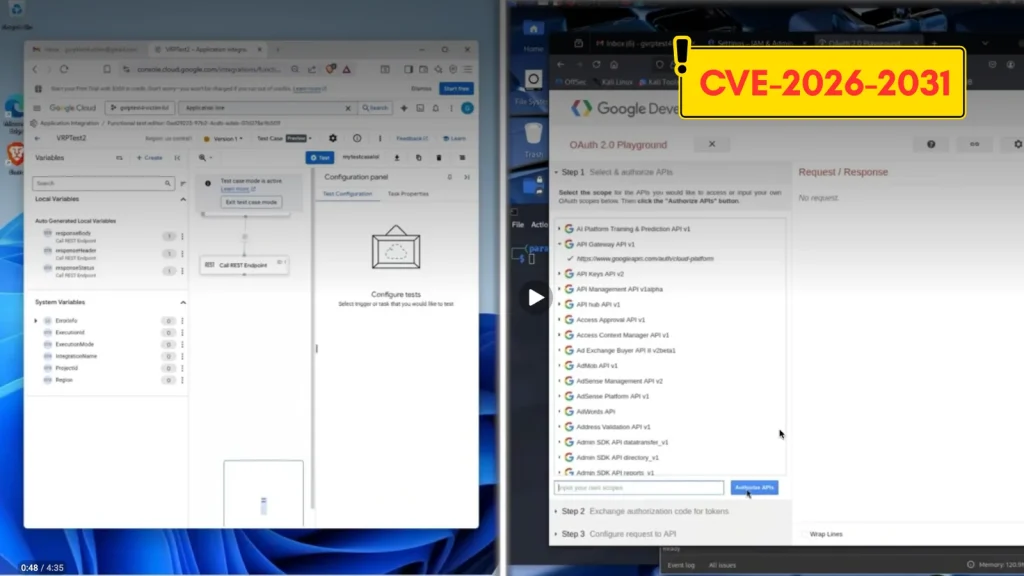
Researcher Earns $148,337 for Google Cloud Production RCE Vulnerability
A Six-Figure Payday: Unpacking the Google Cloud RCE Vulnerability
A significant cybersecurity event recently unfolded within Google Cloud, resulting in a researcher being awarded an impressive $148,337 for uncovering a critical set of flaws. These vulnerabilities, specifically impacting Google Cloud’s Application Integration service, escalated into a Remote Code Execution (RCE) scenario within Google’s production environment. This substantial bounty not only highlights Google’s commitment to security but also underscores the profound impact such vulnerabilities can have.
The Discovery: StubZero and CVE-2026-2031
The researcher in question, Arvin Shivram, meticulously documented his findings under the title “StubZero: The Story of a Google Cloud RCE.” At the core of his discovery is a critical bug, now officially tracked as CVE-2026-2031. This CVE represents a significant RCE vulnerability that could have allowed unauthorized execution of arbitrary code within Google Cloud’s sensitive production infrastructure.
Understanding the gravity of an RCE is crucial. An RCE vulnerability allows an attacker to execute commands on a remote system, effectively taking control of the affected machine. In a cloud production environment like Google’s, the implications of such a breach are far-reaching, potentially exposing sensitive data, disrupting services, and compromising the integrity of vast systems.
Google Cloud’s Application Integration Service: The Target
The vulnerabilities were specifically found within Google Cloud’s Application Integration service. This service is designed to facilitate seamless communication and data exchange between different applications, often acting as a bridge for critical business processes. Its central role in connecting various components makes it a high-value target for attackers. Exploiting flaws within such a foundational service can create a cascade of security issues across an entire cloud ecosystem.
The Impact of Production RCE
Discovering an RCE vulnerability in a production environment is a major concern. It means that the flaw exists in the live systems that are actively serving customers and running Google’s operations, not just in development or staging environments. This distinction is vital as it implies a direct risk to data, service availability, and intellectual property. Shivram’s ability to demonstrate RCE within Google Cloud’s production systems showcases the severity of his findings and the potential for real-world exploitation had it gone undiscovered.
Remediation Actions for Cloud Users
While this specific vulnerability was addressed by Google, the incident serves as a powerful reminder for all organizations leveraging cloud services. Proactive security measures are paramount. Here are key remediation actions and best practices:
- Maintain Patching & Updates: Regularly apply security patches and updates provided by your cloud provider and for any applications you deploy. This seems fundamental but is often overlooked.
- Principle of Least Privilege: Implement the principle of least privilege for all users and services. Grant only the necessary permissions to perform specific tasks, minimizing the potential blast radius of a compromised account or service.
- Network Segmentation: Segment your cloud networks to limit lateral movement in case of a breach. Isolate critical applications and data stores from less sensitive parts of your infrastructure.
- Regular Security Audits & Penetration Testing: Conduct frequent security audits and penetration tests on your cloud environment and applications. Independent security researchers and tools can often unearth vulnerabilities that internal teams might miss.
- Monitor & Log Effectively: Implement robust logging and monitoring solutions. Continuously analyze logs for anomalous activity, unauthorized access attempts, and potential indicators of compromise.
- Incident Response Plan: Develop and regularly test a comprehensive incident response plan tailored for cloud environments. Knowing how to react quickly and effectively can mitigate the damage from a security incident.
- Utilize Cloud Security Posture Management (CSPM) Tools: Employ CSPM tools to continuously monitor your cloud configurations against security best practices and compliance frameworks.
Tools for Cloud Security & Vulnerability Management
For organizations looking to bolster their cloud security posture and vulnerability management, a range of tools can assist:
| Tool Name | Purpose | Link |
|---|---|---|
| Tenable.io | Vulnerability Management & Cloud Security | https://www.tenable.com/products/tenable-io |
| Qualys Cloud Platform | Vulnerability Management, Compliance, & Cloud Security | https://www.qualys.com/cloud-platform/ |
| Wiz | Cloud Security Posture Management (CSPM) & CIEM | https://www.wiz.io/ |
| Aqua Security | Cloud Native Application Protection Platform (CNAPP) | https://www.aquasec.com/ |
| AWS Security Hub | Centralized Security Alerts & Automated Compliance Checks (for AWS environments) | https://aws.amazon.com/security-hub/ |
| Google Cloud Security Command Center | Centralized Visibility & Security Management (for Google Cloud environments) | https://cloud.google.com/security-command-center |
Key Takeaways from the Google Cloud RCE Incident
The discovery of CVE-2026-2031 and the subsequent bounty awarded to Arvin Shivram offer several critical insights for the cybersecurity community. It reinforces the value of external security research and Google’s commitment to its bug bounty program. More importantly, it highlights that even leading cloud providers can have critical vulnerabilities in their production environments. For businesses relying on cloud infrastructure, this event serves as a call to action: continuous vigilance, robust security practices, and a proactive approach to vulnerability management are not optional but essential for protecting digital assets.




