
SecSuite – AI-powered Tool for OSINT, Web and API Security Testing
The cybersecurity landscape is constantly evolving, with new threats and attack vectors emerging daily. For security professionals, penetration testers, and red teams, staying ahead requires robust and adaptable tools. This is where comprehensive security platforms become indispensable, streamlining complex tasks and offering deeper insights. Enter SecSuite, an innovative AI-powered open-source security platform designed to unify critical aspects of intelligence gathering and vulnerability assessment.
Introducing SecSuite: A Unified Approach to Cybersecurity Assessment
Recently unveiled under TheSecuredAnalyst project, SecSuite represents a significant leap forward in the realm of security testing. This modular and extensible toolkit integrates a diverse array of capabilities, from open-source intelligence (OSINT) reconnaissance to sophisticated API security assessments, all enhanced by artificial intelligence. Its availability on GitHub at 53cur3dL34rn/security-suite makes it an accessible and valuable resource for the security community.
Key Capabilities of the AI-Powered SecSuite
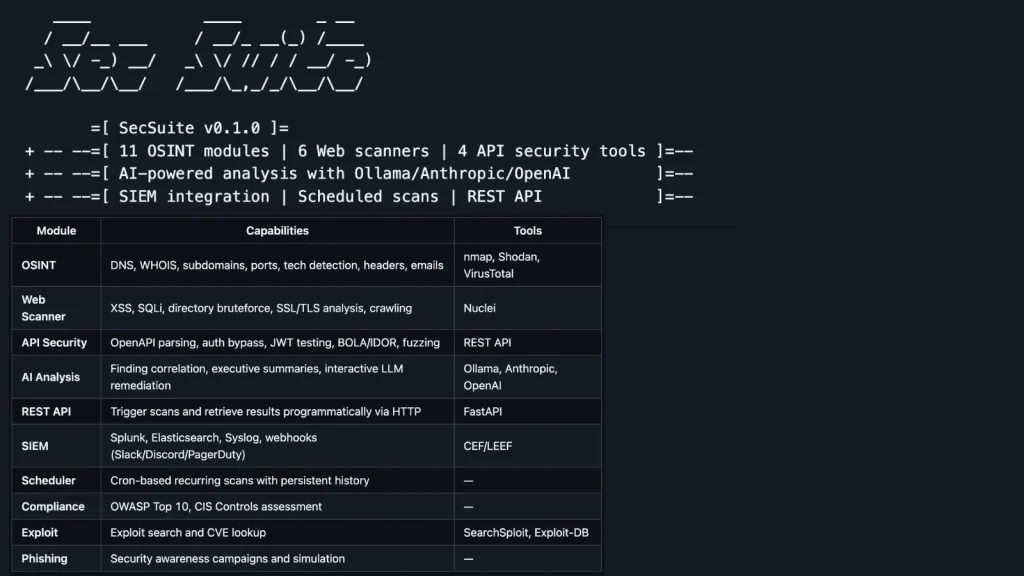
SecSuite distinguishes itself by consolidating several critical security functions into a single, cohesive platform. This integrated approach reduces the need for multiple disparate tools, improving efficiency and providing a more holistic view of an organization’s security posture. Here’s a breakdown of its core features:
- OSINT Reconnaissance: Gathering publicly available information can often uncover valuable clues for attackers or defenders. SecSuite automates and enhances this process, helping security professionals collect data on targets, uncover hidden assets, and identify potential risks that might not be immediately apparent. This foundational step is crucial for understanding an organization’s digital footprint.
- Web Vulnerability Scanning: Web applications remain a primary target for malicious actors. SecSuite incorporates advanced web vulnerability scanning capabilities to identify common and complex security flaws. This includes detecting issues like SQL injection (CWE-89), Cross-Site Scripting (XSS) (CWE-79), and other OWASP Top 10 vulnerabilities.
- API Security Assessment: APIs are the backbone of modern web services and applications, yet they often present unique security challenges. SecSuite provides dedicated features for assessing API security, scrutinizing endpoints for misconfigurations, authentication bypasses, and data exposure risks. Given the increasing reliance on APIs, this capability is paramount for securing interconnected systems.
- Compliance Checking: Adhering to regulatory standards and best practices is non-negotiable for many organizations. SecSuite assists in compliance checking by evaluating systems against industry benchmarks and identifying deviations that could lead to penalties or security breaches. This proactive approach helps maintain a strong security posture while meeting regulatory requirements.
- AI-Powered Analysis: The integration of AI is where SecSuite truly shines. AI algorithms enhance the tool’s ability to analyze vast amounts of data, detect subtle patterns that human analysts might miss, and prioritize potential threats more effectively. This intelligent analysis helps security teams focus their efforts on the most critical vulnerabilities, improving overall response times and efficacy.
Why a Unified Toolkit Matters for Security Professionals
Traditional security testing often involves a fragmented approach, utilizing separate tools for different tasks. This can lead to inefficiencies, integration challenges, and potential gaps in coverage. SecSuite addresses these issues by offering a unified platform:
- Efficiency and Time Saving: By consolidating tools, SecSuite reduces the overhead associated with managing and learning multiple systems. Security professionals can conduct a wider range of tests from a single interface, accelerating the assessment process.
- Holistic Security View: An integrated suite provides a more comprehensive understanding of an organization’s security posture. Data from OSINT, web scans, and API assessments can be correlated, leading to more informed decisions and better risk management.
- Extensibility and Customization: As an open-source project, SecSuite offers the flexibility for security teams to extend its capabilities, adapt it to specific needs, and integrate it with existing security workflows. This adaptability ensures the tool remains relevant in a constantly changing threat landscape.
- Enhanced Threat Detection: The AI component not only speeds up analysis but also improves the accuracy of threat detection. By learning from data, the tool can identify emerging attack techniques and complex vulnerabilities that signature-based systems might overlook.
Remediation Actions for Identified Vulnerabilities
When SecSuite uncovers vulnerabilities, immediate and structured remediation is crucial. Here are general remediation actions applicable to findings from OSINT, web, and API security assessments:
- For OSINT Findings (e.g., exposed sensitive data, outdated information):
- Data Sanitization: Implement policies to prevent sensitive internal data from being publicly exposed. Regularly audit public-facing systems and websites for inadvertent data leaks.
- Information Control: Educate employees on best practices for sharing information online. Review and update privacy settings on company-affiliated accounts and profiles.
- Asset Management: Maintain an up-to-date inventory of all public-facing assets and associated information. Decommission or update outdated information promptly.
- For Web Vulnerabilities (e.g., XSS, SQLi, broken authentication):
- Input Validation: Implement strict input validation on all user-supplied data to prevent injection attacks (e.g., CWE-89, CWE-79).
- Output Encoding: Ensure all user-supplied data displayed on web pages is properly output encoded to prevent XSS.
- Secure Authentication & Session Management: Enforce strong password policies, multi-factor authentication (MFA), and secure session management practices (e.g., HTTPS-only cookies, robust session invalidation).
- Regular Patching: Keep all web application frameworks, libraries, and operating systems updated to the latest secure versions.
- For API Security Issues (e.g., broken object level authorization, excessive data exposure):
- Access Control: Implement robust authentication and authorization mechanisms (e.g., OAuth 2.0, JWT validation) to ensure only authorized users and applications can access specific API resources. Perform object-level authorization checks on every request.
- Rate Limiting: Implement API rate limiting to prevent abuse, brute-force attacks, and Denial of Service (DoS) attempts.
- Input Validation & Sanitization: Just like web applications, API endpoints must validate and sanitize all incoming data to prevent various injection attacks.
- Sensitive Data Handling: Avoid exposing unnecessary sensitive data through API responses. Implement data masking or encryption where applicable.
- Error Handling: Ensure API error messages do not disclose sensitive server-side information. Provide generic error responses.
Leveraging SecSuite in Your Security Operations
SecSuite, developed by TheSecuredAnalyst, is more than just a collection of scripts; it’s a strategic asset for security teams looking to optimize their detection and response capabilities. Its AI-driven insights empower analysts to identify subtle attack patterns and prioritize remediation efforts, significantly enhancing the overall cybersecurity posture of an organization. The modular design further ensures that the platform can adapt to specific organizational needs and evolving threat landscapes.
For security professionals, penetration testers, and red teams, exploring SecSuite offers a compelling opportunity to integrate advanced, AI-powered tools into their security assessment workflows. The open-source nature fosters collaboration and continuous improvement, making it a dynamic and valuable resource in the cybersecurity arsenal.




