Understanding Broadcast Domains and Collision Domains in Layer 2 Networks.
Understanding Broadcast Domains and Collision Domains in Layer 2 Networks
In modern networks, Understanding broadcast domains in modern networks is crucial for efficient network management and performance.. Broadcast domains and collision domains are fundamental concepts in layer 2 networking that impact how devices receive broadcast frames within a network. This article delves into the intricacies of broadcast domains, their function, and their significance in network design.
Introduction to Broadcast Domains

A broadcast domain is a logical division of a network where every device can receive broadcast traffic from any other device within the same domain. Understanding broadcast domains is essential because they dictate the scope of broadcast messages in a network. In essence, a broadcast domain is a network segment where a broadcast frame will be forwarded to every device within that segment.
Definition of Broadcast Domain
A broadcast domain is a network, typically within a local area network (LAN), where devices that receive broadcast frames can hear each other’s broadcast messages. A broadcast frame or broadcast packets sent by one device are propagated to every other device within the same broadcast domain, which is crucial for understanding broadcast domain definition. This contrasts with collision domains, which relate to physical network segments where collisions can occur.
Importance of Broadcast Domains in Networking
Managing broadcast domains is critical for maintaining network efficiency and preventing network congestion. Excessive layer 2 broadcast traffic can lead to a broadcast storm, where the network becomes overwhelmed with broadcast messages, degrading performance. Isolating broadcast domains helps control broadcast traffic, ensuring that broadcast messages only reach the necessary devices, thus optimizing network bandwidth and reducing latency.
How Broadcast Domains Function
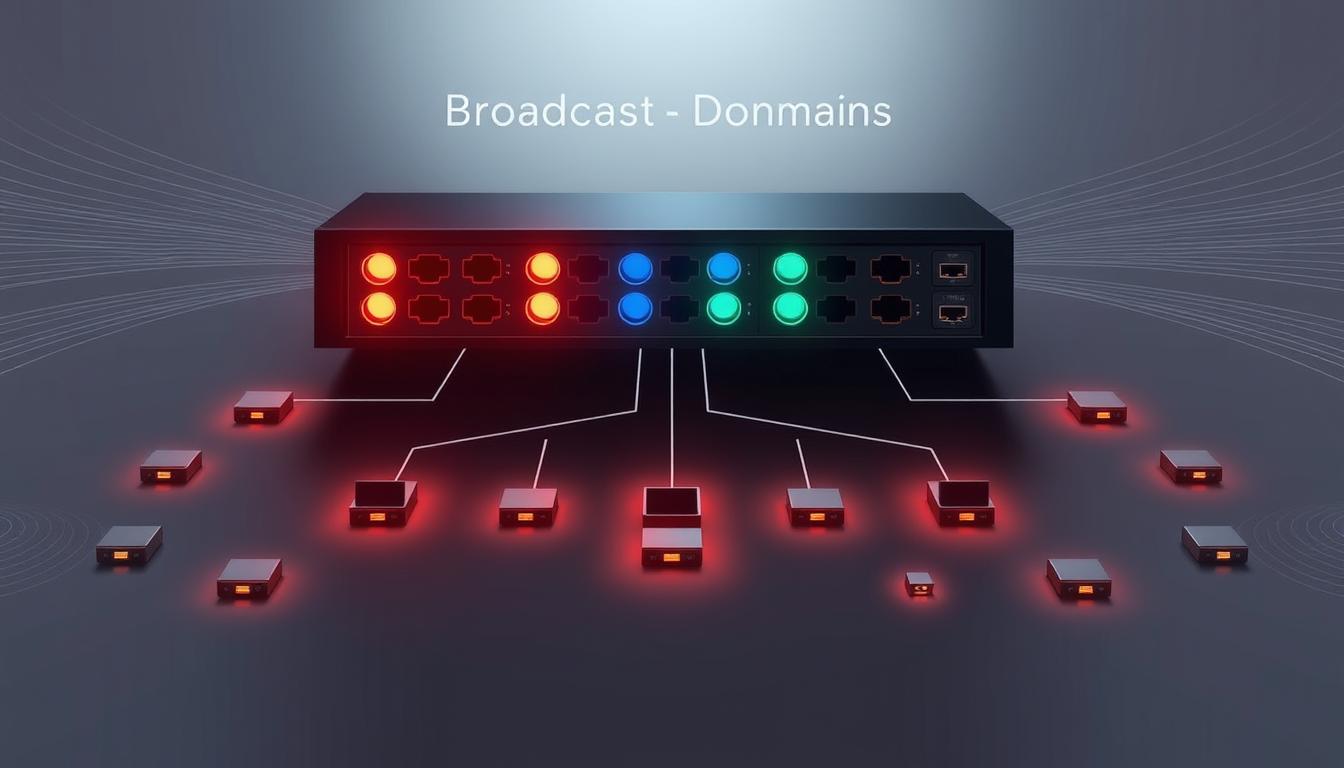
Broadcast domains function at the data link layer (layer 2) of the OSI model. Layer 2 switches play a central role in defining and managing broadcast domains. By default, a layer 2 switch creates a single broadcast domain across all its ports, meaning every device connected to the switch receives every broadcast. However, technologies like VLANs allow network administrators to segment broadcast domains.
Understanding Collision Domains
Definition of Collision Domain
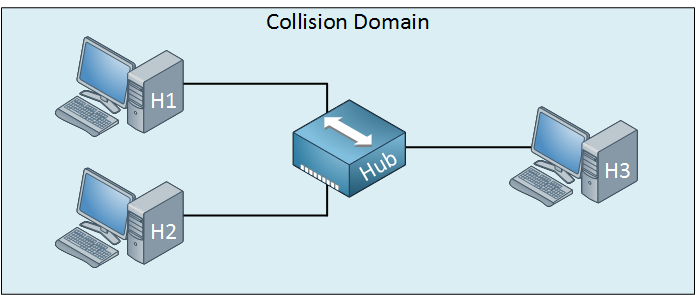
A collision domain, in contrast to a broadcast domain, refers to a network segment where devices compete for bandwidth, potentially causing collisions when two or more devices transmit simultaneously. Essentially, within a collision domain, every device shares the same physical medium; if two devices transmit at the same time, a collision occurs, requiring retransmission. In modern networks, the size and impact of collision domains are minimized using layer 2 switches.
Collision Domain vs Broadcast Domain
Collision domains and broadcast domains represent distinct aspects of network architecture. While a broadcast domain defines the scope within which broadcast packets are forwarded to every device, a collision domain pertains to the physical segment where data collisions can occur. Layer 2 switches help to create multiple broadcast domains through VLANs while also reducing collision domains. A layer 2 switch isolates each port into a single collision domain, which greatly enhances network efficiency.
Effects of Collisions on Network Performance
The presence of collisions within a collision domain can significantly degrade network performance. When a collision occurs, devices must retransmit data, leading to increased latency and reduced throughput. Excessive broadcast traffic can exacerbate the problem, especially if the collision domain is large. By managing broadcast domains effectively and reducing the size of collision domains with switches, network administrators can optimize network performance and ensure reliable communication through proper broadcast domain segmentation.
Layer 2 Networking and Broadcast Traffic
Role of Layer 2 Switches
In modern networks, layer 2 switches play a vital role in handling broadcast traffic. A layer 2 switch operates at the data link layer, forwarding frames based on MAC addresses. By default, a layer 2 switch treats the entire network as a single broadcast domain, meaning that every broadcast frame is forwarded to every device connected to the switch. This can lead to excessive broadcast traffic and reduced network performance if not managed properly.
Managing Broadcast Traffic
Efficiently managing broadcast traffic is crucial for maintaining network performance. Network administrators can use VLANs (virtual local area network) to segment broadcast domains, effectively creating multiple broadcast domains within a physical network. By assigning different ports on a layer 2 switch to different VLANs, administrators can isolate broadcast domains, ensuring that broadcast packets only reach devices within the same VLAN. This reduces unnecessary broadcast traffic and improves overall network efficiency.
Broadcast Storms and Their Impact
A broadcast storm occurs when a large number of layer 2 broadcast packets flood the network, overwhelming devices and causing significant performance degradation. This typically happens when a broadcast frame is continuously retransmitted in a loop, consuming bandwidth and processing resources. Broadcast storms can cripple enterprise networks, making it essential to implement measures to prevent and mitigate them, particularly through the use of multiple VLANs. Proper VLAN configuration and spanning tree protocol (STP) are critical in managing broadcast domains and preventing such occurrences.
Managing Broadcast and Collision Domains

Strategies for Managing Broadcast Domains
Managing broadcast domains effectively involves several strategies to control broadcast traffic and optimize network performance. Some common approaches include:
- Using multiple VLANs to create several broadcast domains within a layer 2 network enhances network performance. This ensures that broadcast messages are confined to specific segments, reducing the overall load on the network.
- Implementing layer 3 switches or routers to separate broadcast domains can further segment the network, providing more granular control of broadcasts.
Techniques to Reduce Collisions
To minimize collisions in a network, it is essential to employ techniques that reduce the likelihood of devices transmitting simultaneously within the same collision domain. Full-duplex communication, where devices can send and receive data at the same time, eliminates collisions altogether. Layer 2 switches inherently reduce collision domains by creating a single collision domain per port. Implementing quality of service (QoS) policies can also prioritize certain types of traffic, reducing the chances of collisions during peak usage.
Setting Broadcast Boundaries in a Network
Establishing clear broadcast boundaries is crucial for maintaining network stability and performance. Several tools are available to achieve broadcast domain segmentation, including:
- VLANs, which allow network administrators to segment broadcast domains and isolate broadcast traffic, preventing broadcast storms from propagating across the entire network.
- Routers that separate broadcast domains and provide an additional layer of segmentation by forwarding traffic based on IP addresses rather than MAC addresses.
Properly configured firewalls can also control broadcast traffic, ensuring that only authorized broadcast messages are allowed to cross network boundaries.

Layer 2 broadcast: What is a broadcast domain and how does it behave in a layer 2 broadcast environment?
A broadcast domain is a network area where devices receive broadcast messages sent to the broadcast mac address and within that broadcast domain those broadcast frames reach every port on the same LAN segment. In a layer 2 broadcast context, switches forward broadcast frames to all ports in the same VLAN so many broadcast messages can spread quickly. Because a domain is a group of devices that get broadcast frames, broadcast traffic to all ports can affect performance; large broadcast domains may result in unnecessary traffic for devices that do not need it. Administrators often create broadcast domains using VLANs to make smaller broadcast domains and improve resource on broadcast handling, producing faster networks and limiting how far broadcast frames reach.
Collision domains and broadcast domains: How do collision domains differ from broadcast domains, and why are smaller collision domains useful?
Collision domains are different from broadcast domains: a collision domain is a portion of the network where frames can collide (typically at a single switch port or hub segment) while a broadcast domain is a network area where broadcast frames are forwarded to all devices. Modern switches create smaller collision domains by giving each device its own switch port, reducing collisions and increasing throughput. However, broadcast domains can spread across multiple switch ports on a single VLAN unless you create broadcast domains with routers or layer 3 devices, because routers separate broadcast domains and stop broadcast traffic from crossing. Using VLANs and routing keeps domains with fewer devices and reduces the negative effects broadcast traffic has on overall network performance.
Broadcast domain definition: How do routers, VLANs, and layer 3 broadcast concepts control where broadcast traffic goes?
A broadcast domain definition is often described as a group of devices that receive the same broadcast messages; routers separate broadcast domains by default, so a router or a layer 3 device stops broadcast traffic from reaching other networks. Layer 3 broadcast behavior means that broadcasts generated in one VLAN or subnet do not forward broadcast traffic to other VLANs unless a router or a bridge intentionally forwards them. To forward broadcast frames between VLANs you need specific configurations like DHCP relays, but typically routers stop broadcast propagation so devices on different subnets do not receive broadcasts. This explains why a device separates broadcast domains and how existing broadcast domain boundaries limit where broadcast frames reach.
Layer 2 broadcast: What are practical ways to manage broadcast domain size and limit broadcast traffic reaches in a switched network?
To manage broadcast domain size and reduce broadcast traffic reaches, network engineers create a broadcast by segmenting networks into multiple VLANs, deploying routers or layer 3 switches (since routers separate broadcast domains), and using access control to limit uses of broadcast addresses. Splitting a large broadcast into smaller broadcast domains reduces many broadcast messages affecting all devices; domains on a single switch can be split into multiple VLANs so devices in one VLAN do not get broadcast from another. Monitoring broadcast domain gets and traffic for multiple vlans helps identify when a domain is too large—if many broadcast frames are observed, consider creating broadcast domains or moving resource-heavy services to different subnets so fewer devices receive broadcast messages.