
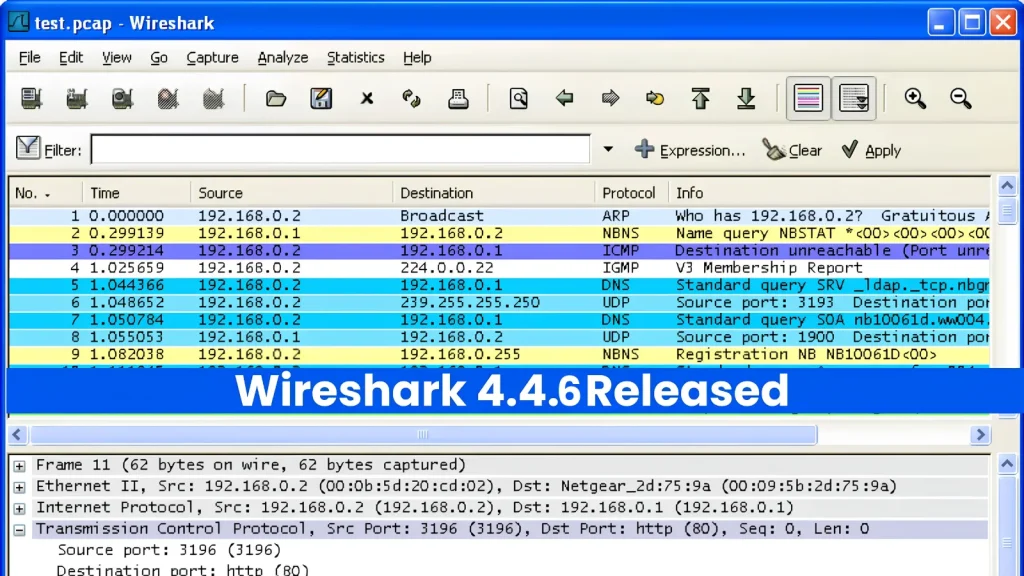
Wireshark 4.6.6 Released With Fix for Dissector Crash via Malformed Packet Injection
For cybersecurity professionals, network analysts, and developers, Wireshark is an indispensable tool. It’s the magnifying glass for network traffic, allowing deep dives into protocols and packet flows. Given its critical role, any vulnerability within Wireshark itself presents a significant concern. Recently, the Wireshark Foundation released version 4.6.6, a crucial update addressing a critical security flaw and various stability issues.
Immediate Action Required: Patching a Critical Dissector Vulnerability
The primary driver behind the Wireshark 4.6.6 release is the remediation of a critical security vulnerability found within the application’s ROHC (Robust Header Compression) protocol dissector. This flaw, tracked as CVE-2022-45277, could enable an attacker to execute a denial-of-service (DoS) attack. By injecting a specially crafted, malformed packet into a network segment being monitored by an unpatched Wireshark instance, an attacker could trigger a crash of the application.
Dissectors are core components of Wireshark, responsible for interpreting and decoding the specific structures of various network protocols. A flaw in a dissector can lead to unexpected behavior, including application instability or, as in this case, a complete crash. The ROHC protocol is designed to efficiently compress IP, UDP, RTP, and other header types for use over low-bandwidth or unreliable links. While not as universally prevalent as TCP/IP, ROHC is used in specific environments, making this vulnerability a targeted, yet impactful, threat for those analyzing such traffic.
Beyond the Critical Fix: Stability and Compatibility Enhancements
In addition to the critical ROHC dissector vulnerability, Wireshark 4.6.6 also brings a welcome suite of over a dozen bug fixes. Many of these address stability and compatibility issues specifically impacting Windows users. These improvements enhance the overall reliability and user experience, reducing crashes and unexpected behavior that can disrupt critical analysis tasks. While not as high-profile as a security patch, these stability updates are essential for maintaining Wireshark’s reputation as a robust and dependable network analysis tool.
Understanding the Impact of Dissector Vulnerabilities
Dissector vulnerabilities like CVE-2022-45277 highlight an important aspect of network security: even the tools designed to protect and analyze can become targets. When a network analysis tool crashes due to malicious input, it can lead to several problems:
- Loss of Monitoring: A crashed Wireshark instance means a blind spot in network visibility, potentially allowing other malicious activities to go undetected.
- Interruption of Incident Response: During an active incident, a tool crash can severely hamper an analyst’s ability to gather crucial evidence and understand attack vectors.
- Productivity Loss: Frequent crashes lead to wasted time and effort for security professionals.
Remediation Actions: Securing Your Wireshark Deployment
Given the nature of the vulnerability and the general importance of uninterrupted network analysis, immediate action is recommended for all Wireshark users:
- Update Immediately: Download and install Wireshark 4.6.6 from the official Wireshark website. This is the most crucial step to mitigate the ROHC dissector vulnerability.
- Verify Installation: After updating, confirm that your Wireshark installation is indeed version 4.6.6 to ensure the patch has been applied correctly.
- Practice Secure Network Tapping: When using Wireshark in production environments, ensure that the tap or span port is appropriately configured to avoid exposing the analysis machine to potentially malformed packets from untrusted sources, if possible.
- Regular Updates: Establish a routine for regularly checking for and applying Wireshark updates. Staying current is the best defense against known vulnerabilities.
Tools for Network Monitoring and Further Analysis
While Wireshark is paramount for detailed packet analysis, a broader security posture benefits from a suite of tools. Here are some relevant tools:
| Tool Name | Purpose | Link |
|---|---|---|
| Wireshark | Comprehensive network protocol analyzer, deep packet inspection. | wireshark.org |
| Snort / Suricata | Intrusion Detection/Prevention Systems (IDS/IPS) for real-time traffic analysis and alerting. | snort.org | suricata-ids.org |
| Zeek (formerly Bro) | Network Security Monitor (NSM) for high-level traffic summaries and detection of suspicious activities. | zeek.org |
| tcpdump | Command-line packet analyzer for capturing and filtering network traffic. | tcpdump.org |
Key Takeaways
The release of Wireshark 4.6.6 addresses a significant security vulnerability (CVE-2022-45277) in the ROHC dissector, which could lead to application crashes via malformed packet injection. This update is critical for maintaining the stability and security of crucial network analysis operations. Beyond this security fix, the release also brings several stability and compatibility improvements, particularly for Windows users. All Wireshark users are advised to update to version 4.6.6 immediately to secure their network analysis capabilities and ensure operational resilience.




