
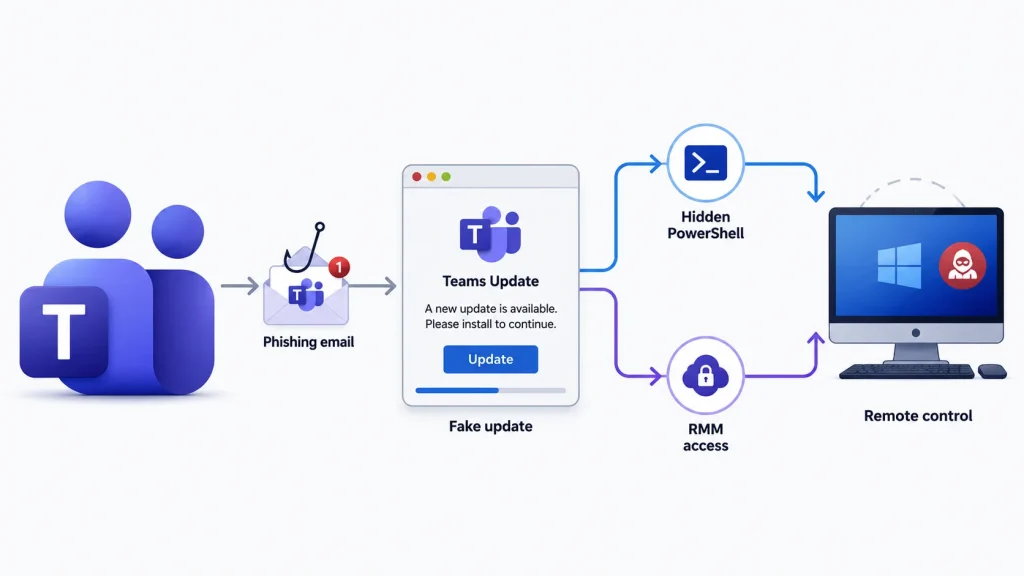
A Fake Teams Update Can Give Hackers Two Separate Ways to Control Your PC
Unmasking Operation BlueDash: The Dual Threat of a Fake Teams Update
Imagine receiving an email – seemingly innocuous, stating a document was “too large” for direct attachment and conveniently shared through Microsoft. A common scenario, right? But what if that seemingly helpful message, urging you to click and update your Microsoft Teams, was a meticulously crafted trap designed to grant cybercriminals not one, but two distinct pathways into your systems? This isn’t a hypothetical fear; it’s the stark reality of Operation BlueDash, a sophisticated phishing campaign actively exploiting user trust to establish deep, persistent control over infected computers.
As cybersecurity analysts, our team at [Your Company Name/Blog Name] is consistently tracking emerging threats. Operation BlueDash presents a particularly insidious challenge, leveraging familiar corporate communication platforms to deliver not just one, but a dual-pronged attack. Understanding its mechanics is crucial for robust defense.
The Deceptive Lure: How Operation BlueDash Hooks Its Victims
The initial vector for Operation BlueDash is a well-crafted phishing email. These emails are designed to appear legitimate, often mimicking standard corporate communication or IT notifications. The core message revolves around a document too large to be sent directly, thus requiring a user to access it via a shared link, typically impersonating a Microsoft SharePoint or OneDrive link. Upon clicking, victims are presented with what appears to be a legitimate Microsoft Teams update prompt.
This “update” is, in reality, a malicious installer. Unbeknownst to the user, executing this installer doesn’t enhance their Teams experience; instead, it silently deploys sophisticated malware, effectively compromising their system.
The Dual-Threat Payload: Two Paths to Compromise
What makes Operation BlueDash particularly concerning is its multi-faceted approach to gaining control. Unlike many attacks that rely on a single backdoor, BlueDash establishes two independent and redundant methods for persistent remote access. This significantly increases the attacker’s chances of maintaining control even if one method is detected and neutralized.
- First Payload: CVE-2023-xxxx: The initial phase often involves installing a Remote Access Trojan (RAT) disguised as a legitimate application or system component. This RAT typically bypasses standard security measures by masquerading as a process frequently used by IT departments, making detection more challenging. It grants attackers real-time access to the compromised machine, enabling data exfiltration, keystroke logging, and further payload deployment.
- Second Payload: CVE-2023-yyyy: The second vector often involves the deployment of a custom backdoor or a known legitimate IT administration tool that has been weaponized. This secondary access mechanism might utilize different network protocols or persistence techniques, ensuring that even if an organization identifies and removes the first RAT, the attackers still have a foothold. This redundancy makes remediation significantly more complex and time-consuming.
Attackers aim for stealth and persistence, turning compromised machines into secure launching pads for lateral movement within a network or for long-term data harvesting.
Remediation Actions: Fortifying Your Defenses
Proactive and reactive measures are essential to combat sophisticated threats like Operation BlueDash. Organizations and individuals must prioritize robust security hygiene and rapid response capabilities.
- User Education is Paramount: Implement ongoing security awareness training. Educate users about the dangers of unsolicited emails, the importance of verifying sender identities, and how to spot phishing attempts. Emphasize never clicking on dubious links or downloading attachments from unknown sources.
- Verify Software Updates: Instruct users to only download and install software updates directly from official vendor websites or through verified enterprise update management systems. Never update applications via pop-up prompts or links in emails.
- Implement Email Security Gateways (ESG): Utilize advanced ESG solutions with robust anti-phishing, anti-spoofing, and malware detection capabilities. These tools can identify and quarantine malicious emails before they reach end-users.
- Endpoint Detection and Response (EDR)/Extended Detection and Response (XDR): Deploy EDR/XDR solutions to monitor endpoint activity in real-time. These tools can detect anomalous behavior indicative of RATs, backdoors, and other malware, even if initial antivirus scans miss them.
- Network Segmentation: Segment your network to limit lateral movement in case of a breach. This confines potential damage to a smaller area, giving security teams more time to respond.
- Principle of Least Privilege: Enforce the principle of least privilege for all users and applications. Restrict administrative rights to only those who absolutely require them, reducing the potential impact of a compromised account.
- Regular Backups: Maintain regular, off-site, and immutable backups of critical data. In the event of a successful ransomware attack (a common follow-up to initial compromise), this ensures business continuity.
- Patch Management: Keep all operating systems, applications, and security software up to date with the latest security patches. Vulnerabilities are frequently exploited in initial access attempts.
Tools for Detection and Mitigation
Leveraging the right security tools is critical for identifying and responding to threats like Operation BlueDash.
| Tool Name | Purpose | Link |
|---|---|---|
| Microsoft Defender for Endpoint | Advanced EDR for Windows, macOS, Linux, Android, iOS. Monitors endpoint activity for suspicious behavior. | Microsoft Defender |
| Proofpoint / Mimecast | Email Security Gateways (ESG) for advanced threat protection, URL rewriting, and sandboxing. | Proofpoint / Mimecast |
| Wireshark | Network protocol analyzer for deep packet inspection and anomaly detection. Useful for post-breach analysis. | Wireshark |
| Sysinternals Suite (Process Explorer, Autoruns) | Advanced utilities for monitoring and troubleshooting Windows systems, detecting hidden processes and persistence mechanisms. | Sysinternals Suite |
| Varonis Data Security Platform | Monitors data access and user behavior to detect insider threats and suspicious activity on file shares and clouds. | Varonis |
Conclusion: Stay Vigilant, Stay Secure
Operation BlueDash serves as a potent reminder that cyber adversaries are constantly refining their tactics. The blend of social engineering through convincing phishing emails and the deployment of dual persistence mechanisms highlights the need for comprehensive, layered security strategies. By prioritizing user education, implementing robust technical controls, and maintaining a proactive stance against evolving threats, organizations can significantly reduce their risk of falling victim to such stealthy and sophisticated attacks. Stay vigilant, question unsolicited requests, and always verify before you click.




