
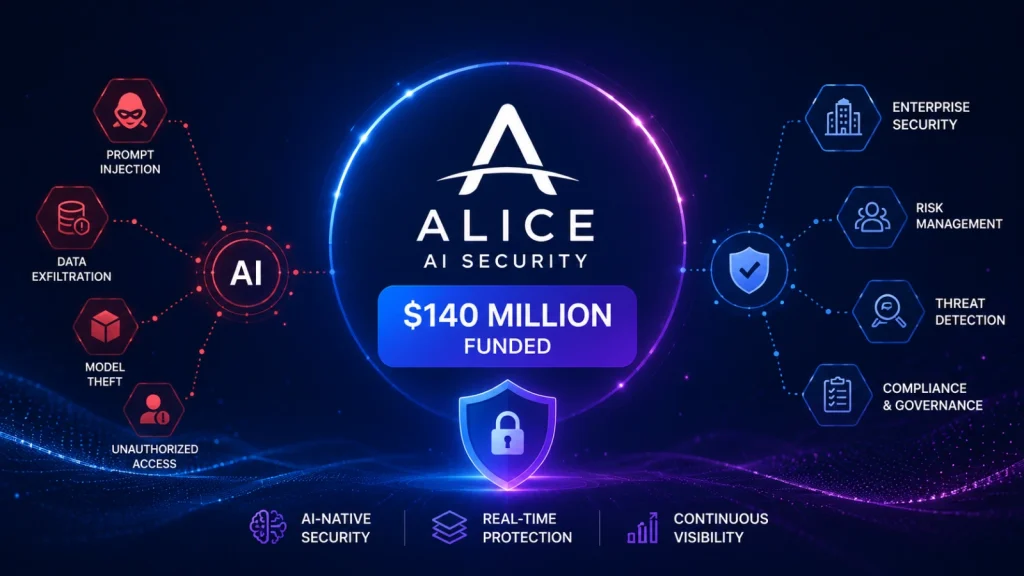
AI Security Startup Alice Raises $140 Million as Enterprise AI Threats Surge
AI Security Startup Alice Secures $140 Million Amid Rising Enterprise AI Threats
The landscape of enterprise technology is rapidly transforming, with artificial intelligence (AI) becoming an indispensable, yet increasingly vulnerable, component of business operations. Recent news underscores this critical shift: Alice, the AI trust, safety, and security company formerly known as ActiveFence, has successfully closed a significant funding round of $140 million. This investment, led by Apax Digital Funds and featuring new backing from key industry players like SentinelOne and Samsung Electronics, highlights the escalating concerns around AI security and the urgent need for robust defense mechanisms.
The Genesis of Alice: Addressing AI Trust and Safety
Alice’s rebranding from ActiveFence signifies a sharper focus on the multifaceted challenges surrounding AI. Their mission extends beyond traditional cybersecurity to encompass AI trust, safety, and security – a holistic approach vital for organizations deploying AI at scale. The substantial capital infusion reflects investor confidence in Alice’s ability to address sophisticated threats unique to AI systems, which often involve data integrity, model manipulation, and ethical considerations. The involvement of venture capital firms such as Resolute Ventures, Grove Ventures, CRV, Highland Europe, and Norwest, alongside new strategic investors, underscores a collective recognition of the burgeoning market for specialized AI security solutions.
The Surging Tide of Enterprise AI Threats
The rapid adoption of AI across enterprises brings with it an equally rapid proliferation of novel attack vectors. Traditional cybersecurity measures, while foundational, are often insufficient to counter threats targeting AI models directly. These include data poisoning, model evasion, and intellectual property theft concerning proprietary AI algorithms. For instance, adversaries might employ techniques to inject malicious data into training datasets, corrupting the AI’s learning process and leading to biased or erroneous outputs. Similarly, model evasion attacks aim to trick an AI into misclassifying input, potentially bypassing critical security controls or making incorrect business decisions.
While specific CVEs directly attributing to “AI threats” are still an evolving area, the underlying vulnerabilities in software components used in AI pipelines are often cataloged. For example, vulnerabilities in frameworks like TensorFlow or PyTorch, or in the underlying operating systems and libraries, could be exploited. An example of a related vulnerability might be CVE-2023-39325, a medium-severity vulnerability found in Google TensorFlow that could lead to denial of service, emphasizing the continuous need for vigilance in the foundational components of AI infrastructure.
Investment and Strategic Partnerships: A Market Validation
The $140 million funding round is a clear indicator of the market’s demand for specialized AI security. Apax Digital Funds’ leadership, combined with strategic investments from SentinelOne and Samsung Electronics, speaks volumes. SentinelOne’s expertise in endpoint security and AI-powered threat detection positions them as a logical partner, likely seeking to integrate Alice’s capabilities into their broader security offerings. Samsung Electronics’ participation highlights the critical importance of AI security for hardware manufacturers and consumer electronics, where AI integration is becoming ubiquitous. This blend of financial and strategic backing provides Alice with significant resources to innovate and scale its solutions globally.
Remediation Actions: Securing Your Enterprise AI
Securing AI deployments requires a multi-layered strategy that extends beyond conventional cybersecurity practices. Organizations must proactively address the unique challenges presented by AI systems:
- Data Integrity and Validation: Implement robust data validation pipelines to prevent data poisoning. Use techniques like differential privacy and anomaly detection to identify and neutralize malicious data injections during training and inference.
- Model Robustness Testing: Conduct adversarial testing to identify vulnerabilities in AI models. Employ techniques like white-box and black-box attacks to understand how models respond to perturbed inputs and build defenses against evasion.
- Access Control and Auditing: Apply strict access controls to AI training data, models, and deployment environments. Implement comprehensive logging and auditing to track access and modifications, ensuring accountability and detecting unauthorized activities.
- Ethical AI Frameworks: Develop and adhere to ethical AI guidelines to prevent biased or harmful AI outputs. Regularly review AI systems for fairness, transparency, and accountability.
- Secure Development Lifecycle for AI (SDL-AI): Integrate security considerations throughout the entire AI development lifecycle, from data collection and model training to deployment and maintenance.
- Supply Chain Security for AI Components: Scrutinize all third-party AI models, libraries, and frameworks for potential vulnerabilities before integration.
The Future of AI Security: A Collaborative Effort
Alice’s substantial funding round is more than just a financial milestone; it signals a pivotal moment for the AI security industry. As AI continues to permeate every facet of enterprise operations, the need for specialized, proactive security measures will only intensify. The collaboration between established cybersecurity firms, technology giants, and innovative startups like Alice will be crucial in building a resilient and trustworthy AI ecosystem. Organizations must recognize that securing AI is not an optional add-on but a fundamental requirement for successful and responsible AI deployment.




