
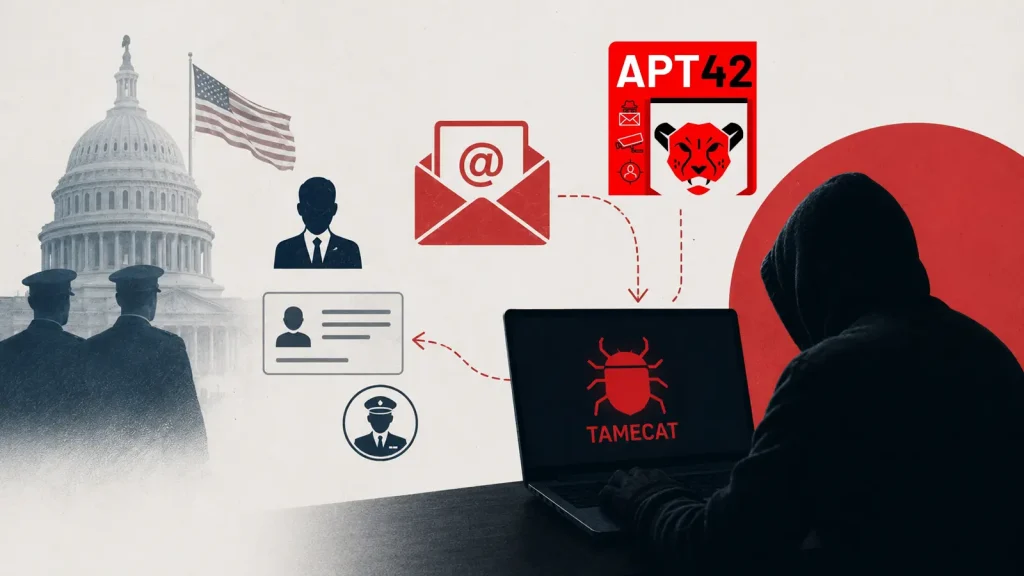
APT42 Uses AI-Assisted Phishing and TAMECAT Malware to Target Government and Defense Officials
The cyber espionage landscape is witnessing a stark evolution, with nation-state actors adopting increasingly sophisticated tactics. A recent report reveals a concerning trend: APT42, an Iran-linked advanced persistent threat group, has significantly escalated its operations. They are now leveraging what appears to be AI-assisted research, crafting highly convincing phishing campaigns, and deploying a more resilient iteration of their custom malware, TAMECAT. This aggressive campaign specifically targets high-value individuals within government and defense sectors, alongside policy experts and even their close family members.
APT42: A Persistent Threat with Evolving Tactics
APT42, also known by aliases such as Charming Kitten, Phosphorus, and TA453, has long been recognized for its persistent cyber espionage activities. Their primary objective typically revolves around intelligence gathering aligned with Iranian geopolitical interests. Historically, their operations have relied on volume-based phishing attempts. However, this latest evolution marks a strategic shift towards precision and efficacy over sheer quantity.
The AI-Assisted Phishing Advantage
What sets this recent APT42 campaign apart is the apparent integration of AI in its initial reconnaissance and social engineering phases. Rather than casting a wide net, APT42 appears to be meticulously researching targets to create highly believable personas and contextually relevant lures. This likely involves:
- Enhanced Impersonation: Crafting email addresses, domains, and social media profiles that mimic legitimate entities or individuals, making initial contact appear authentic.
- Personalized Lures: Developing phishing content tailored to the target’s interests, professional role, or personal connections, significantly increasing the likelihood of engagement.
- Reduced Suspicion: Moving away from generic, easily detectable phishing attempts towards nuanced, personalized communications that bypass traditional email filters and raise fewer red flags.
The focus on senior government and defense officials, policy experts, and their families underscores the high-stakes nature of these attacks. Compromising these individuals can yield critical intelligence, access to sensitive networks, or leverage for future operations.
TAMECAT’s Resilience: A Malware Makeover
Central to APT42’s operational success is its custom malware, TAMECAT. The group has reportedly deployed a more robust and resilient version of this malware in recent campaigns. While specific technical details about the enhancements are often proprietary to intelligence reports, a “more resilient” version typically implies:
- Improved Evasion Techniques: Better capabilities to bypass endpoint detection and response (EDR) systems, antivirus software, and network security appliances.
- Enhanced Persistence Mechanisms: More sophisticated methods for maintaining access to compromised systems even after reboots or security cleanups.
- Stealthier Communications: Advanced command and control (C2) communication methods that are harder to detect and block, potentially using encrypted channels or legitimate-looking traffic.
- Anti-Analysis Features: Techniques to hinder reverse engineering efforts by security researchers, such as obfuscation or anti-debugging measures.
The deployment of such a refined tool indicates APT42’s commitment to long-term access and intelligence extraction from their high-value targets.
Who is Most at Risk?
The targeting profile unequivocally points to individuals with access to sensitive information or influence over national policies. This includes:
- Senior officials within government agencies.
- Military personnel and defense contractors.
- Foreign policy advisors and think tank experts.
- Family members of high-value targets, used as an indirect vector for compromise.
Organizations and individuals within these sectors must understand the heightened threat level and adapt their security postures accordingly.
Remediation Actions and Defensive Strategies
Mitigating the threat posed by APT42’s sophisticated tactics requires a multi-layered approach focusing on both technological defenses and human awareness. No specific CVEs are directly associated with APT42’s TTPs (Tactics, Techniques, and Procedures), but general security best practices are paramount.
- Advanced Email Security: Implement and regularly update advanced threat protection (ATP) solutions for email gateways. These should include sandbox detonation, URL rewriting, and robust attachment analysis to detect sophisticated phishing lures.
- Security Awareness Training: Conduct regular, realistic phishing simulations and provide ongoing education to all personnel, especially high-value targets. Training should focus on identifying social engineering tactics, recognizing unusual communication patterns, and verifying sender identities.
- Multi-Factor Authentication (MFA): Mandate MFA for all accounts, particularly for remote access, email, and critical internal systems. This significantly reduces the impact of compromised credentials.
- Endpoint Detection and Response (EDR): Deploy EDR solutions across all endpoints to monitor for suspicious activities, detect malware, and respond swiftly to potential compromises.
- Network Segmentation: Segment networks to limit the lateral movement of attackers if an initial compromise occurs.
- Principle of Least Privilege: Enforce the principle of least privilege for all users and systems, ensuring that individuals only have the access necessary for their roles.
- Incident Response Plan: Develop and regularly test a comprehensive incident response plan to ensure a swift and effective reaction to security incidents.
- Threat Intelligence Integration: Subscribe to and integrate relevant threat intelligence feeds to stay updated on APT42’s evolving tactics and indicators of compromise (IoCs).
Conclusion
The latest activities of APT42, characterized by AI-assisted phishing and a more resilient TAMECAT malware, signify a significant escalation in the cyber espionage threat landscape. Their shift towards highly targeted, meticulously crafted attacks against government and defense officials demands heightened vigilance. Organizations must prioritize robust security awareness training, implement advanced technical controls, and continually adapt their defenses to counter these evolving nation-state threats. Proactive defense and a strong security posture are no longer optional but essential for safeguarding critical national security information.




