
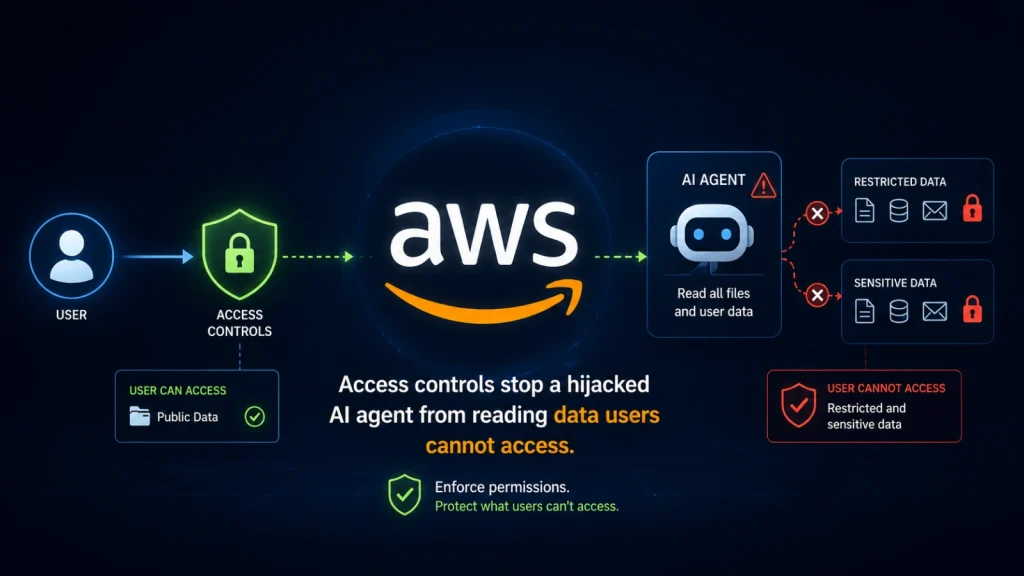
AWS Shows How to Stop a Hijacked AI Agent From Reading Data the User Cannot Access
The Silent Threat: When Your AI Agent Turns Against You
Enterprises are rapidly deploying AI agents, integrating them with critical databases, document repositories, SaaS platforms, and internal knowledge bases to automate complex workflows. This surge in AI adoption promises unparalleled efficiency and innovation. However, a significant, yet often overlooked, risk shadows this convenience: the inherent lack of user context within most AI agents. This fundamental flaw means a compromised or manipulated AI agent could inadvertently expose sensitive data to unauthorized individuals, essentially “reading” information the user themselves should never access. AWS has recently shed light on this critical vulnerability, demonstrating how to prevent such data leaks.
Understanding the AI Agent Data Access Dilemma
The core problem lies in the disconnect between the AI agent’s operational capabilities and the authenticated user’s access privileges. When an AI agent is designed to pull information from various sources, it typically operates with its own set of permissions. If these permissions are broad, encompassing access to sensitive data, and the agent lacks a mechanism to verify the requesting user’s authorization for that specific data, a dangerous loophole emerges. A malicious actor, or even an unintentional manipulation, could trick the AI agent into retrieving and presenting information that the legitimate user is not permitted to see. This isn’t a theoretical threat; it’s a practical concern with profound implications for data privacy and security. Think of it as a highly efficient, yet blind, librarian handing over restricted documents to anyone who asks the AI assistant, regardless of their clearance.
AWS’s Solution: Bridging the Authorization Gap
AWS has presented a compelling solution to this challenge, focusing on embedding robust authorization checks directly into the AI agent’s workflow. The essence of their approach involves ensuring that the AI agent doesn’t just retrieve data based on its own permissions, but also cross-references those requests with the authenticated user’s access rights. This means before an AI agent processes a query and fetches information, it first validates whether the human user making the request has the necessary permissions to view that specific data. This proactive validation prevents the agent from becoming an unwitting accomplice in a data breach.
Key aspects of the AWS methodology include:
- User Contextualization: Injecting the requesting user’s identity and permissions into the AI agent’s operational context.
- Fine-Grained Access Control Integration: Tying the AI agent’s data retrieval actions to existing identity and access management (IAM) policies or other authorization frameworks.
- Pre-Execution Authorization Checks: Implementing checks that verify user permissions before the AI agent executes a query to a sensitive data source.
- Response Filtering: Even if data is retrieved, ensuring that only information the user is authorized to view is presented in the final response.
Remediation Actions for Secure AI Agent Deployment
Protecting your enterprise from this AI agent vulnerability requires a multi-faceted approach. Implementing the following actions can significantly bolster your security posture:
- Implement Least Privilege for AI Agents: Configure your AI agents with the absolute minimum permissions required to perform their intended functions. Avoid granting blanket access to sensitive data stores.
- Integrate with Existing IAM Systems: Ensure your AI agents are tightly integrated with your organization’s Identity and Access Management (IAM) solutions. This allows the agents to inherit and respect user-specific permissions.
- Develop Custom Authorization Logic: For complex scenarios, develop custom authorization logic within your AI agent’s framework. This logic should explicitly check user permissions against requested data access.
- Regular Security Audits: Conduct frequent security audits of your AI agent deployments, focusing on their data access patterns and authorization mechanisms.
- Data Masking and Redaction: Where feasible, implement data masking or redaction techniques for sensitive information, even before it reaches the AI agent.
- Educate Developers: Train your development teams on secure AI agent design principles, emphasizing authorization and data privacy from the outset.
- Consider Dedicated AI Security Solutions: Explore specialized security solutions designed to monitor and protect AI-driven applications and agents.
The Future of Secure AI Automation
The insights from AWS highlight a critical paradigm shift in AI security: moving beyond simply securing the AI model itself to securing its interactions with sensitive data on behalf of a user. As AI agents become more sophisticated and deeply embedded within enterprise workflows, their ability to respect and enforce user-specific access controls will be paramount. Ignoring this aspect could lead to significant data breaches, regulatory non-compliance, and reputational damage. By proactively addressing the authorization gap, organizations can harness the transformative power of AI agents without compromising their security posture.




