
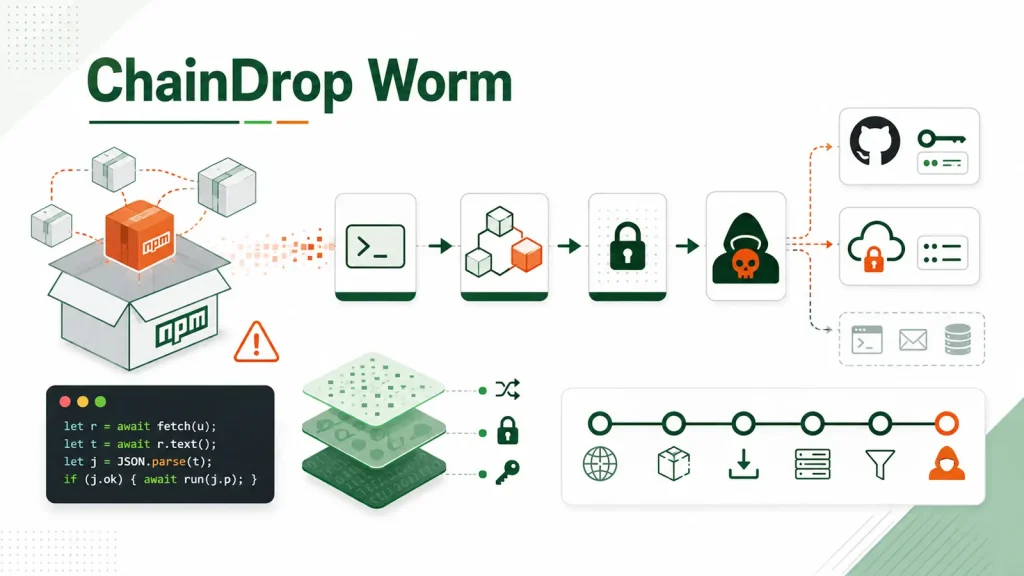
ChainDrop Worm Infects 400+ npm Packages to Steal GitHub and Cloud Credentials
Routine software installations are often seen as benign, a simple step in a developer’s workflow. However, a new threat has turned this perception on its head, transforming these updates into a dangerous conduit for credential theft. We’re talking about the ChainDrop worm, a self-propagating entity that has infiltrated over 400 npm packages, quietly laying siege to developer laptops, build systems, and critical cloud environments. The insidious nature of this campaign lies in its ability to compromise packages without disrupting their functionality, leaving development teams blissfully unaware that a seemingly innocuous update has opened a backdoor directly into their infrastructure.
Understanding the ChainDrop Worm’s Modus Operandi
The ChainDrop worm represents a sophisticated attack vector, leveraging the widespread use of npm (Node Package Manager) in modern software development. Its primary objective is to exfiltrate sensitive credentials, specifically targeting GitHub and various cloud service providers. The worm achieves this through a self-propagating mechanism, meaning that once it infects an initial package, it actively seeks out and compromises others within the npm ecosystem.
The danger is amplified by its stealth. Developers installing or updating an infected package will likely experience no immediate change in functionality. The package will perform as expected, masking the underlying compromise. This lack of overt symptoms makes detection challenging and allows the worm to spread and persist within environments largely unnoticed.
The Risk to Developers and Organizations
The implications of a ChainDrop infection are severe and far-reaching:
- GitHub Credential Theft: Compromised GitHub credentials can lead to unauthorized access to repositories, intellectual property theft, code manipulation, and further supply chain attacks.
- Cloud Environment Breach: Stolen cloud credentials (e.g., AWS, Azure, Google Cloud) grant attackers access to sensitive data, critical infrastructure, and the ability to deploy malicious resources, incur fraudulent charges, or disrupt services.
- Supply Chain Compromise: By infecting widely used npm packages, ChainDrop poses a significant threat to the entire software supply chain. Applications that depend on these compromised packages can inherit the vulnerability, spreading the risk downstream to end-users.
- Data Exfiltration: With access to development environments and cloud resources, attackers can exfiltrate sensitive company data, customer information, and proprietary code.
Remediation Actions for ChainDrop Worm Infections
Proactive and reactive measures are crucial to mitigate the risks posed by the ChainDrop worm. Organizations and individual developers must implement robust security practices:
- Audit Dependencies: Regularly audit all npm package dependencies for known vulnerabilities and suspicious behavior. Utilize tools that can scan for compromised packages.
- Implement Software Composition Analysis (SCA): Integrate SCA tools into your CI/CD pipeline to automatically identify and flag vulnerable or malicious packages before they are deployed.
- Least Privilege Principle: Ensure that build systems and development environments operate with the principle of least privilege, limiting their access to only what is absolutely necessary.
- Multi-Factor Authentication (MFA): Enforce MFA for all GitHub accounts, cloud console access, and other critical services to add an extra layer of security against credential theft.
- Rotate Credentials: Regularly rotate API keys, access tokens, and other sensitive credentials, especially those used in automated build processes.
- Monitor Outbound Network Traffic: Implement network monitoring to detect unusual outbound connections or data exfiltration attempts from development machines and build servers.
- Sandbox Build Environments: Isolate build environments in sandboxed containers or virtual machines to limit the blast radius of any potential infection.
- Stay Informed: Keep abreast of the latest security advisories and threats related to package managers and software supply chain attacks.
Tools for Detection and Mitigation
Leveraging the right tools can significantly enhance your defense against threats like ChainDrop.
| Tool Name | Purpose | Link |
|---|---|---|
| Snyk | Software Composition Analysis (SCA), vulnerability scanning, dependency tracking. | https://snyk.io/ |
| Dependabot | Automated dependency updates and vulnerability alerts for GitHub repositories. | https://github.com/dependabot |
| OWASP Dependency-Check | Analyzes project dependencies and identifies known vulnerabilities. | https://owasp.org/www-project-dependency-check/ |
| npm audit | Built-in npm command to audit dependencies for security vulnerabilities. | https://docs.npmjs.com/cli/v9/commands/npm-audit |
| Cloud Security Posture Management (CSPM) solutions | Continuously monitor cloud environments for misconfigurations and compliance issues. (e.g., Palo Alto Networks Prisma Cloud, CrowdStrike Cloud Security) | https://www.paloaltonetworks.com/cloud-security/prisma-cloud |
Conclusion
The ChainDrop worm serves as a stark reminder of the persistent and evolving threats within the software supply chain. Its ability to self-propagate and operate without detection makes it particularly dangerous, turning everyday development tasks into potential security breaches. Protecting against such attacks requires a multi-layered approach, combining vigilant dependency management, robust security tooling, and adherence to fundamental cybersecurity principles. Organizations must prioritize the security of their development pipelines and cloud environments to safeguard against sophisticated credential theft campaigns.




