
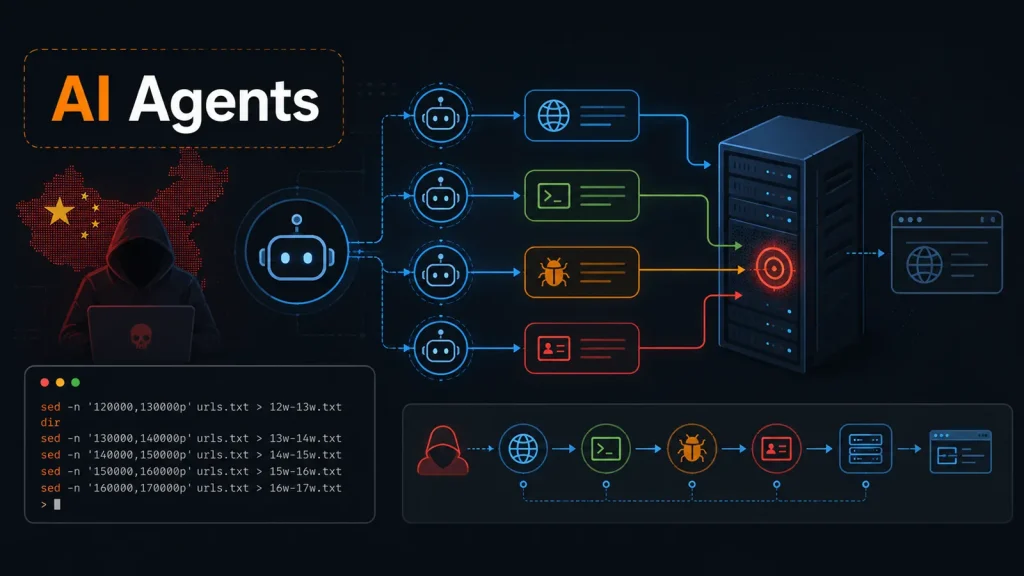
Chinese Hackers Use AI Agents to Exploit Web Servers and Automate Attacks
The landscape of cyber threats is continuously evolving, and a concerning new development highlights the growing sophistication of state-sponsored cybercrime. Recent reports indicate that a Chinese-speaking cybercrime group, tracked as UAT-10147, is leveraging advanced AI-assisted tools to automate attacks and exploit vulnerable web servers. This alarming trend underscores how familiar security flaws become exponentially more dangerous when combined with the power of artificial intelligence, allowing attackers to scale their operations with unprecedented efficiency.
AI-Powered Exploitation: A New Frontier in Cyber Warfare
UAT-10147 has demonstrated a worrying capability to transform readily available vulnerabilities into potent entry points across a diverse range of sectors. Their targets include government agencies, educational institutions, media organizations, technology firms, and even gaming companies. This broad scope, coupled with their use of AI, signifies a strategic shift from manual, labor-intensive exploitation to a highly automated and efficient attack methodology.
The core of their strategy involves using AI agents to identify and exploit common weaknesses in internet-facing Windows and Linux systems. While the specific AI tools remain undisclosed, their impact is clear: these agents streamline the reconnaissance, vulnerability scanning, and initial access phases of an attack, significantly reducing the time and resources required for successful compromise. This automation enables the group to rapidly scan vast networks for exploitable flaws, escalating the risk for organizations globally.
Targeted Systems and Vulnerabilities
The group’s focus on internet-facing servers means that any organization running publicly accessible web services is potentially at risk. While the original source does not explicitly list CVEs, common vulnerabilities in web servers often include:
- Remote Code Execution (RCE): Flaws that allow attackers to execute arbitrary code on a server. Examples often include deserialization vulnerabilities or improperly configured web applications.
- SQL Injection: A prevalent web security vulnerability that allows attackers to interfere with the queries an application makes to its database.
- Cross-Site Scripting (XSS): Enables attackers to inject client-side scripts into web pages viewed by other users. While primarily affecting users, severe XSS can lead to session hijacking or data exfiltration.
- Server-Side Request Forgery (SSRF): A vulnerability where an attacker can induce the server-side application to make HTTP requests to an arbitrary domain of the attacker’s choosing.
- Directory Traversal: Allows attackers to access restricted directories and files outside the web server’s root directory.
The use of AI agents makes the discovery and exploitation of such vulnerabilities far more efficient, meaning that even well-known, unpatched flaws become critical vectors for compromise.
Remediation Actions: Fortifying Your Digital Defenses
Given the automated nature of these attacks, proactive and comprehensive security measures are paramount. Organizations must adopt a multi-layered defense strategy to mitigate the risks posed by UAT-10147 and similar threat actors.
- Patch Management: Implement a rigorous and timely patch management program. All internet-facing systems, applications, and their underlying operating systems (Windows and Linux) must be updated immediately upon release of security patches.
- Vulnerability Management: Conduct regular vulnerability scans and penetration tests of all public-facing assets. Prioritize remediation based on exploitability and potential impact.
- Web Application Firewall (WAF): Deploy and properly configure a WAF to protect web applications from common attacks like SQL injection, XSS, and RCE. A WAF can detect and block malicious requests even if underlying vulnerabilities exist.
- Network Segmentation: Isolate critical servers and sensitive data through network segmentation. This limits an attacker’s lateral movement even if they gain initial access to a less critical system.
- Strong Authentication and Access Control: Enforce strong, unique passwords, multi-factor authentication (MFA), and the principle of least privilege for all administrative accounts and critical systems.
- Intrusion Detection/Prevention Systems (IDS/IPS): Utilize IDS/IPS to monitor network traffic for suspicious activity and known attack patterns, potentially identifying automated scanning attempts.
- Security Information and Event Management (SIEM): Implement a SIEM solution to centralize log collection and analysis, enabling rapid detection of anomalies and potential compromises.
- Employee Training: Educate employees about phishing, social engineering, and the importance of secure computing practices, as human error remains a common entry point for attackers.
Tools for Detection and Mitigation
| Tool Name | Purpose | Link |
|---|---|---|
| OpenVAS / Greenbone Vulnerability Management | Comprehensive vulnerability scanning and management | Greenbone.net |
| OWASP ZAP | Web application security scanner (dynamic application security testing) | Zaproxy.org |
| Nessus | Enterprise-grade vulnerability assessment solution | Tenable.com |
| Snort / Suricata | Open-source network intrusion detection and prevention systems | Snort.org / Suricata-ids.org |
| ModSecurity | Open-source web application firewall (WAF) | Modsecurity.org |
The Future of Automated Attacks
The actions of UAT-10147 serve as a stark warning: the integration of AI into cyberattack methodologies is not a distant future but a present reality. As AI technologies become more accessible and sophisticated, the threat landscape will continue to evolve, demanding even greater vigilance and adaptability from cybersecurity professionals. Organizations must recognize that traditional, manual defense strategies may not be sufficient against automated, AI-driven adversaries. Investing in advanced threat intelligence, automation for defense, and continuous security posture management is no longer optional but essential for survival in this new era of cyber threats.




