
Citrix NetScaler Heap Overflow Flaw Lets Remote Attackers Execute Code as Root – PoC Released
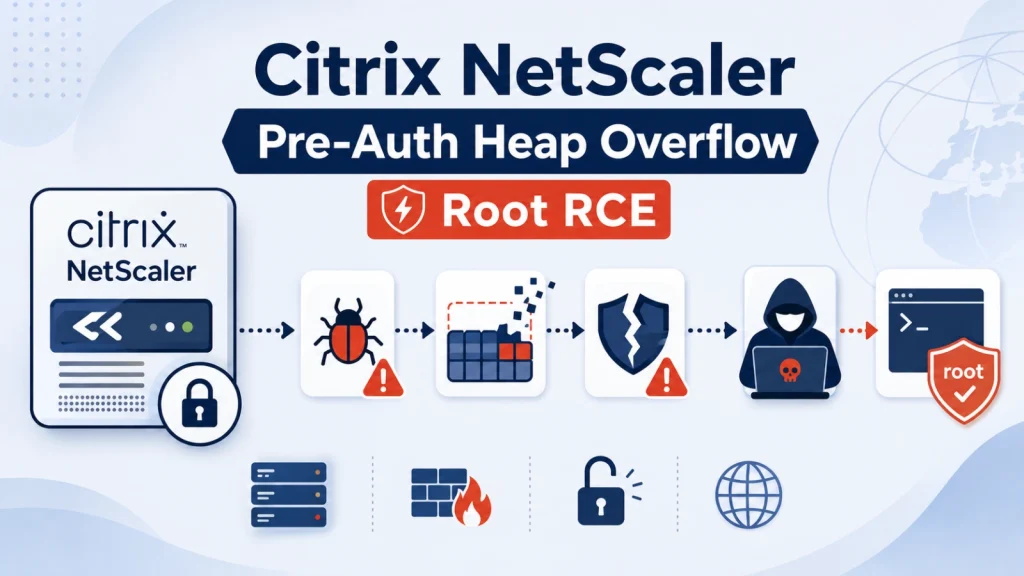
A critical pre-authentication heap overflow vulnerability in Citrix NetScaler ADC and NetScaler Gateway has been demonstrated to allow unauthenticated, root-level remote code execution (RCE). A working proof-of-concept (PoC) exploit has been released, elevating the urgency for immediate patching and remediation.
This flaw, tracked as CVE-2023-8452, was initially disclosed by Cloud Software Group in their June 30 security bulletin CTX696604. While initially described as a memory overflow leading to potential denial-of-service, the recent PoC release confirms its far more severe potential for full system compromise.
Understanding the Citrix NetScaler Heap Overflow (CVE-2023-8452)
The vulnerability stems from a heap overflow condition within the Citrix NetScaler ADC and NetScaler Gateway products. A heap overflow occurs when a program writes data beyond the allocated buffer in the heap memory, potentially corrupting adjacent memory and leading to unpredictable behavior or, in this case, arbitrary code execution.
What makes CVE-2023-8452 particularly dangerous is its pre-authentication nature. This means an attacker does not need valid credentials to exploit the flaw. Furthermore, the successful exploitation demonstrated by the PoC results in root-level RCE, granting the attacker complete control over the affected system. This level of access allows for data exfiltration, system manipulation, and the establishment of persistent backdoors, posing a significant threat to organizational security.
Impact of Remote Code Execution on Citrix NetScaler
The ability for unauthenticated, root-level RCE on a critical network appliance like Citrix NetScaler ADC or Gateway has profound implications. These devices are often positioned at the network edge, handling sensitive traffic and providing access to internal resources. A successful exploit could lead to:
- Network Compromise: Attackers can gain a foothold within the corporate network, pivoting to other systems and resources.
- Data Breach: Access to sensitive data traversing the NetScaler or stored on connected systems.
- Service Disruption: Tampering with configurations, causing denial-of-service, or completely shutting down critical services.
- Evasion of Security Controls: A compromised NetScaler can be used to bypass existing security measures and monitoring.
- Persistent Access: Establishment of backdoors for long-term access and covert operations.
Remediation Actions for Citrix NetScaler Administrators
Given the severity and the availability of a PoC exploit for CVE-2023-8452, immediate action is paramount. Administrators of Citrix NetScaler ADC and NetScaler Gateway deployments should prioritize the following steps:
- Immediate Patching: Apply the security updates released by Cloud Software Group. Refer to the official security bulletin CTX696604 for specific versions and upgrade paths. This is the most critical step to mitigate the vulnerability.
- Network Segmentation: Ensure NetScaler devices are isolated on dedicated network segments, limiting potential lateral movement in case of compromise.
- Monitor Logs: Scrutinize NetScaler logs for unusual activity, failed login attempts, or unexpected process executions that might indicate exploitation attempts.
- Regular Backups: Maintain regular backups of NetScaler configurations and system images to facilitate rapid recovery if a compromise occurs.
- Review Access Controls: Implement the principle of least privilege for all access to NetScaler devices, both administrative and user-facing.
- Penetration Testing: Consider engaging security professionals to conduct penetration testing on your NetScaler deployments to identify and address any remaining vulnerabilities.
Relevant Tools for Detection and Mitigation
While patching is the primary mitigation, various tools can aid in detection, scanning, and overall security posture improvement:
| Tool Name | Purpose | Link |
|---|---|---|
| Nessus | Vulnerability scanning and detection | https://www.tenable.com/products/nessus |
| OpenVAS | Open-source vulnerability scanner | http://www.openvas.org/ |
| Wireshark | Network protocol analyzer for traffic inspection | https://www.wireshark.org/ |
| Splunk / ELK Stack | Log management and security information and event management (SIEM) | https://www.splunk.com/ / https://www.elastic.co/elastic-stack/ |
| Citrix ADM (Application Delivery Management) | Centralized management, monitoring, and analytics for NetScaler | https://www.citrix.com/products/citrix-application-delivery-management/ |
Conclusion
The disclosure of a working PoC for CVE-2023-8452 underscores the critical importance of timely security updates for network infrastructure. The pre-authentication heap overflow leading to root-level remote code execution on Citrix NetScaler ADC and Gateway devices presents a severe risk to any organization utilizing these products. Immediate patching and a proactive security posture are essential to prevent potential compromises and maintain the integrity of critical IT environments.




