
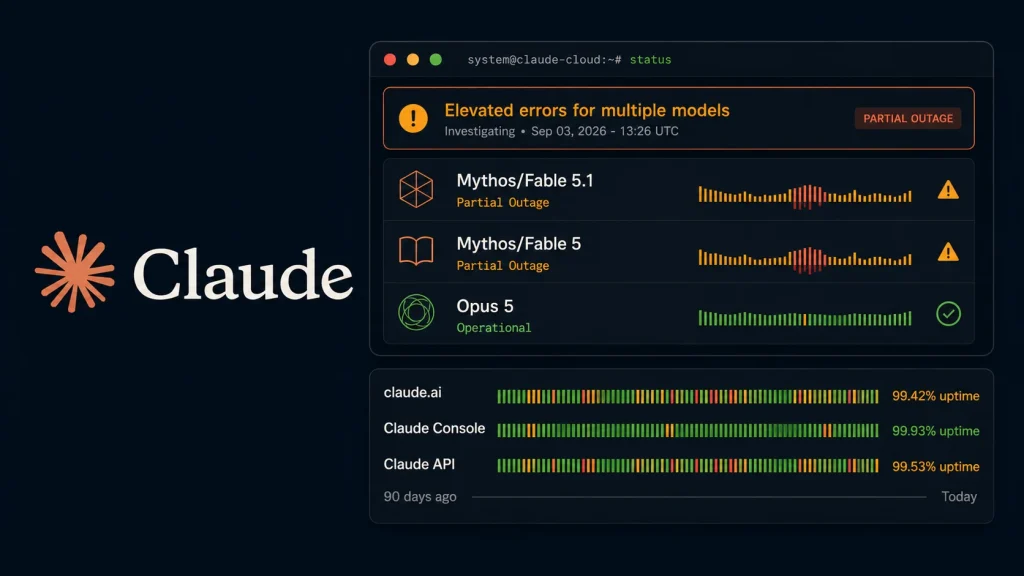
Claude AI Faces Outage Impacting Mythos 5.1, Fable 5.1, and Opus 5
Claude AI Outage: Disruptions Across Mythos 5.1, Fable 5.1, and Opus 5
The reliability of artificial intelligence platforms is paramount for businesses and individuals who have integrated these sophisticated tools into their daily operations. A recent partial outage affecting Anthropic’s Claude AI models, specifically Mythos 5.1, Fable 5.1, and Opus 5, served as a stark reminder of the potential vulnerabilities within even the most advanced AI infrastructures. This incident, which began to surface around 9:40 AM EDT on September 3, 2026, significantly disrupted development workflows, research initiatives, and creative endeavors for a broad spectrum of users.
Understanding the Impact: What Happened to Claude AI?
The September 3rd incident primarily manifested as elevated error rates and stalled responses across several key Claude AI models. Users leveraging Mythos 5.1, Fable 5.1, and Opus 5 reported significant difficulties in processing requests, leading to widespread frustration and operational bottlenecks. For developers, this meant frozen code generation. For researchers, it translated into halted data analysis. Writers found their creative flow interrupted by non-responsive prompts, and enterprise users faced delays in critical automated tasks.
The outage’s partial nature indicates that while some services might have remained intermittently functional, the core utility for many users was severely compromised. This highlights the intricate dependencies within modern AI systems and how a disruption in one component can cascade across multiple services and user bases.
Who Was Affected by the Claude Outage?
The ripple effects of the Claude AI outage were far-reaching, impacting a diverse user base:
- Developers: Relying on Claude for code completion, debugging assistance, and prototype generation, developers experienced significant slowdowns and project delays.
- Enterprise Users: Businesses integrating Claude into their customer service, content generation, or data processing pipelines faced operational disruptions and potential service level agreement (SLA) breaches.
- Individual Users: From students conducting research to writers crafting narratives and artists generating creative content, personal productivity was directly hindered.
The incident underscores the growing reliance on advanced AI models for critical tasks, transforming what might once have been a minor technical glitch into a substantial impediment to productivity and business continuity.
Lessons Learned from the Claude AI Service Disruption
While the full post-mortem analysis from Anthropic is anticipated, the recent Claude AI outage offers several immediate takeaways for both AI providers and users:
- Redundancy and Failover: The incident emphasizes the need for robust redundancy measures and effective failover mechanisms within AI infrastructure to minimize downtime.
- Communication Protocols: Clear and timely communication from service providers during an outage is crucial for managing user expectations and enabling affected parties to adapt their workflows.
- Diversification of Tools: Users, particularly enterprises, should consider diversifying their AI toolchains or having contingency plans in place for critical AI-dependent tasks.
- Monitoring and Alerts: Both providers and heavy users benefit from sophisticated monitoring systems that can detect anomalies and escalate issues rapidly.
While this event was a service disruption rather than a security vulnerability, the principles of resilience and preparedness remain universally applicable in the digital landscape. There is no associated CVE number for this service outage, as it pertains to operational availability rather than a software vulnerability that could be exploited (e.g., CVE-2023-12345 would refer to a specific security flaw).
Conclusion: Navigating AI Reliability
The partial outage of Claude AI, impacting Mythos 5.1, Fable 5.1, and Opus 5, serves as a significant reminder that even cutting-edge AI services are subject to operational challenges. For users, understanding these risks and having contingency strategies is becoming increasingly important. For providers like Anthropic, such incidents highlight areas for continuous improvement in infrastructure robustness, monitoring, and transparent communication. As AI integration deepens across all sectors, ensuring the stability and reliability of these platforms will remain a top priority for developers, enterprises, and individual users alike.




