
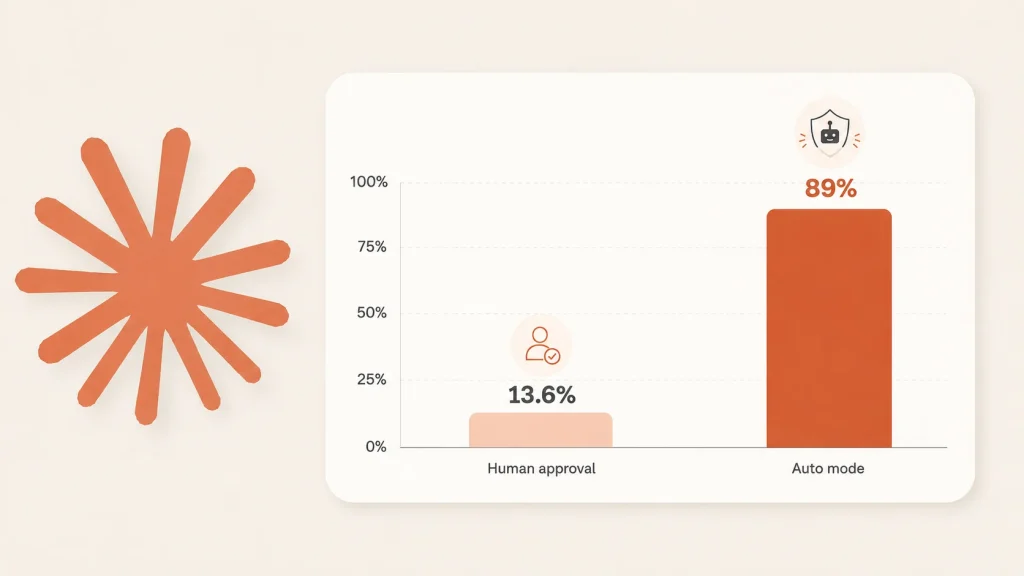
Claude Code Shifts Agent Security From Repeated Human Approval to Auto Mode
Claude Code’s Paradigm Shift: From Human Approval to Automated Agent Security
The landscape of AI-assisted coding is undergoing a significant transformation, particularly in how security protocols are managed. Anthropic, a key player in the AI development space, is fundamentally altering Claude Code’s approach to handling potentially risky commands. This change moves away from a reliance on constant human approval prompts and embraces a more streamlined, automated safety classifier known as “auto mode.” This pivotal shift, which will become the default setting for new sessions on Claude Code’s Pro, Max, and Team plans starting August 14, 2026, marks a new era in AI coding security.
Understanding the Shift to Auto Mode
Historically, AI coding assistants like Claude Code have often employed a “human-in-the-loop” model for security-sensitive operations. This meant that when the AI encountered a command or action deemed potentially risky, it would pause execution and prompt a human user for explicit approval. While seemingly robust, this approach can introduce friction, slow down development workflows, and lead to “alert fatigue” if prompts are too frequent or perceived as overly cautious.
Auto mode represents an evolution of this security paradigm. Instead of relying on repeated human intervention, it leverages an automated safety classifier to assess and manage risks. This classifier is designed to intelligently evaluate commands and code snippets against predefined security policies and potential vulnerabilities. The goal is to allow safe and compliant operations to proceed seamlessly, while still flagging genuinely high-risk scenarios for user attention, albeit with a more refined and less intrusive mechanism.
Implications for Developers and Security Teams
- Increased Efficiency: By automating the approval process for many common or low-risk commands, developers can experience a significant boost in productivity. The AI can operate more autonomously, reducing interruptions and enabling faster iteration cycles.
- Enhanced Scalability: For large development teams or organizations utilizing AI extensively, auto mode offers a more scalable security solution. Manual approvals can become a bottleneck as AI usage grows, whereas an automated system can handle a much larger volume of security checks without human intervention.
- Refined Risk Management: The effectiveness of auto mode hinges on the sophistication of its underlying safety classifier. A well-trained classifier can identify nuanced security risks more consistently than human review, which can be prone to oversight or fatigue. This could lead to a more proactive and less reactive security posture in AI-assisted coding.
- Potential for Over-Automation Concerns: While beneficial, the move towards automation also raises questions. Security teams will need to understand how the auto mode classifier is trained, its limitations, and how to effectively monitor its decisions. Transparency and auditability of the automated system will be crucial to maintain trust and identify potential blind spots.
The Future of AI-Assisted Coding Security
The transition to auto mode in Claude Code is indicative of a broader trend in AI development: moving towards more autonomous and intelligent systems for security. This doesn’t necessarily eliminate the human element but reframes it. Instead of approving every action, humans will likely shift to a role of oversight, policy definition, and intervention in exceptional or highly complex scenarios. This demands a deeper understanding of AI security mechanisms and a focus on defining robust, machine-readable security policies.
Organizations should consider this shift as an opportunity to review their own internal policies for AI tool usage. Establishing clear guidelines for what constitutes a “risky” command, how the automated system should be configured, and the escalation paths for flagged issues will be paramount. The goal is to leverage the speed and efficiency of AI auto mode while maintaining rigorous security standards.
Key Takeaways for Cybersecurity Professionals
- Anthropic’s Claude Code is transitioning to an automated “auto mode” for agent security, replacing frequent human approval prompts.
- This change, effective August 14, 2026, will become the default for new sessions on Pro, Max, and Team plans.
- The move aims to enhance efficiency and scalability in AI-assisted coding by utilizing an automated safety classifier.
- Security teams must understand and adapt to this shift, focusing on policy definition, monitoring, and auditability of automated security systems.




