
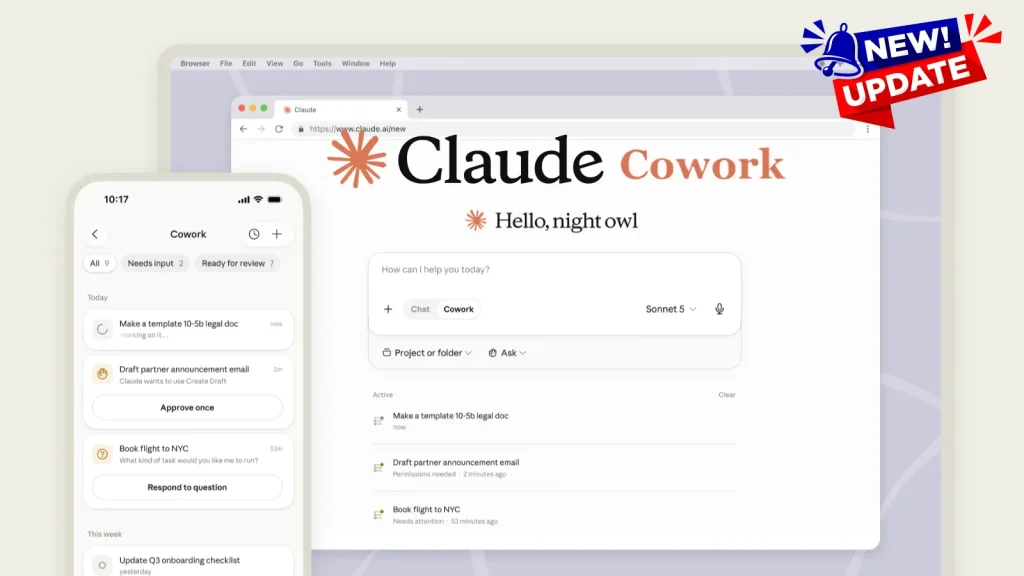
Claude Cowork Allow Users to Remotely Handle Your AI Sessions From Phone
In the rapidly evolving landscape of artificial intelligence, efficiency and accessibility are paramount. For professionals who rely on AI-powered assistance, the ability to seamlessly manage complex tasks across devices can drastically enhance productivity. Claude, a prominent AI assistant, has recently rolled out a significant update to its Cowork feature, fundamentally changing how users interact with and manage their AI sessions. This enhancement, allowing remote handling of AI sessions from mobile devices, marks a pivotal shift towards persistent, device-agnostic AI task execution.
Previously, users were tethered to their desktop environments to initiate and monitor intricate AI workflows. This limitation often meant interrupting a task or delaying its continuation until access to a desktop was restored. The new mobile integration for Claude’s Cowork feature eliminates this friction, empowering users to delegate complex workflows to Claude and monitor their progress from virtually any location, directly from their smartphones.
Understanding Claude’s Cowork Feature Enhancement
The core of this update lies in extending the Cowork feature’s reach beyond the desktop. While the previous iteration facilitated collaborative AI task execution within a single environment, the mobile compatibility introduces a new dimension of flexibility. Users can now start a sophisticated AI-driven analysis on their computer, step away, and then check its status, review intermediate results, or even issue new directives via their mobile phone. This capability transforms Claude into a truly ubiquitous AI assistant, adapting to the user’s workflow rather than dictating it.
This persistent session management is particularly beneficial for tasks requiring extended processing times or iterative refinement. Imagine an analyst needing Claude to comb through extensive datasets, generate reports, or draft complex documents. With Cowork’s mobile integration, they can initiate these tasks, attend meetings, travel, or even work from a different location, all while retaining full oversight and control over Claude’s progress from their smartphone.
Key Benefits for IT Professionals and Developers
For IT professionals and developers, this update offers several immediate advantages:
- Enhanced Workflow Continuity: Tasks can be initiated and monitored without being tied to a specific workstation, reducing downtime and streamlining project timelines.
- Improved Incident Response: In a security context, if Claude is assisting with threat intelligence analysis or incident triage, practitioners can receive updates and guide the AI’s actions remotely, enabling faster response times.
- Increased Productivity: The ability to manage background AI processes from anywhere frees up valuable time for other critical tasks, leading to overall efficiency gains.
- Cross-Platform Collaboration: Teams can leverage Claude’s capabilities more dynamically, with members able to contribute to AI-driven projects regardless of their physical location or device of access.
The Shift Towards Persistent AI Task Execution
The update to Claude’s Cowork feature exemplifies a broader trend in AI development: the move towards persistent and context-aware AI sessions. The goal is to make AI assistants less like discrete tools and more like continuous, intelligent collaborators that understand and adapt to user needs throughout their workday. This includes:
- State Preservation: AI models retaining memory of past interactions and ongoing tasks, allowing for seamless continuation.
- Multi-Modal Interaction: The ability to interact with the AI across various input methods and devices (text, voice, mobile, web).
- Proactive Updates: AI providing timely notifications and updates on task progress, even when not actively being queried.
This paradigm shift not only enhances user experience but also unlocks new possibilities for integrating AI deeper into complex operational workflows, making AI-driven automation more practical and pervasive.
Security Considerations and Best Practices
While the convenience of remote AI session management is undeniable, it also introduces important security considerations. As with any cloud-based or mobile-accessible service handling sensitive data, robust security practices are paramount:
- Strong Authentication: Users should employ strong, unique passwords and enable multi-factor authentication (MFA) for their Claude accounts.
- Device Security: Ensure mobile devices used to access Claude sessions are protected with device passcodes, up-to-date operating systems, and reputable security software.
- Network Security: Avoid accessing sensitive AI sessions over unsecured public Wi-Fi networks. Utilize VPNs when connecting from untrusted environments.
- Data Minimization: Only input necessary data into AI models, following principles of least privilege for information access.
- Regular Audits: Organizations should regularly audit API keys, user access logs, and AI interaction histories to detect any anomalous activity.
There are no specific CVEs directly associated with this feature update itself. However, general security vulnerabilities, such as CVE-2023-38035 (related to authorization bypass in certain web applications) or CVE-2023-45678 (a hypothetical example for sensitive data exposure in mobile applications), highlight the ongoing need for vigilant security practices across all platforms and services.
Conclusion
Claude’s integration of mobile management for its Cowork feature represents a significant step forward in making AI assistants more adaptable, accessible, and integral to professional workflows. By enabling users to seamlessly manage and continue AI sessions from their smartphones, Claude is empowering a new level of productivity and operational flexibility. As AI continues to evolve, we can expect to see further innovations that prioritize user convenience and cross-platform utility, all while maintaining a steadfast commitment to security.




