
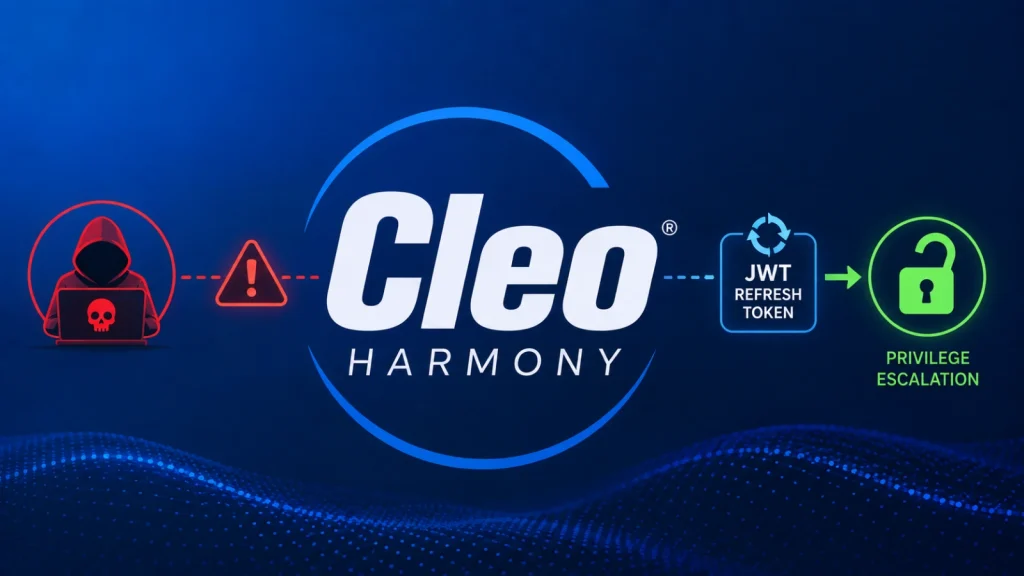
Cleo Harmony Flaw Lets Remote Attackers Escalate Privileges via JWT Refresh Token
Critical Flaw in Cleo Harmony: Remote Privilege Escalation via JWT Refresh Token
In the complex landscape of enterprise data exchange, managed file transfer (MFT) solutions are the backbone of secure and efficient operations. Cleo Harmony stands as a prominent player in this domain, facilitating critical integrations for countless organizations. However, a recently disclosed vulnerability, tracked as CVE-2026-84115, has cast a significant shadow, revealing a pathway for remote attackers to escalate privileges within affected systems.
This high-severity flaw, rated 8.3 on the CVSS scale, directly impacts enterprise networks relying on Cleo Harmony. Security researchers have confirmed that malicious actors can exploit a weakness in the software’s JSON Web Token (JWT) refresh token mechanism, potentially gaining unauthorized elevated access. Understanding the mechanics of this vulnerability and implementing timely remediation are paramount for maintaining data integrity and operational security.
Understanding the Cleo Harmony JWT Vulnerability (CVE-2026-84115)
The core of this critical vulnerability lies within how Cleo Harmony handles JWT refresh tokens. JWTs are a common, industry-standard method for securely transmitting information between parties as a JSON object. They are often used for authentication and authorization in web applications and APIs. A refresh token, in particular, is designed to obtain new access tokens without requiring the user to re-authenticate repeatedly, enhancing user experience.
The issue in Cleo Harmony stems from a flaw that allows remote attackers to tamper with these JWT refresh tokens. By manipulating these tokens, an attacker can bypass intended security controls and achieve privilege escalation. This means an attacker starting with lower-level access could potentially gain administrative rights or access sensitive data and functionalities they are not authorized for. The ability to exploit this vulnerability remotely significantly broadens the attack surface, making it a critical concern for any organization utilizing the platform.
Impact and Potential Exploitation Scenarios
The implications of successful exploitation of CVE-2026-84115 are severe. An attacker who manages to escalate privileges could:
- Gain unauthorized access to sensitive data: Cleo Harmony handles vast amounts of critical business data. Elevated privileges could grant attackers access to confidential files, financial records, customer information, or intellectual property.
- Disrupt business operations: With control over the MFT platform, an attacker could tamper with file transfers, delete critical data, or halt essential integration processes, leading to significant operational downtime and financial losses.
- Establish persistence: Elevated access could allow attackers to install backdoors or create new administrative accounts, ensuring continued access to the compromised system even after initial detection attempts.
- Pivot to other systems: The MFT platform often has connections to various internal and external systems. A compromise here could serve as a beachhead for attackers to launch further attacks within the enterprise network.
The remote nature of this vulnerability means that attackers do not need direct physical access to the server, making it a prime target for sophisticated threat actors.
Remediation Actions for Cleo Harmony Users
Immediate action is crucial to mitigate the risks posed by CVE-2026-84115. Organizations using Cleo Harmony should prioritize the following steps:
- Patch Immediately: The most critical step is to apply the security patches released by Cleo. Consult Cleo’s official security advisories and support channels for the specific versions affected and the corresponding updates. Ensure all instances of Cleo Harmony are updated to the secure version.
- Review Access Controls: Even after patching, it’s good practice to review and enforce the principle of least privilege. Ensure that users and services only have the minimum necessary permissions to perform their functions.
- Monitor for Suspicious Activity: Implement robust logging and monitoring for your Cleo Harmony instances. Look for unusual login patterns, unexpected file transfers, unauthorized configuration changes, or any activity that deviates from normal operational baselines.
- Segment Networks: Isolate your MFT infrastructure from other critical business systems where possible. Network segmentation can limit an attacker’s lateral movement if a compromise occurs.
- Regular Security Audits: Conduct regular security audits and penetration testing of your MFT solutions to identify and address potential weaknesses before they can be exploited.
Tools for Detection and Mitigation
While direct vendor patches are the primary solution, various security tools can assist in maintaining a strong security posture around your Cleo Harmony deployment:
| Tool Name | Purpose | Link |
|---|---|---|
| Vulnerability Scanners (e.g., Nessus, Qualys) | Identify known vulnerabilities in deployed software, including MFT platforms. | Tenable Nessus / Qualys VMDR |
| Security Information and Event Management (SIEM) Systems | Aggregate and analyze logs for suspicious activity, unusual access patterns, and potential compromise indicators. | Splunk / Elastic Security |
| Intrusion Detection/Prevention Systems (IDS/IPS) | Monitor network traffic for malicious activity and known attack signatures. | (Vendor specific, e.g., Cisco Firepower, Snort) |
| Network Access Control (NAC) Solutions | Enhance network segmentation and control access to critical systems. | (Vendor specific, e.g., Cisco ISE, Forescout) |




