
ClickFix Malware Campaign Exploits CAPTCHAs to Spread Cross-Platform Infections
ClickFix Malware Campaign Exploits CAPTCHAs to Spread Cross-Platform Infections
The digital threat landscape constantly evolves, with new attack methodologies pushing the boundaries of social engineering and technical evasion. Recent findings from Guardio Labs have highlighted a significant new threat, dubbed “ClickFix,” a sophisticated malware campaign that has rapidly eclipsed previous prevalent scams. This campaign leverages a potent combination of propagating methods, intricate narratives, and evasion techniques, fundamentally changing how cross-platform infections are propagated. Understanding ClickFix is no longer optional; it’s a critical imperative for maintaining robust security posture.
The Evolution of a Threat: From Fake Updates to ClickFix
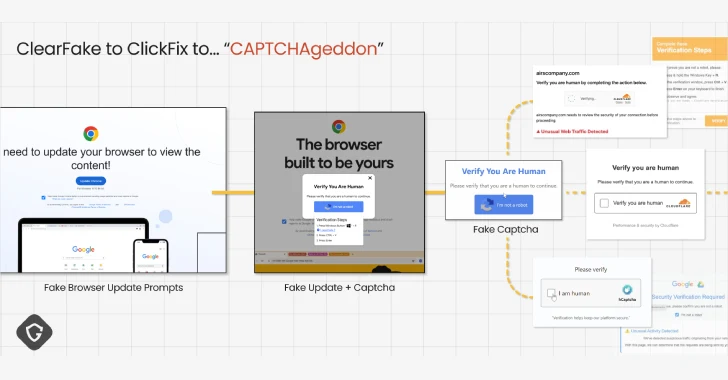
For years, the internet was plagued by the ubiquitous “fake browser update” scam, tricking users into downloading malicious software under the guise of legitimate system maintenance. ClickFix, however, represents a significant evolution in malware propagation. Guardio Labs’ research indicates that this new strain “quickly outpaced and ultimately wiped out the infamous fake browser update scam that plagued the web.” This isn’t just an incremental improvement; it’s a paradigm shift in how threat actors achieve widespread infection.
The success of ClickFix can be attributed to its sophisticated use of social engineering, particularly its exploitation of CAPTCHA mechanisms. By manipulating user interaction with seemingly innocuous CAPTCHA challenges, ClickFix lures victims into unknowingly compromising their systems across various platforms.
How ClickFix Operates: Social Engineering and Evasion
The core of the ClickFix campaign lies in its ability to weaponize trust and leverage common web interactions. While the full technical details are still emerging, the key elements identified by Guardio Labs point to a multi-faceted approach:
- Narrative Sophistication: Unlike crude phishing attempts, ClickFix employs highly convincing narratives, often creating a sense of urgency or legitimacy that compels users to act without excessive scrutiny. These narratives are tailored to bypass user skepticism.
- Exploitation of CAPTCHAs: This is a novel and particularly insidious aspect. By presenting malicious CAPTCHA challenges, ClickFix tricks users into performing actions that initiate malware downloads or grant unauthorized permissions. This method blends into everyday web browsing, making detection difficult.
- Cross-Platform Infection: ClickFix is not limited to a single operating system or browser. Its design allows it to propagate and infect users across various environments, including different browsers and potentially mobile devices, expanding its attack surface significantly.
- Evasion Techniques: To ensure longevity and widespread distribution, the campaign incorporates advanced evasion techniques. These likely include polymorphic code, anti-analysis checks, and dynamic C2 infrastructure to avoid detection by traditional security solutions.
Implications for Cybersecurity Professionals
The rise of ClickFix underscores several critical implications for cybersecurity professionals:
- Enhanced User Education: Traditional scam warnings may be insufficient. Users must be educated on more sophisticated social engineering tactics, especially those embedded within seemingly legitimate web interactions like CAPTCHAs.
- Advanced Behavioral Analysis: Signature-based detection alone will not suffice. Organizations need to invest in and deploy security solutions capable of behavioral analysis to identify anomalous activities triggered by ClickFix, even if the payload is polymorphic.
- Zero-Trust Architecture: The multi-platform nature of ClickFix reinforces the need for a zero-trust approach, where no user or device is inherently trusted, and all access requests are authenticated and authorized rigorously.
- Continuous Threat Intelligence: Staying abreast of the latest threat intelligence, particularly from research firms like Guardio Labs, is crucial for proactive defense against evolving threats such as ClickFix.
Remediation Actions and Prevention
Mitigating the risk posed by the ClickFix malware campaign requires a layered security approach and proactive measures:
- Implement Multi-Factor Authentication (MFA): Even if credentials are compromised through social engineering, MFA significantly reduces the likelihood of unauthorized access.
- Regular Security Awareness Training: Conduct frequent, updated training sessions that focus on identifying sophisticated social engineering tactics, including suspicious CAPTCHA requests or unusual website behaviors.
- Employ Robust Endpoint Detection and Response (EDR): EDR solutions can detect and respond to suspicious activities indicative of malware execution, even if the initial infection vector bypasses traditional anti-malware.
- Network Segmentation: Isolate critical systems and data from general user networks to limit lateral movement in case of an infection.
- Principle of Least Privilege: Ensure users and applications only have the minimum necessary permissions to perform their functions, reducing the potential impact of a compromise.
- Regular Software Updates and Patch Management: While ClickFix itself is more social engineering-driven, unpatched vulnerabilities can serve as secondary infection vectors or facilitate privilege escalation post-initial compromise.
- Browser Security Extensions: Encourage or enforce the use of reputable browser security extensions that block malicious ads, trackers, and known phishing sites.
- Email and Web Gateway Security: Deploy advanced security solutions at the perimeter to filter out malicious links and attachments before they reach end-users.
Relevant Tools for Detection and Mitigation
| Tool Name | Purpose | Link |
|---|---|---|
| Guardio Labs Research | Threat Intelligence and Research on ClickFix | https://guard.io/labs |
| Endpoint Detection & Response (EDR) Solutions | Advanced threat detection, investigation, and response on endpoints. | (Vendor specific, e.g., CrowdStrike, SentinelOne) |
| Security Information and Event Management (SIEM) | Centralized logging and analysis for anomaly detection. | (Vendor specific, e.g., Splunk, IBM QRadar) |
| DNS Filtering Services | Block access to known malicious domains. | (Vendor specific, e.g., Cisco Umbrella, Cloudflare Gateway) |
Conclusion
The emergence of the ClickFix malware campaign signifies a critical shift in the sophistication of cyber threats. By exploiting seemingly benign web interactions like CAPTCHAs and employing advanced social engineering, it has proven highly effective in achieving cross-platform infections. Cybersecurity professionals must adapt their defense strategies, prioritizing user education, advanced behavioral analysis, and a zero-trust approach. Staying informed and implementing robust, layered security measures are paramount in defending against this evolving and insidious threat.




