
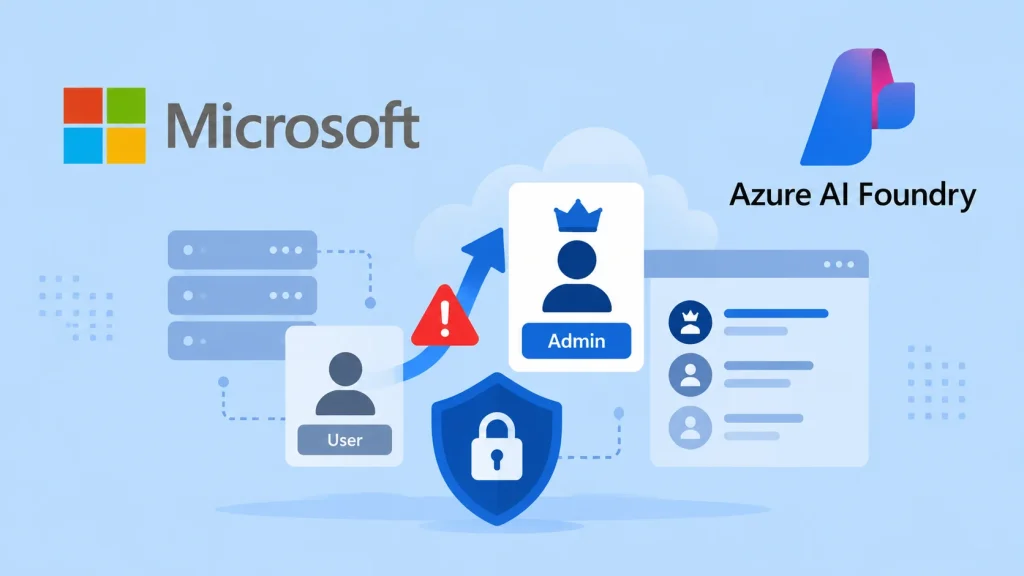
Critical Microsoft Azure AI Foundry Vulnerability Allows Attackers to Escalate Privileges
Unauthenticated Privilege Escalation: A Critical Threat to Azure AI Foundry
The landscape of enterprise cloud platforms demands unwavering security, especially when handling cutting-edge technologies like generative AI. A recent maximum-severity security flaw, CVE-2026-85889, discovered and subsequently patched by Microsoft, highlights the critical importance of continuous vigilance. This vulnerability within Azure AI Foundry, Microsoft’s dedicated platform for building and managing generative AI applications and agents, presented a severe risk: an unauthenticated attacker could escalate privileges over the network without any user interaction.
Carrying the highest possible CVSS score of 10.0, this flaw underscores the potential for devastating impact. Understanding the nature of such vulnerabilities, their implications, and the necessary remediation steps is paramount for any organization leveraging cloud AI services.
Understanding the Azure AI Foundry Vulnerability (CVE-2026-85889)
The core of this critical issue was an unauthenticated privilege escalation vulnerability within Microsoft Azure AI Foundry. For an attacker, “unauthenticated” means they don’t need any legitimate credentials to initiate an attack. “Privilege escalation” refers to their ability to gain higher levels of access or control than they should legitimately possess. In this scenario, the attacker could effectively gain administrative control over an affected Azure AI Foundry instance without needing to log in or interact with a user.
The CVSS score of 10.0 signifies that the vulnerability is easily exploitable, requires no user interaction, provides complete compromise of confidentiality, integrity, and availability, and has a wide impact. This combination makes CVE-2026-85889 a “wormable” class of vulnerability, meaning an attacker could potentially automate its exploitation to compromise multiple systems rapidly.
Implications for Organizations Using Azure AI Foundry
The potential consequences of an unauthenticated privilege escalation in a platform like Azure AI Foundry are extensive:
- Data Exfiltration: Attackers could access sensitive data used to train AI models, intellectual property embedded within the models themselves, or even customer data processed by AI applications.
- Model Manipulation: Malicious actors could tamper with AI models, introducing backdoors, poisoning training data, or altering model behavior for nefarious purposes, leading to biased outputs or security risks in dependent applications.
- Resource Abuse: Compromised instances could be used for cryptocurrency mining, launching further attacks, or other forms of resource abuse, incurring significant costs for the legitimate account holder.
- Operational Disruption: Attackers could delete or corrupt critical AI projects, disrupt ongoing AI application development, or completely disable services, leading to significant business interruption.
- Reputational Damage: A security breach of this magnitude would severely impact an organization’s reputation, eroding trust among customers and partners.
Remediation Actions for Azure AI Foundry Users
Microsoft has already patched CVE-2026-85889. For users of Azure AI Foundry, the primary and most crucial action is to ensure all instances are fully updated. Cloud providers typically push these patches automatically; however, it’s vital to verify and confirm their application.
- Verify Patch Application: Confirm that your Azure AI Foundry instances have received and applied the latest security updates from Microsoft. Consult your Azure portal for service health notifications and update statuses.
- Implement Least Privilege: Regularly review and enforce the principle of least privilege for all users and services interacting with Azure AI Foundry. Restrict access to only what is absolutely necessary.
- Network Segmentation: Ensure strong network segmentation is in place. Limit direct internet exposure for your AI Foundry instances where possible, using virtual networks, firewalls, and private endpoints.
- Monitor for Anomalies: Implement robust logging and monitoring for your Azure environment, specifically focusing on Azure AI Foundry. Look for unusual access patterns, unauthorized configuration changes, or unexpected resource consumption.
- Regular Security Audits: Conduct periodic security audits and penetration tests on your cloud infrastructure, including your AI development and deployment platforms, to identify potential weaknesses before they can be exploited.
Tools for Detection and Mitigation
While Microsoft’s patch is the primary fix, ongoing security practices are essential. Here are some tools that aid in maintaining a strong security posture in an Azure environment:
| Tool Name | Purpose | Link |
|---|---|---|
| Azure Security Center / Microsoft Defender for Cloud | Comprehensive cloud security posture management (CSPM) and cloud workload protection (CWPP). Monitors resources, provides security recommendations, and detects threats. | Microsoft Defender for Cloud |
| Azure Monitor | Collects, analyzes, and acts on telemetry data from your Azure and on-premises environments. Essential for logging and anomaly detection. | Azure Monitor |
| Azure Policy | Helps enforce organizational standards and assess compliance at scale. Useful for ensuring proper configurations and security settings. | Azure Policy |
| Azure Network Watcher | Monitors, diagnoses, and views network performance and health. Aids in identifying suspicious network activity. | Azure Network Watcher |
Protecting Your Generative AI Footprint
The discovery and immediate patching of CVE-2026-85889 underscore a critical truth: even the most sophisticated cloud platforms require constant vigilance. As organizations increasingly adopt generative AI, the attack surface expands, demanding a proactive and comprehensive security strategy. Ensuring that all components, especially foundational platforms like Azure AI Foundry, are up-to-date with the latest security patches is non-negotiable. Furthermore, adopting a defense-in-depth approach, encompassing robust access controls, network segmentation, and continuous monitoring, is essential to safeguard your innovative AI investments from critical threats.




