
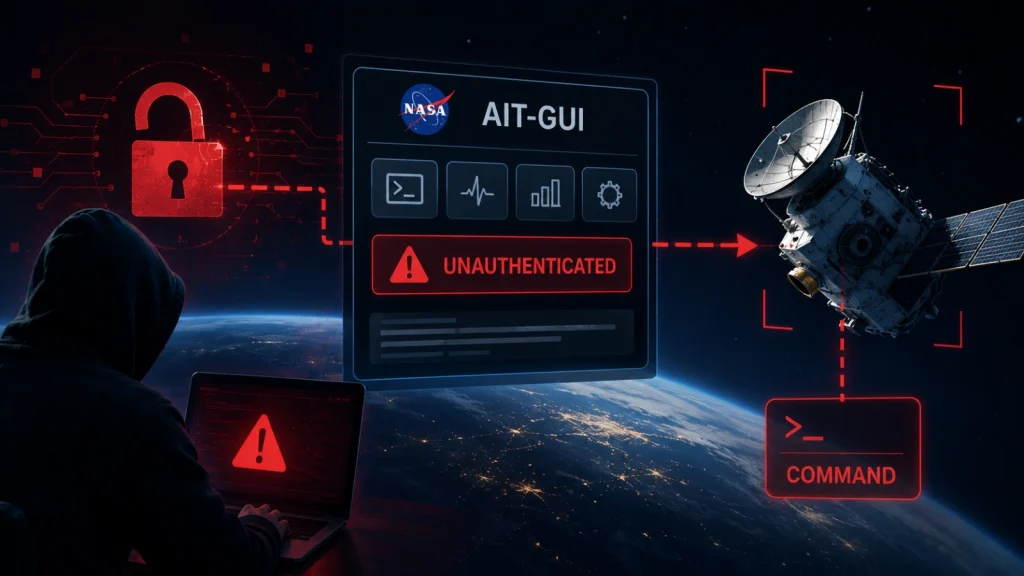
Critical NASA AIT-GUI Flaw Lets Unauthenticated Attackers Issue Spacecraft Commands
A Critical Flaw in NASA’s AIT-GUI: Unauthenticated Access to Spacecraft Commands
Imagine a scenario where the very systems designed to control our most advanced scientific instruments and spacecraft could be manipulated by an attacker, without any authentication whatsoever. This isn’t the plot of a sci-fi thriller; it’s a sobering reality brought to light by a recently disclosed critical vulnerability in NASA/JPL’s open-source AMMOS Instrument Toolkit GUI (AIT-GUI).
Security researcher Yuval Elbar of Cycode identified this severe flaw, rated 9.4 on the CVSS v3.1 scale, highlighting a significant security risk for critical space infrastructure. This vulnerability, if exploited, could grant unauthorized individuals the ability to send live commands to spacecraft, execute arbitrary scripts, and initiate command sequences, all without requiring a login.
Understanding the AIT-GUI Vulnerability
The core of this vulnerability lies within the AIT-GUI’s architecture, an integral part of NASA’s AMMOS (Advanced Multi-Mission Operations System) toolkit. The AIT-GUI is designed to provide a graphical interface for monitoring and controlling spacecraft and their instruments, a crucial component for mission operations.
The disclosed flaw allows an unauthenticated attacker to bypass security mechanisms and directly interact with the underlying systems. This level of access is profoundly concerning, as it opens the door to:
- Unauthenticated Command Execution: Attackers could issue commands directly to spacecraft and scientific instruments without valid credentials.
- Arbitrary Script Execution: The ability to run arbitrary scripts on the system provides a platform for various malicious activities, from data exfiltration to system disruption.
- Unauthorized Command Sequence Initiation: Complex operational sequences, typically reserved for authorized personnel, could be triggered by an attacker, potentially leading to irreversible consequences.
The high CVSS score of 9.4 underscores the severity of this vulnerability, indicating that it is easily exploitable and has a high impact on confidentiality, integrity, and availability.
Potential Impact on Space Missions and Data
The implications of such a vulnerability are vast and potentially catastrophic. Beyond the immediate operational risks to active space missions, the integrity of scientific data and the security of valuable space assets could be compromised. Imagine a scenario where mission-critical commands are issued maliciously, or scientific instruments are reprogrammed to provide erroneous data. The long-term consequences for space exploration and scientific research could be profound.
While specific missions affected haven’t been publicly detailed in relation to this flaw, the widespread use of AIT-GUI within NASA/JPL suggests a broad potential impact.
Remediation Actions
Addressing a vulnerability of this magnitude requires immediate and decisive action. For organizations utilizing AIT-GUI or similar open-source tools in critical environments, the following steps are paramount:
- Immediate Patching: Prioritize the application of any official patches or updates released by NASA/JPL to address this specific vulnerability. Users should actively monitor official channels for these releases.
- Network Segmentation and Access Control: Ensure that AIT-GUI instances are isolated within secure network segments. Implement strict access control policies, limiting network access to only necessary personnel and systems.
- Authentication Enforcement: Even if the flaw bypasses authentication, robust authentication mechanisms should be in place as a layered defense. Implement multi-factor authentication (MFA) wherever possible.
- Regular Security Audits: Conduct frequent security audits and penetration tests on systems utilizing AIT-GUI and other critical infrastructure components to identify and remediate similar vulnerabilities proactively.
- Monitoring and Alerting: Implement comprehensive logging and monitoring solutions to detect unusual activity or unauthorized access attempts to AIT-GUI and associated systems.
- Review Supply Chain Security: For organizations integrating open-source components, this incident highlights the importance of thorough supply chain security reviews and proactive vulnerability management.
CVE and Further Information
While the initial report did not immediately provide a CVE identifier, it is crucial for users and security professionals to monitor official CVE databases and NASA/JPL security advisories for the assigned CVE-TBD (placeholder, as one was not specified in the source material) related to this AIT-GUI flaw. Once available, the CVE will provide a standardized reference for tracking and addressing the vulnerability.
Essential Tools for Vulnerability Management
Proactive security requires a robust toolkit for detection, scanning, and mitigation. Below are some categories of tools that can assist in managing vulnerabilities like the AIT-GUI flaw:
| Tool Category | Purpose | Examples / Link Type |
|---|---|---|
| Vulnerability Scanners | Automated detection of known vulnerabilities in software and systems. | Tenable Nessus, Qualys VMDR, OpenVAS |
| Network Intrusion Detection/Prevention Systems (NIDS/NIPS) | Monitoring network traffic for malicious activity and blocking threats. | Snort, Suricata, Commercial NIDS/NIPS solutions |
| Security Information and Event Management (SIEM) | Centralized collection and analysis of security logs for threat detection. | Splunk, IBM QRadar, Elastic SIEM |
| Software Composition Analysis (SCA) Tools | Identifying vulnerabilities in open-source components used in applications. | Synopsys Black Duck, Snyk, Sonatype Nexus Lifecycle |
Conclusion
The disclosure of a critical vulnerability in NASA/JPL’s AIT-GUI serves as a stark reminder that even the most advanced and critical systems are susceptible to security flaws. The potential for unauthenticated attackers to issue commands to spacecraft underscores the continuous need for vigilance, rigorous security testing, and rapid remediation efforts in all aspects of cybersecurity, particularly in environments controlling critical infrastructure. Organizations leveraging such technologies must prioritize security hygiene, invest in robust vulnerability management, and stay abreast of the latest threat intelligence to safeguard their operations and data.




