
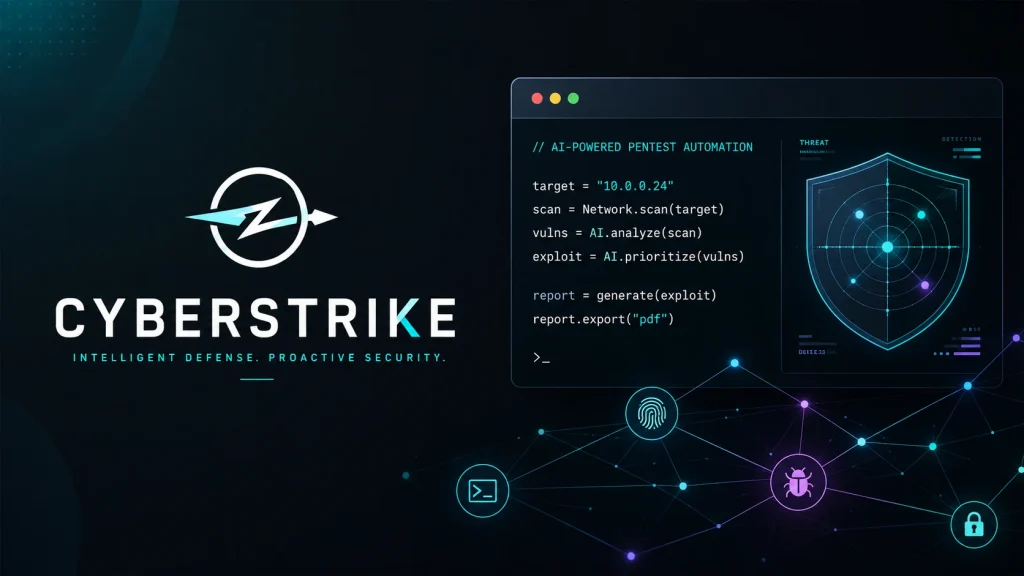
CyberStrike – AI-Powered Security Platform for Automated Penetration Testing
Unleashing Autonomous Red Teaming: Introducing CyberStrike, the AI-Powered Offensive Security Platform
The landscape of cybersecurity is relentlessly evolving, pushing organizations to continuously adapt their defenses. While Blue Teams work tirelessly to protect assets, the role of Red Teams—simulating real-world attacks—is critical for identifying weaknesses before malicious actors exploit them. Traditionally, red teaming is a labor-intensive process, demanding significant expertise and time. This is precisely where innovation like CyberStrike emerges as a game-changer.
CyberStrike is an ambitious open-source project poised to redefine offensive security. It promises to transform existing large language model (LLM) subscriptions, such as those for Claude or GPT, into fully autonomous red-team operators. This isn’t merely another chatbot wrapper; CyberStrike is a dedicated terminal-based tool designed to handle the entire penetration testing lifecycle with minimal human intervention.
Beyond the Chatbot: How CyberStrike Functions
Unlike conversational AI interfaces that require constant prompting, CyberStrike operates as a sophisticated, terminal-based application. Its core innovation lies in its ability to orchestrate complex offensive security tasks autonomously. This includes a multi-stage approach to penetration testing:
- Reconnaissance: Gathering information about target systems, networks, and applications to identify potential entry points and weaknesses.
- Vulnerability Discovery: Actively scanning and analyzing targets for known vulnerabilities (e.g., CVE-2023-34051) and misconfigurations.
- Exploitation: Leveraging identified vulnerabilities to gain unauthorized access or control over systems. This critical phase demonstrates the real-world impact of a security flaw.
- Reporting: Generating comprehensive reports detailing findings, exploited vulnerabilities, and potential remediation strategies.
By automating these intricate steps, CyberStrike significantly reduces the manual effort and specialized knowledge traditionally required for effective red teaming. It leverages the advanced reasoning capabilities of LLMs to make informed decisions throughout the attack simulation process.
The Power of Autonomous Red Teaming
The implications of an AI agent like CyberStrike for offensive security are profound:
- Increased Efficiency: Automating repetitive and time-consuming tasks allows security teams to focus on more strategic initiatives.
- Consistent Testing: AI agents can perform tests with a high degree of consistency, reducing the chance of human error and ensuring thorough coverage.
- Scalability: Organizations can scale their red teaming efforts more easily, testing a wider range of assets and systems more frequently.
- Uncovering Novel Attack Paths: The analytical power of LLMs, when properly directed, could potentially identify novel attack vectors that human testers might overlook.
- Democratization of Red Teaming: By lowering the barrier to entry, CyberStrike could make advanced penetration testing more accessible to a broader range of organizations, including those with limited resources.
Remediation Actions and Future Considerations
While CyberStrike is an offensive tool, its ultimate purpose is to strengthen defenses. The detailed reports generated by such autonomous platforms provide actionable intelligence for remediation. Organizations should prioritize:
- Patch Management: Regularly updating and patching systems to address known vulnerabilities, such as those highlighted by CyberStrike’s scans (e.g., CVE-2024-22024, a critical vulnerability in Ivanti Connect Secure).
- Configuration Hardening: Implementing security best practices for all systems and applications, eliminating common misconfigurations that attackers often exploit.
- Network Segmentation: Dividing networks into smaller, isolated segments to limit the lateral movement of attackers if a breach occurs.
- Identity and Access Management (IAM): Enforcing the principle of least privilege and robust authentication mechanisms to prevent unauthorized access.
- Security Awareness Training: Educating employees about social engineering tactics, which often serve as an initial vector for sophisticated attacks.
- Continuous Monitoring: Deploying robust security monitoring tools to detect and respond to suspicious activities in real-time, even those initiated by automated red team agents.
Conclusion: The Evolution of Cybersecurity
CyberStrike represents a significant leap forward in the application of AI to offensive security. By turning powerful LLMs into autonomous red-team operators, it promises to enhance the efficiency, thoroughness, and accessibility of penetration testing. As the project matures, it will undoubtedly play a crucial role in helping organizations proactively identify and mitigate vulnerabilities, ultimately strengthening their overall security posture against an ever-more sophisticated threat landscape. The future of cybersecurity will increasingly involve AI not just in defense, but also as a critical tool for simulating and understanding offensive capabilities.




