
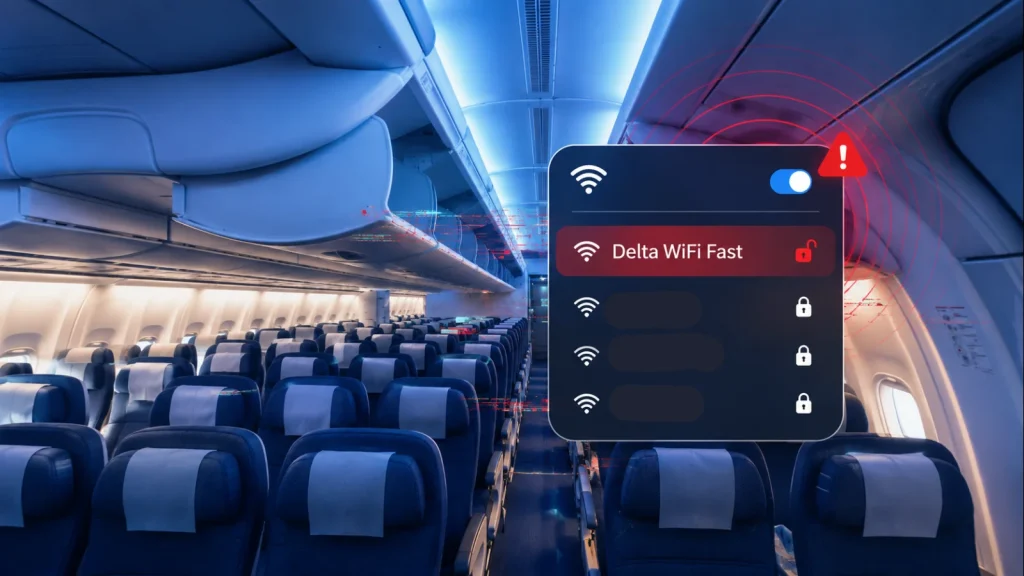
DEF CON Attendees Allegedly Jammed Plane Wi-Fi and Broadcast Fake ‘Delta WiFi Fast’ Network
When a DEF CON After-Party Takes Flight: The Delta Wi-Fi Jamming Incident
Imagine this: you’re settling into your seat on a Delta Air Lines flight, eager to catch up on emails or stream a movie. Suddenly, your usual “Delta Wi-Fi” network vanishes, replaced by a new, suspiciously fast-looking “Delta WiFi Fast.” This wasn’t a standard airline upgrade; it was an alleged, audacious act of cyber mischief unfolding on a flight filled with attendees departing the world’s largest hacking conference, DEF CON. This incident, as reported by Cyber Security News, highlights the very real and immediate threats posed by sophisticated social engineering and network manipulation, even in seemingly secure environments.
This blog post will dissect the alleged incident, explore the potential implications of such attacks, and provide crucial insights for businesses and individuals on how to safeguard against similar threats.
The Alleged In-Flight Cyber Attack: Jamming and Phishing on 30,000 Feet
The core of the incident involved two primary alleged actions: the jamming of the aircraft’s official Wi-Fi network and the subsequent broadcasting of a convincing fake network. Jamming, in this context, refers to the intentional interference with radio signals to prevent legitimate communications. On an aircraft, this could involve disrupting the onboard Wi-Fi signal, effectively knocking legitimate users offline.
Once the official Wi-Fi was allegedly neutralized, the next step was to deploy a fraudulent access point. The “Delta WiFi Fast” network was designed to appear legitimate, leveraging the psychological tendency of users to prefer faster connections. The intent behind such a network is clear: to “phish” fellow travelers – to trick them into connecting to the rogue network, thereby potentially exposing their sensitive data, login credentials, or even compromising their devices through malicious redirects or malware injection.
Understanding the Vulnerabilities: Why This Could Happen
This incident underscores several fundamental cybersecurity vulnerabilities that are not unique to an aircraft environment:
- Wi-Fi Network Spoofing: Creating a fake Wi-Fi access point with a name identical or very similar to a legitimate one is a common attack vector. Users often don’t verify the authenticity of a network before connecting.
- Lack of Client-Side Authentication: Most consumer devices automatically connect to familiar Wi-Fi networks or readily connect to open networks. There’s often no robust mechanism for the client device to authenticate the access point’s legitimacy.
- Human Factor: The allure of “faster” internet or the simple desire to connect without scrutinizing the source makes individuals susceptible to social engineering tactics.
- Potential for RF Jamming: While highly illegal and regulated, the use of radio frequency jammers to disrupt wireless signals is technically feasible, even if the legality and practicalities on an aircraft are complex.
While this particular incident did not result in a known CVE, the underlying principles relate to common network security flaws. For example, some vulnerabilities in Wi-Fi protocols like WPA2 (though largely patched in modern implementations) could, in theory, be exploited to facilitate such attacks, even if this specific instance involved a more direct jamming approach rather than a protocol exploit. However, the immediate concern isn’t a specific protocol flaw but the combination of deliberate interference and social engineering.
Remediation Actions: Protecting Yourself and Your Organization
Preventing and mitigating similar incidents requires a multi-layered approach:
- Educate Users on Wi-Fi Best Practices:
- Always verify the exact name of the legitimate Wi-Fi network with official sources (e.g., flight attendants, airport signage).
- Be suspicious of networks with unusual names or promises of “fast” connections that appear out of nowhere.
- Avoid connecting to open or unsecured Wi-Fi networks, especially for sensitive transactions.
- Utilize Virtual Private Networks (VPNs): A reputable VPN encrypts all your internet traffic, providing a secure tunnel even if you are connected to a compromised Wi-Fi network. This largely protects your data from being intercepted.
- Disable Auto-Connect for Wi-Fi: Configure devices to require manual approval before connecting to new Wi-Fi networks.
- Keep Device Software Updated: Ensure operating systems, browsers, and applications are always up-to-date to patch known vulnerabilities.
- Implement Network Access Control (NAC): For organizations, NAC solutions can restrict network access to authorized and compliant devices, preventing rogue access points from compromising internal networks.
- Deploy Wireless Intrusion Detection/Prevention Systems (WIDS/WIPS): These systems can monitor wireless spectrums for unauthorized access points, jamming attempts, and other anomalies.
- Physical Security Measures (for critical infrastructure): While challenging on a commercial flight, in other environments, physical security around network equipment can prevent tampering.
Tools for Detection and Mitigation
While the incident on the plane was dealt with by flight crew, individuals and organizations can leverage various tools to enhance their Wi-Fi security posture:
| Tool Name | Purpose | Link |
|---|---|---|
| Wi-Fi Analyzer Apps (e.g., NetSpot, Wi-Fi Analyzer) | Identify legitimate and rogue access points, analyze signal strength, and detect unusual network activity. | NetSpot |
| Reputable VPN Services (e.g., ExpressVPN, NordVPN) | Encrypt internet traffic, protecting data even on untrusted networks. | ExpressVPN |
| WIPS (Wireless Intrusion Prevention Systems) | Actively detect and mitigate unauthorized access points and wireless threats in enterprise environments. | Vendor-specific (e.g., Cisco, Aruba) |
| Packet Sniffers (e.g., Wireshark) | Analyze network traffic to identify suspicious packets or unauthorized data transmissions. (Requires technical expertise) | Wireshark |
Lessons Learned from the Alleged DEF CON Flight Incident
The alleged incident on the Delta flight serves as a potent reminder that cybersecurity threats are pervasive and can manifest in unexpected environments. It underscores the critical importance of user awareness, robust security practices, and vigilance against social engineering. While the legality and ethics of such an “experiment” are highly questionable, the incident provides valuable insights into the vulnerabilities we face every day. Staying informed, practicing good cyber hygiene, and questioning unusual network behaviors are essential steps in protecting ourselves from both amateur mischief and sophisticated attacks.




